

Bitcoin doesn’t need banks. It doesn’t need governments. It doesn’t need anyone to trust anyone else. And yet, it works. Every day, billions of dollars move across its network without a single central authority. How? The answer lies in Proof of Work - a simple, brutal, and brilliantly effective system that turns electricity and hardware into digital trust.
How Proof of Work Stops Fraud
Imagine you’re trying to send someone 1 Bitcoin. The network needs to make sure you didn’t just spend that same Bitcoin twice - a problem called double-spending. Without a bank to check your balance, how does Bitcoin know you’re not cheating? Proof of Work solves this by making validation expensive. Every ten minutes, a new block of transactions is added to Bitcoin’s blockchain. To add it, a miner must solve a math puzzle. Not a hard math problem like calculus - but a brute-force search. The miner takes the data from the last block, adds the new transactions, and runs it through the SHA-256 hashing algorithm. The goal? Find a hash that starts with a certain number of zeros. For example, as of late 2023, the network required a hash with 19 leading zeros in hexadecimal. That’s not just hard - it’s computationally insane. The system doesn’t care who solves it. It only cares that the solution is correct and that it took massive work to find. The first miner to crack it broadcasts the block. Everyone else checks the answer - and it’s easy to verify. But finding it? That took billions of guesses. That’s Proof of Work: work that’s hard to do, but easy to check.The Cost of Attack
Here’s where security kicks in. If you wanted to reverse a transaction - say, undo a payment you made to buy a car - you’d need to change that block. But you can’t just change one block. Bitcoin’s chain links together. Each block contains the hash of the one before it. Change one, and every block after it becomes invalid. To fix that, you’d have to redo every single block since then. And here’s the kicker: you’d need to outwork the entire network. Not just one miner. Not even ten. You’d need more than half of all the computing power on the Bitcoin network. That’s called a 51% attack. And as of December 2023, the Bitcoin network’s total hashrate was 600 exahashes per second. That’s 600,000,000,000,000,000,000 calculations per second. To pull off a 51% attack, you’d need to build and run mining equipment worth over $15 billion - just to keep it running for a month. And even then, you wouldn’t get rich. You’d only be able to reverse recent transactions. You couldn’t create new Bitcoin. You couldn’t steal other people’s coins. You’d just cause chaos, and everyone would know it was you. The market would crash. Your $15 billion investment? Worthless. That’s the economic firewall. The cost of attacking Bitcoin is higher than the reward. It’s not about being unbreakable. It’s about being too expensive to break.Why SHA-256 and Not Something Else?
Bitcoin uses SHA-256 - a cryptographic hash function developed by the NSA. It’s not the fanciest algorithm out there, but it’s proven. It’s fast. It’s reliable. And it’s been tested for decades. Every time a miner runs a block through SHA-256, it produces a unique 256-bit string. Change one letter in the transaction data? The hash changes completely. It’s deterministic, irreversible, and collision-resistant. The SHA-256 algorithm runs 64 rounds of complex operations on an 80-byte block header. Each round scrambles the data further. There’s no shortcut. No clever math trick. You just guess - over and over - until you get lucky. That’s why ASIC miners were invented: custom chips built for one thing - doing SHA-256 hashes as fast as possible. An Antminer S19 XP can do 140 trillion hashes per second. And it still takes, on average, 10 minutes to find a valid block. The network adjusts the difficulty every 2,016 blocks (roughly every two weeks) to keep that 10-minute target. If more miners join, the puzzle gets harder. If miners leave - like after a Bitcoin price crash in 2022 - the puzzle gets easier. It’s self-correcting. No human needed.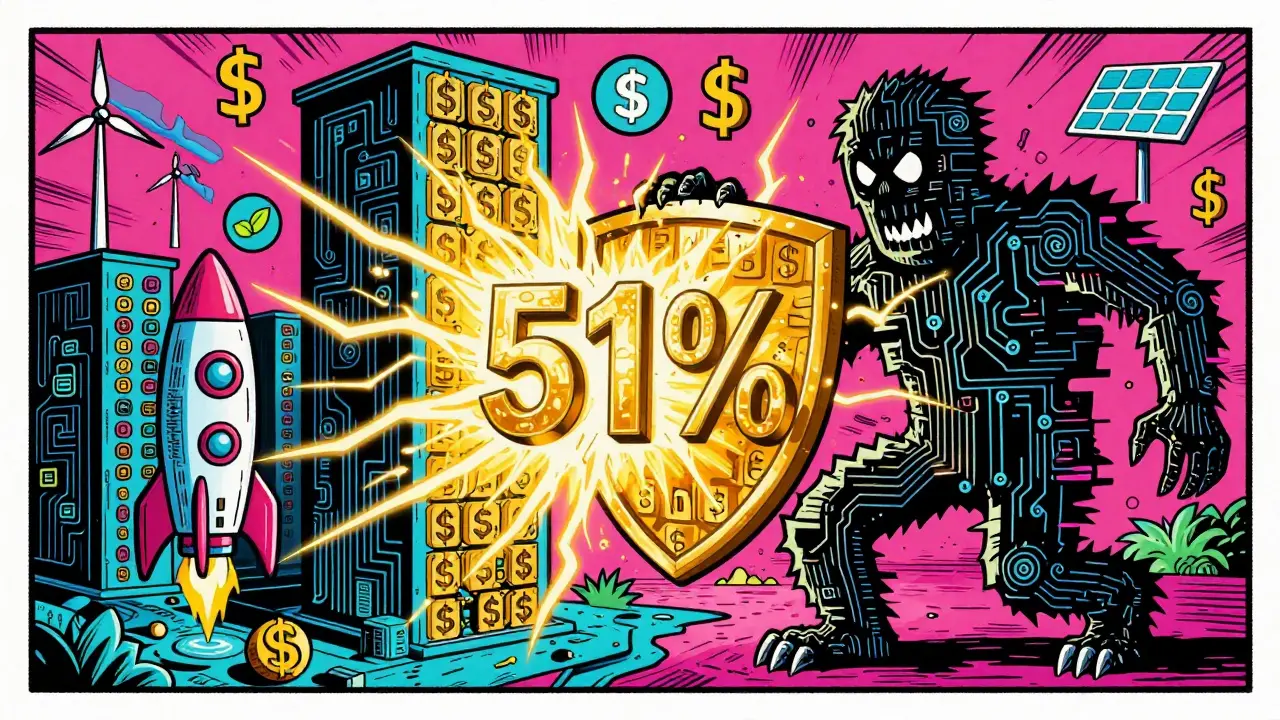
Proof of Work vs. Proof of Stake
Ethereum switched to Proof of Stake in 2022. Instead of burning electricity, validators lock up ETH as collateral. If they misbehave, they lose their stake. It’s cheaper. It’s greener. But it’s not the same kind of security. In Proof of Work, security comes from real-world resources: electricity, hardware, cooling systems, factories. You can’t fake that. You can’t create it out of thin air. In Proof of Stake, security comes from tokens - digital assets that exist inside the system. You can buy them. You can borrow them. You can even rent them. In late 2023, Ethereum’s security cost was around $18.6 billion to attack. Bitcoin’s? Around $15.8 billion per month - and that’s just to sustain an attack. The total value secured by Bitcoin’s network? Over $538 billion. The cost to attack it is a fraction of what it protects. That asymmetry is why Bitcoin’s security is unmatched. The Nakamoto coefficient - the number of entities that control 51% of the network - is 3 for Bitcoin. For Ethereum’s PoS system, it’s 19. That means fewer players are needed to control Bitcoin’s consensus. And those players? They’re not just token holders. They’re companies spending real money on power plants and mining rigs.Energy Use? Yes. But It’s Purposeful
Critics say Bitcoin uses too much energy. In 2023, it consumed about 121 terawatt-hours per year - more than Argentina. But here’s what they don’t say: that energy isn’t wasted. It’s a security budget. Every kilowatt-hour spent is a dollar spent protecting the network. And that’s why Bitcoin miners are now the world’s largest buyers of stranded renewable energy - excess wind, curtailed hydro, flared gas. According to the Bitcoin Mining Council, 48.1% of Bitcoin mining runs on renewable sources. Some miners are built right next to wind farms in Texas, using power that would otherwise be turned off. Others use hydroelectric surplus in Canada. The energy isn’t being burned for fun. It’s being burned to make Bitcoin unbreakable. And it works. Since Bitcoin launched in 2009, there has never been a successful 51% attack. Not once. Not even close. There have been exchange hacks - over $3.8 billion stolen since 2011 - but never a single transaction reversed on the Bitcoin blockchain.
What Makes It Last?
Bitcoin’s security doesn’t rely on trust. It relies on math, economics, and physics. You don’t need to believe in Satoshi Nakamoto. You don’t need to trust the developers. You just need to understand that the network costs more to attack than it’s worth. The system is designed so that honest miners earn more than they spend. They get paid in Bitcoin and transaction fees. The block reward is currently 6.25 BTC per block (after the 2020 halving). After the next halving in April 2024, it drops to 3.125 BTC. But as Bitcoin’s price rises, transaction fees increase. The system adapts. Miners aren’t just volunteers. They’re businesses. They run on profit margins. They need to cover electricity, cooling, maintenance, and hardware replacement. ASIC miners last about 18 months before they’re obsolete. That’s why miners constantly upgrade - not because they’re loyal to Bitcoin, but because they’re chasing profit. And that profit is what keeps the network secure.Real-World Resilience
When Ukraine’s power grid was targeted in 2022, Bitcoin kept running. When China banned mining in 2021, miners moved to Texas, Kazakhstan, and Georgia - and the network didn’t blink. When the price crashed 70% in late 2022, half the miners shut down. The difficulty dropped. The rest kept mining. The network adjusted. And within months, it was stronger than before. There’s no central switch to flip. No CEO to fire. No board meeting to approve changes. Just code. Just math. Just electricity. And that’s why, after 14 years, Bitcoin still works - because Proof of Work turns money into memory. It turns energy into truth. And it turns a global network of strangers into a system no one can break.Can Proof of Work be hacked?
Technically, yes - but only if someone spends more than $15 billion per month to control over half of Bitcoin’s total computing power. That’s a 51% attack. No one has ever done it successfully. Even when a single mining pool briefly held 55% of the network in 2014, they voluntarily reduced their share after public backlash. The cost to attack Bitcoin is higher than the potential reward, making it economically irrational.
Why doesn’t Bitcoin switch to Proof of Stake like Ethereum?
Bitcoin’s community values security over efficiency. Proof of Stake reduces energy use, but it also lowers the cost of attacking the network by relying on digital tokens rather than real-world resources. Bitcoin’s security comes from the fact that attackers must spend physical assets - electricity, hardware, infrastructure - that can’t be created within the system. Proof of Work creates a verifiable, irreversible cost that makes fraud uneconomical. For a store of value like Bitcoin, that’s more important than speed or energy savings.
How does Bitcoin prevent double-spending without a central authority?
Bitcoin prevents double-spending by requiring every transaction to be confirmed in a block that’s linked to all previous blocks. Once a transaction is buried under six blocks (about an hour), reversing it would require redoing all those blocks - a task that demands more computing power than the entire network. Since miners are incentivized to build on the longest chain, they naturally reject any conflicting transactions. The system enforces consensus through computational work, not trust.
Is Bitcoin’s energy consumption a flaw?
It’s a trade-off. Bitcoin uses about 121 TWh per year - comparable to a mid-sized country. But that energy isn’t waste. It’s the price of security. Over 48% of Bitcoin mining now runs on renewable or stranded energy sources, like excess wind power or flared gas that would otherwise be burned off. The energy isn’t used to generate heat - it’s used to secure a $500+ billion network. For many, that’s a fair exchange.
What happens if Bitcoin mining becomes unprofitable?
If mining becomes unprofitable, miners shut down. That reduces the network’s hashrate. Bitcoin’s difficulty adjustment automatically lowers the puzzle’s complexity every two weeks until miners can earn again. This self-correcting mechanism ensures the network stays secure even during price crashes. The system doesn’t rely on miners being profitable forever - just profitable enough to keep the network running. As long as Bitcoin has value, someone will mine it.
kavya barikar
March 24, 2026 AT 00:19Proof of Work isn't perfect, but it's honest. It turns electricity into truth. No magic, no trust needed. Just math and cost.
Neil MacLeod
March 25, 2026 AT 14:14Let’s be real - this whole ‘energy as security budget’ argument is just a fancy way of saying we’re burning money to protect digital IOUs. The environmental cost isn’t a trade-off - it’s a feature of a system that prioritizes symbolism over utility.
And don’t get me started on the ‘renewable energy’ myth. Miners don’t care if it’s wind or gas - they care about the cheapest kilowatt. If a coal plant in West Virginia offers 2.3 cents/kWh, that’s where the rigs go. Greenwashing doesn’t change the physics.
Bitcoin’s ‘security’ is just economic inertia. It’s not unbreakable - it’s just that no one has been desperate enough to try. When the next crash hits and mining becomes unprofitable, we’ll see how resilient this ‘economic firewall’ really is.
The fact that we’re still talking about SHA-256 in 2024 is laughable. We’re running a global financial system on a hash function designed in 1993. That’s not robust - it’s a relic.
And yet, somehow, it works. Not because it’s elegant, but because it’s stubborn. Like a mule that refuses to move even when the ground is falling out from under it.
I don’t hate Bitcoin. I just think its entire value proposition is built on a lie: that cost equals security. It doesn’t. Cost equals inertia. And inertia isn’t a foundation - it’s just something that hasn’t collapsed yet.
Maybe in 20 years, we’ll look back and laugh at how we thought burning power plants was the best way to secure a ledger.
Or maybe we won’t. Because by then, the whole thing will have turned into a cult.
Andrea Zaszczynski
March 26, 2026 AT 23:45Okay but like… why is everyone so obsessed with the energy? I get it, it’s a lot. But if I’m paying $500 to send $10k across the world without a bank, and it takes 10 minutes and uses enough power to light my whole apartment for a week - I’m cool with it. It’s not waste, it’s insurance.
Also, miners aren’t just ‘burning electricity’ - they’re turning surplus energy into value. Like, in Texas, they’re using wind that would’ve been shut off because the grid couldn’t handle it. That’s not pollution - that’s recycling.
And yeah, SHA-256 is old. But it’s like using a hammer to drive a nail. Doesn’t need to be fancy. Just needs to work. Every time.
Lorna Gornik
March 28, 2026 AT 05:35lol at people who think PoW is ‘wasteful’ 🤡
you’re mad the network’s secured by REAL stuff? like, actual power plants and hardware? not just ‘stake’ that you can borrow from a DeFi protocol? 😂
bitcoin’s not a ‘tech innovation’ - it’s a social contract written in electricity. and i’m here for it. 🤖⚡
Cordany Harper
March 28, 2026 AT 09:06As someone who’s been mining since 2017, I’ve seen this play out. When China cracked down, everyone panicked. But miners didn’t vanish - they just moved. Texas, Georgia, Canada - the network didn’t skip a beat.
And the difficulty adjustment? That’s the real genius. It’s not some centralized committee tweaking numbers. It’s math. It’s code. It’s automatic. Miners come and go - the chain just keeps going.
People act like Bitcoin’s ‘energy use’ is a flaw. But think about it - what’s more wasteful? Burning a few terawatt-hours to secure $500B in value… or the entire global banking system that runs on paper, lawyers, and 3am wire transfers?
Bitcoin’s not perfect. But it’s the only system where the cost of failure is higher than the cost of success.
DarShawn Owens
March 29, 2026 AT 08:09I love how this post breaks it down. It’s not about being ‘unhackable’ - it’s about being too expensive to hack. That’s the kind of security I can get behind.
Also, the fact that miners are now using stranded renewables? That’s not a coincidence. It’s economics. Bitcoin’s not just changing finance - it’s changing energy.
Keep going. This is the future.
manoj kumar
March 29, 2026 AT 22:16Wow. Just… wow. You people really think burning coal and gas to ‘secure’ a digital ledger is ‘innovation’? That’s not progress - that’s a cult. You’re not protecting value - you’re just gambling with electricity.
And don’t even get me started on ‘renewables.’ You think a miner in Kazakhstan running on coal-powered grid is ‘green’? Wake up. This isn’t a movement - it’s a pyramid scheme with more hardware.
Bitcoin’s ‘security’ is just a placebo. The real security is in the fact that no one dares to admit it’s a bubble.
vu phung
March 30, 2026 AT 11:05Let’s zoom out for a sec. PoW isn’t about ‘mining’ - it’s about consensus through commitment. The hash rate isn’t just a number - it’s a manifestation of distributed economic will.
When you stake your ASICs, your power contract, your cooling infrastructure - you’re not just validating blocks. You’re betting your capital on the network’s integrity. That’s not abstract. That’s real. And that’s why it’s resilient.
PoS? You can rent validators. You can short the token. You can collude with exchanges. PoW? You need physical assets. Real machines. Real power. Real stakes.
That asymmetry? That’s the edge. And it’s why Bitcoin’s Nakamoto Coefficient is 3 - not 19.
This isn’t crypto. This is digital infrastructure. And infrastructure doesn’t get built on trust. It gets built on cost.
Annette Gilbert
March 31, 2026 AT 07:57Oh sweet mercy, another Bitcoin evangelist who thinks burning the planet is ‘security.’
Let me guess - you also think the 121 TWh is ‘just renewable’ and that miners are ‘saving stranded energy’ like they’re climate heroes 🤡
Newsflash: If you’re using wind power that would’ve been curtailed, you’re not ‘saving’ it - you’re just monetizing waste. And when the grid needs that power back? You’ll be the first to demand subsidies.
Meanwhile, Ethereum’s PoS uses 0.01% of Bitcoin’s energy and still secures $200B+. So why are we still running a 1993 algorithm on a global scale like it’s 2005?
Bitcoin’s not a revolution. It’s a fossil fuel-powered museum exhibit.
John Alde
April 1, 2026 AT 07:37There’s something deeply human about Proof of Work - not because it’s efficient, but because it’s visible. You can’t hide the energy. You can’t fake the hardware. You can’t spin the hash rate.
When a miner in rural Texas turns on their rig, you can see the lights flicker. You can hear the fans. You can smell the heat. It’s tangible. And that tangibility is what makes Bitcoin feel real - even when the price is volatile.
Compare that to PoS, where your ‘security’ is just a number in a wallet. A number you can borrow. A number you can rent. A number that vanishes if the market turns.
PoW doesn’t promise perfection. It promises persistence. It says: ‘If you want to change this, you have to pay for it - in real terms.’ And that’s a message that’s lasted 14 years.
It’s not magic. It’s not elegant. But it’s honest.
And sometimes, honesty is the rarest resource of all.