
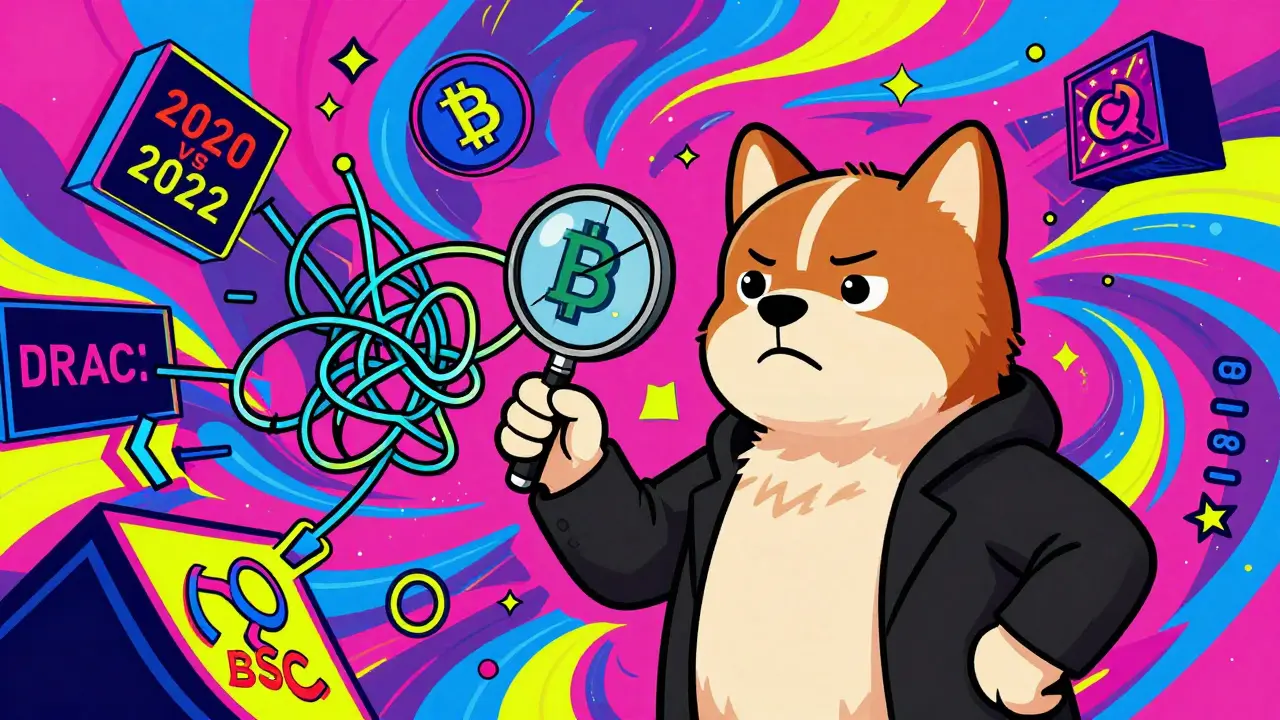
You have likely seen a ticker symbol flash on your screen or heard a whisper in a Telegram group about Teddy Doge, also known as Teddy V2. It sounds like the next big thing in the world of meme coins. But before you send any funds, stop. The data surrounding this token is not just messy; it is contradictory to the point of danger. When major platforms cannot agree on what the asset actually is, you are not investing-you are gambling with blinders on.
As of May 2026, Teddy Doge sits in the shadowy corners of the cryptocurrency market. It lacks the transparency of established projects and the liquidity of popular ones. This article breaks down exactly what Teddy Doge claims to be, why the numbers don't add up, and how to protect yourself from potential pitfalls associated with obscure tokens.
The Identity Crisis: What Is Teddy Doge?
If you ask three different sources what Teddy Doge is, you will get three different answers. This inconsistency is the first red flag for any serious investor. According to CoinMarketCap, Teddy Doge was introduced in 2020 in the United Arab Emirates. It claims to be built on principles of decentralization and aims to provide users with a unique blockchain identity. It supposedly runs on a network called DRAC.
However, Coinbase tells a completely different story. They list the launch date as 2022 and state that the token operates on the BNB Smart Chain using the BEP20 standard. These are not minor details. The blockchain network determines everything about a token's security, transaction speed, and compatibility with wallets. If one source says it’s on DRAC and another says BNB Smart Chain, at least one of them is wrong-or worse, there are two different tokens fighting over the same name.
This confusion is compounded by the existence of similar-sounding tokens. For instance, OKX lists a token called 'Teddy the Tile Doge' with a price of $0.00012952 and a circulating supply of 1 billion tokens. While this might be a separate project, the naming similarity creates noise that makes due diligence nearly impossible for the average user.
Promised Features vs. Reality
On paper, the Teddy Doge ecosystem looks ambitious. CoinMarketCap describes a suite of decentralized finance (DeFi) features. These include:
- A decentralized exchange (DEX) for swapping tokens.
- Liquidity provision and yield farming opportunities.
- A cross-chain bridge for moving assets between blockchains.
- Platforms for minting and auctioning NFTs.
- A dedicated wallet for managing digital assets.
- Tools for analyzing market trends.
Perhaps most intriguingly, the project proposes using a "living biobank" to ensure the authenticity of blockchain identities. It also employs community-driven governance through faction voting. In theory, this gives holders a say in the project's direction. However, these features remain largely theoretical. There is no evidence of widespread adoption, active development updates, or functional infrastructure supporting these claims. Without a working product, these features are just words on a website.
The Price Puzzle: Why Numbers Don't Match
The most alarming aspect of Teddy Doge is the disparity in its market data. Let’s look at the numbers available in mid-2026:
| Platform | Price (USD/EUR) | 24h Volume | Circulating Supply | Status |
|---|---|---|---|---|
| Binance | <$0.000001 | $401.75 | 0 | Not Listed |
| Coinbase | €0.0000000001 | €22.91 | 0 | 100% below ATH |
| Crypto.com | $0.00000001234 | N/A | 810,524,312 | Not Tradable Yet |
| CoinPaprika | $0.011628 | $2.74 | N/A | +6,007% Volatility |
Look closely at this table. Binance and Coinbase report a circulating supply of zero. Crypto.com reports over 810 million tokens. CoinPaprika shows a price of over one cent, while others show fractions of a penny. A 6,000% increase in 24 hours on CoinPaprika, driven by a volume of only $2.74, is not growth-it is statistical noise. Such extreme volatility with negligible volume indicates that a single trade can manipulate the price entirely. This is not a healthy market; it is a ghost town with broken signs.
Liquidity Risks and Exchange Absence
Liquidity is the lifeblood of any cryptocurrency. It allows you to buy and sell without drastically affecting the price. Teddy Doge has almost none. Major exchanges like Binance explicitly state that the coin is not listed for trading. Crypto.com notes it is not yet tradable. Bitrue indicates that trading recently began but metrics are unavailable. This absence from top-tier exchanges means you cannot easily enter or exit a position. If you manage to find a place to buy it, you may find no one willing to buy it back from you.
Low liquidity often leads to "slippage," where the price you see when clicking buy is significantly different from the price you actually pay. In the case of Teddy Doge, slippage could mean losing a significant portion of your investment in a single transaction. Furthermore, the lack of listing on reputable exchanges suggests that the project failed to meet basic compliance or security standards required by these platforms.
How to Verify Token Authenticity
Given the confusion around Teddy Doge, how do you know if you are looking at the real thing? Here is a checklist for verifying obscure tokens:
- Check the Contract Address: Never trust the name alone. Find the official smart contract address on a blockchain explorer like Etherscan or BscScan. Compare it with the address provided by the project’s official social media channels. If they don’t match, it is a scam.
- Analyze Holder Distribution: Use tools like Dune Analytics or Nansen to see who holds the tokens. If a small number of wallets hold the majority of the supply, the risk of a "rug pull" (where developers dump their tokens and crash the price) is extremely high.
- Review On-Chain Activity: Look at the number of daily transactions. If the protocol claims to have millions of users but shows fewer than ten transactions per day, the data is fabricated.
- Cross-Reference Sources: As seen with Teddy Doge, if CoinMarketCap and Coinbase disagree on the blockchain network, pause. Legitimate projects have consistent technical documentation across all major aggregators.

Is Teddy Doge a Scam or Just Failed?
Distinguishing between a failed project and a malicious scam can be difficult. A failed project might have had good intentions but poor execution, leading to abandonment. A scam is designed from the start to steal funds. Teddy Doge exhibits traits of both. The conflicting origin stories (2020 vs. 2022) and technical specs (DRAC vs. BSC) suggest either severe mismanagement or intentional obfuscation. The promise of a "biobank" for identity verification sounds technologically complex and expensive, yet there is no public evidence of such infrastructure being built. This gap between hype and reality is typical of vaporware projects that aim to attract speculative buyers before disappearing.
Investors should exercise extreme caution. Tokens with near-zero market cap, inconsistent data, and no exchange listings offer no fundamental value. They rely entirely on the hope that someone else will pay more later-a classic definition of a Ponzi-like dynamic common in low-quality meme coins.
Alternatives with Better Transparency
If you are interested in meme coins or DeFi projects with actual utility, consider sticking to tokens with verified track records. Projects like Shiba Inu (SHIB) or Pepe (PEPE) may still be volatile, but they have massive communities, clear contract addresses, and listings on major exchanges. For DeFi enthusiasts, established protocols like Uniswap or PancakeSwap offer transparent governance and audited code. Always prioritize projects that publish regular audits from firms like CertiK or Hacken.
What blockchain is Teddy Doge (Teddy V2) built on?
There is conflicting information. CoinMarketCap states it is built on the DRAC network, while Coinbase lists it as operating on the BNB Smart Chain (BEP20). This discrepancy is a major red flag indicating potential data errors or multiple distinct tokens using similar names.
Can I buy Teddy Doge on Binance or Coinbase?
No. Binance explicitly states that Teddy Doge is not listed for trading. Coinbase tracks the price but does not facilitate direct trading on its main platform for many low-cap assets, and the token shows zero circulating supply on their data feed, making purchase impossible through standard channels.
Why is the price of Teddy Doge so different on various websites?
The price differences stem from extreme illiquidity and data aggregation errors. With trading volumes as low as $2.74 on some platforms, a single small trade can cause massive percentage swings. Additionally, some platforms may be tracking different contracts or outdated data, leading to prices ranging from near-zero to several cents.
What is the "living biobank" feature mentioned in Teddy Doge's description?
The project claims to use a living biobank to ensure the authenticity of blockchain identities. However, there is no public evidence, whitepaper detail, or technological proof that this system exists or functions. It appears to be a marketing claim rather than a deployed feature.
Is Teddy Doge the same as Teddy the Tile Doge?
It is unclear. OKX and CoinGecko reference a token called "Teddy the Tile Doge" with a supply of 1 billion tokens and a different price history. Given the naming similarities and data chaos, it is highly possible these are separate entities, adding to the confusion for investors.
When was Teddy Doge launched?
Sources conflict. CoinMarketCap cites a 2020 launch in the UAE, while Coinbase lists a 2022 launch. This lack of consensus on basic historical facts further undermines the project's credibility.
Diana Morris
May 25, 2026 AT 08:34stop buying garbage tokens that dont even have a real contract address
this is literally financial suicide for the uninformed
i see people losing their shirts on these meme coins every single day and it makes me sick
do your damn research before you throw money into a black hole
Dianne Wright
May 25, 2026 AT 22:56you guys are all so naive thinking this is just a bad investment when its clearly a sophisticated scam designed to drain your wallets
i told everyone in my group chat about the liquidity traps but nobody listens until they lose everything
it is exhausting watching smart people act like children chasing shiny objects
the biobank feature is pure vaporware nonsense meant to confuse you while they rug pull
i feel personally attacked by how much money people waste on this trash
trisya hazriyana
May 27, 2026 AT 21:04the semantic drift in token identity verification protocols is fascinatingly catastrophic in this case study
one might posit that the ontological status of Teddy Doge is fundamentally ambiguous given the divergent metadata schemas employed by major aggregators
it is ironic how the decentralized ethos is undermined by centralized data silos failing to reconcile basic ledger truths
perhaps we need a meta-layer of truth consensus mechanisms beyond simple majority voting among exchanges
but sure let us keep pretending that a six thousand percent volatility spike on two dollars of volume represents genuine market sentiment analysis
Debbie Lewis
May 29, 2026 AT 00:00just stick to the basics folks
if you cannot find the contract address easily walk away
i have seen too many good projects fail because of hype cycles like this