
You’ve probably seen the ticker $IP pop up on your exchange dashboard and wondered what it actually does. Unlike Bitcoin, which aims to be digital gold, or Ethereum, which powers general-purpose smart contracts, Story Protocol is a specialized Layer 1 blockchain built for one specific job: managing intellectual property. It turns abstract concepts like copyright, trademarks, and patents into programmable assets that live on-chain. If you are an artist, a developer, or just curious about how AI will pay creators in the future, this is the infrastructure designed to make that happen.
The Core Problem: Why We Need On-Chain IP
Intellectual property theft costs the United States alone over $600 billion annually. That number is staggering, but the real issue isn't just money-it's control. Traditionally, registering a song, a piece of code, or an image involves lawyers, paperwork, and months of waiting. Once registered, enforcing those rights is even harder. You have to prove someone stole your work, then sue them, hoping they have the funds to pay you.
Story Protocol flips this model. It creates a decentralized registry where you can register virtually any form of IP-artwork, music, code, or even AI agents-in seconds. The key innovation here is making IP "programmable." Instead of a static legal document sitting in a filing cabinet, your IP becomes a dynamic asset on the blockchain. This allows for automated licensing, instant royalty distribution, and clear attribution every time your work is used.
This becomes critical when you consider the rise of artificial intelligence. AI models need massive amounts of data to learn. Currently, many companies scrape the web without permission, leading to lawsuits and ethical gray areas. Story provides a way for creators to offer their data for AI training with clear, machine-readable terms. If an AI company uses your dataset, the protocol automatically routes royalties back to you. It solves what analysts call AI's biggest bottleneck: access to rights-cleared, specialized data.
How the $IP Token Works
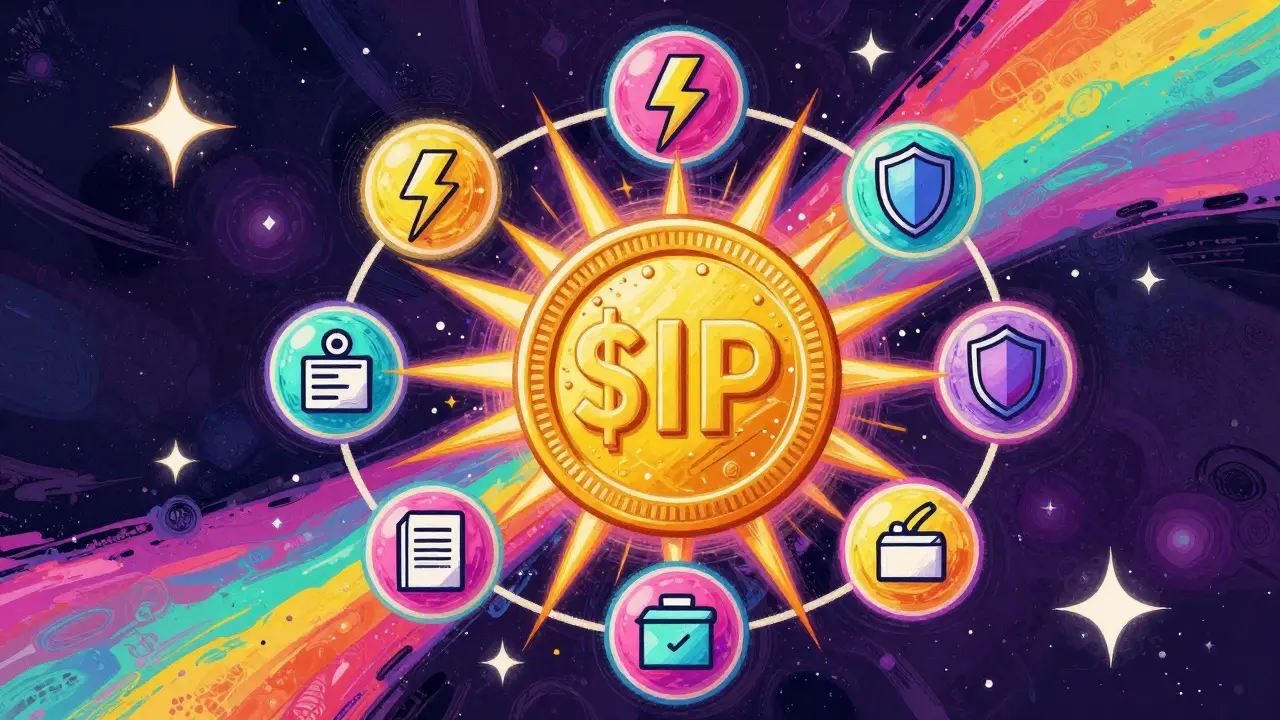
The native currency of this ecosystem is the $IP token. It’s not just a speculative asset; it has six distinct utility functions that keep the network running:
- Gas Fees: Just like ETH on Ethereum, you need $IP to pay for transactions on the Story blockchain.
- Registration: Registering an Intellectual Property Asset (IPA) requires burning or paying fees in $IP.
- Licensing: Acquiring commercial rights to use someone else’s IP often involves paying in $IP.
- Governance: Holders can vote on protocol upgrades and parameter changes.
- Staking: Users stake $IP to secure the network and earn rewards.
- Royalty Distribution: Revenue from licensed IP is distributed to owners in $IP.
The tokenomics are structured with a total supply of 1 billion tokens. At launch, approximately 250 million tokens (25% of the total supply) entered circulation. The remaining tokens are allocated to the Foundation, ecosystem initiatives, and initial incentives. This distribution aims to balance early adoption with long-term sustainability. As of late 2025, market data showed the token trading around $4.39 USD, reflecting significant interest in its utility rather than just hype.
Key Features and Tools
Story isn’t just a ledger; it’s a toolkit for creators. The platform includes several modules designed to simplify IP management:
| Module | Function | User Benefit |
|---|---|---|
| Story Explorer | Discovery interface | Finds registered IP assets by type, creator, or license type. |
| Licensing Module | Permissionless licensing | Automates agreements based on predefined terms (e.g., Open Use vs. Commercial). |
| Dispute Module | Conflict resolution | Uses staking-based mechanisms to resolve IP conflicts without courts. |
| StoryKit | Developer UI tools | White-label components that reduce app development time by 60-70%. |
| IP Hub | Centralized repository | Manages portfolios of IP assets for individual creators or enterprises. |
The licensing system is particularly robust. It supports four main categories: Open Use, Non-Commercial Remix, Commercial Use, and Commercial Remix. These terms are machine-readable, meaning software can instantly check if a usage is permitted. For example, an AI developer can query the Story chain to see if a specific dataset is available for commercial training and at what cost. This eliminates the legal guesswork that currently plagues the industry.
Comparison: Story vs. General Blockchains
Why build a new blockchain instead of using Ethereum or Solana? The answer lies in specialization. On Ethereum, creating a custom IP registry requires writing complex smart contracts, deploying them, and maintaining gas efficiency. It’s possible, but it’s not optimized for high-frequency micro-transactions like royalty splits.
Story Protocol is purpose-built. Its architecture reduces the time to register and monetize IP from weeks to seconds. While Ethereum serves as a general-purpose computer, Story acts as a dedicated IP office. This specialization allows for lower latency and higher throughput for IP-specific operations. However, this comes with a trade-off: Story has a smaller ecosystem of decentralized applications (dApps) compared to Ethereum. It is niche, not broad.
Another differentiator is enforcement. Traditional blockchains don’t inherently understand "copyright." Story’s dispute module introduces a staking-based resolution system. If two parties claim ownership of an asset, stakeholders in the network can vote on the outcome based on evidence provided. This creates a decentralized arbitration layer that doesn’t exist on most other chains.
Real-World Adoption and Partnerships
Theory is nice, but adoption proves value. Story has secured partnerships that validate its approach beyond the crypto sphere. One notable example is Seoul Exchange, one of only two licensed platforms for unlisted securities in South Korea. They exclusively use Story to settle tokenized real-world assets, signaling institutional trust in the protocol’s security and compliance features.
In the entertainment sector, Barunson-the studio behind the Oscar-winning film *Parasite*-launched their nPLUG IP remixing platform on Story. This demonstrates that traditional media houses are interested in leveraging blockchain for fan engagement and derivative content creation. By allowing fans to legally remix and trade derivatives of official content, studios can capture revenue streams that were previously lost to piracy.
On the testnet, over 47,000 IP assets were registered as of late 2025. Early adopters include digital artists, musicians, and AI developers. User feedback highlights the ease of registration; one developer reported registering a music portfolio in under five minutes with no prior blockchain experience. This low barrier to entry is crucial for mass adoption.
Risks and Challenges
No technology is without risks. Story faces several hurdles. First, there is the question of legal recognition. While the protocol creates machine-readable licenses, these must align with existing international copyright laws. Regulatory clarity is still evolving, especially regarding the intersection of blockchain and IP law.
Second, ecosystem maturity remains a challenge. Compared to established chains, Story has fewer dApps and integrations. Developers need more time to build tools that leverage the protocol’s unique features. Until the user base grows, liquidity for certain niche IP assets may remain thin.
Finally, there is competition. Other projects are attempting to solve IP issues through Layer 2 solutions on Ethereum or specialized NFT standards. Story’s team argues that dedicated infrastructure is necessary due to the complexity of IP management, but skeptics point out that modular blockchains might offer similar benefits with less fragmentation.
Future Outlook
The roadmap for Story includes full mainnet launch, deeper integration with AI model training pipelines, and expansion of liquid staking options. Analysts project that Story could capture 15-20% of the AI training data market within three years, driven by increasing regulatory pressure on AI companies to use rights-cleared data.
If you believe that AI will dominate the next decade, you also have to believe that data rights will become a major economic factor. Story positions itself at the center of this shift. Whether it succeeds depends on widespread adoption by both creators who want protection and companies who want compliance. The technology is ready; the market is now testing its willingness to pay.
What is the difference between Story Protocol and NFTs?
NFTs typically represent ownership of a single digital item, like a JPEG or a collectible. Story Protocol focuses on the underlying intellectual property rights themselves. An NFT might prove you own a copy of a song, but Story allows you to manage the copyright, license the song for commercial use, and automate royalty payments. It’s about the rights, not just the file.
Can I register my personal photos on Story?
Yes. Story supports various types of IP, including images, music, code, and text. You can register your photos as Intellectual Property Assets (IPAs) and set licensing terms. For example, you could allow non-commercial use for free while charging a fee for commercial licensing.
Is the $IP token a good investment?
All cryptocurrencies carry risk. The value of $IP depends on the adoption of the Story Protocol. If more creators and AI companies use the network, demand for the token (used for fees and licensing) may increase. However, you should conduct your own research and consider the project’s current market cap, tokenomics, and competitive landscape before investing.
How does Story help AI developers?
AI developers need large datasets for training models. Using scraped data carries legal risks. Story provides a marketplace for rights-cleared data. Developers can license datasets directly from creators, ensuring compliance and avoiding potential lawsuits. The protocol handles attribution and royalty payments automatically.
What happens if there is a dispute over IP ownership?
Story includes a Dispute Module. When a conflict arises, stakeholders who have staked $IP tokens can vote on the outcome based on submitted evidence. This decentralized arbitration process aims to resolve conflicts faster and cheaper than traditional court systems, though final legal recourse may still be necessary in extreme cases.