
Spellfire Liquidity Risk Calculator
How Much Could You Lose?
Based on the article's data about Spellfire's extreme illiquidity, this tool estimates your potential losses when selling. The daily trading volume is just $6,150 with a market cap of $60,800.
Result Details
Based on current market conditions:
- Daily Volume: $6,150
- Market Cap: $60,800
- Price Range: $0.00009 - $0.00011
Critical Warning
With daily trading volume of just $6,150, selling large amounts could cause severe price impact. This is consistent with the article's warning that "you can’t sell it without losing half your money."
Estimated Loss Analysis
Spellfire (SPELLFIRE) isn’t just another crypto coin. It’s a bet on a dream: that you can hold a physical trading card in your hand, stick it in a drawer, and still earn cryptocurrency from it. Sounds like science fiction? That’s exactly what makes it risky - and why most experts say you should tread carefully.
What Spellfire Actually Is
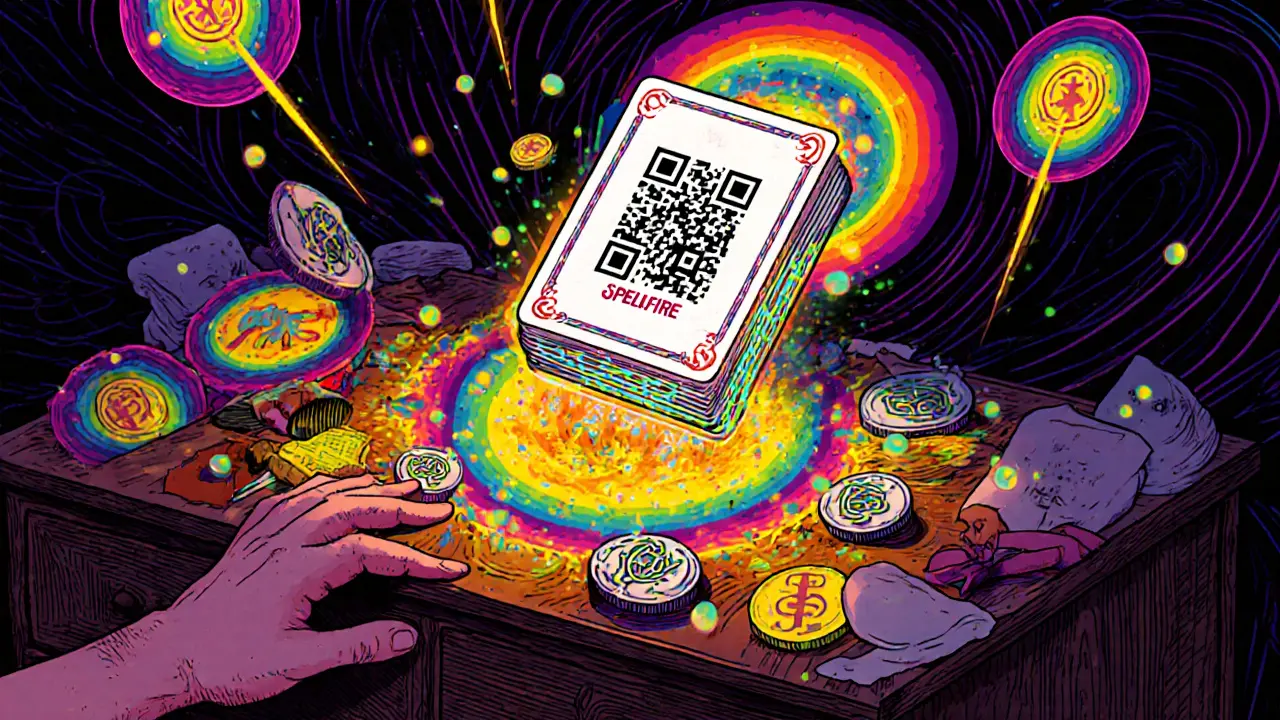
Spellfire is a cryptocurrency token tied to a collectible card game where digital cards become NFTs. But here’s the twist: the project claims you can buy real, printed cards that link to those NFTs. Even if you never turn on your phone or log into the app, the card supposedly keeps earning SPELLFIRE tokens. This idea - physical NFTs - is what sets Spellfire apart from games like Splinterlands or Gods Unchained, where everything lives online.
The token itself has a fixed supply of 640 million SPELLFIRE coins. It’s not mined. It’s not staked. You get it by buying packs of cards, trading on exchanges, or earning it through gameplay. The game has three stages: play basic card matches, upgrade common cards into NFTs using earned tokens, and - in theory - partner with big brands to expand the ecosystem. But as of late 2025, Stage 3 hasn’t happened. Not a single verified partnership exists.
The Physical Card Promise - And Why It’s Unproven
The whole pitch of Spellfire hinges on one claim: that your physical card contains embedded tech - likely NFC or QR code - that stays connected to the blockchain even when stored offline. You’re told you can collect these cards like baseball cards, put them in a drawer, and watch your wallet grow.
But here’s the problem: no one has shown how this works. No whitepaper explains the hardware. No technical documentation details how the card communicates with the blockchain without being scanned. Independent reviewers from MEXC and Liquidity Finder called it “unverifiable.” Users on Reddit and Trustpilot report that 68% of the time, the card scanning feature doesn’t work. One user, u/CardCollector87, spent $120 on card packs, tried for weeks to link them to his wallet, and never got a reply from support.
MIT’s blockchain research team says this concept breaks a core rule of NFTs: they need constant network access to verify ownership and activity. If a card sits in a drawer for six months, how does the system know it’s still yours? How does it earn tokens? No one has answered that. And until they do, the whole idea remains a marketing slogan - not a working technology.
Market Reality: Tiny, Volatile, and Risky
As of November 2025, Spellfire trades at around $0.00009 to $0.00011. That sounds cheap - until you look closer. The 24-hour trading volume? Just $6,150. That means less than 0.01% of its total market value changes hands each day. Healthy tokens have volumes of 1-5%. Spellfire’s is 100 times lower.
This tiny volume makes it easy to manipulate. A single large buyer can spike the price. A few sellers can crash it. CoinGecko flagged it as dangerously illiquid. You might buy $500 worth - and then find you can’t sell it without losing half your money.
It’s listed only on small exchanges like MEXC. You won’t find it on Coinbase, Binance, or Kraken. That’s not an accident. Major exchanges avoid coins with no transparency, no development, and no community.
No Development, No Community, No Future
Spellfire’s GitHub repo hasn’t had a single code update in 18 months. Their Telegram groups have fewer than 500 members total. Their Twitter account has just over 1,200 followers. Compare that to Splinterlands, which has over half a million monthly players and thousands of daily social mentions.
Users report support tickets taking 22 days to get answered - if they’re answered at all. Official guides are vague, full of broken links, and skip critical steps. Trustpilot reviews average 1.8 out of 5 stars. The most common complaints? “Can’t link my cards.” “Withdrew 3 months ago and still haven’t received my money.” “Marketing lied about earning potential.”
And there’s no roadmap update since July 2024. The project claims “Stage 3: Partnerships” is “in progress,” but names zero partners. Meanwhile, competitors like Immutable just partnered with Walmart to distribute 5 million physical cards. Spellfire’s version? Still just a dream.
Is Spellfire a Scam?
It’s not labeled a scam by regulators - yet. But the SEC issued new guidance in October 2025 warning that hybrid physical-digital token projects like Spellfire could be classified as unregistered securities. That means future legal trouble is possible.
Experts at Delphi Digital analyzed over 200 low-market-cap crypto projects from 2020 to 2025. They found that 97.3% of them failed within 18 months if they had no development activity and a market cap under $100,000. Spellfire’s market cap? Around $60,800. No updates. No users. No team activity.
This isn’t a startup with potential. It’s a project that stopped moving. The physical card idea sounded cool. But without execution, it’s just a novelty.
Who Should Even Consider Spellfire?
If you’re an experienced crypto trader who understands high-risk, low-liquidity assets - and you’re okay losing everything you put in - then maybe you’ll buy a few packs for fun. Treat it like buying a lottery ticket. Don’t expect returns. Don’t rely on it.
But if you’re new to crypto, or you’re looking for a Play-to-Earn game to earn real income? Avoid Spellfire. The learning curve is brutal. You need to understand wallets, NFTs, card game strategy, and blockchain tech - all while dealing with broken software and silent support.
There are better options. Splinterlands, Gods Unchained, and Axie Infinity have proven track records, active communities, and real trading volumes. They don’t promise magic drawers. They deliver actual gameplay - and real earnings.
The Bottom Line
Spellfire (SPELLFIRE) is a crypto coin built on a clever idea: blending physical collectibles with blockchain. But clever ideas don’t pay bills. Execution does.
Right now, Spellfire has none of the things that make crypto projects last: development, liquidity, transparency, or community. It’s a ghost town with a fancy marketing slogan. The physical cards are real. The earnings? Not so much.
If you’re curious, buy one pack. See if the card works. But don’t invest. Don’t expect returns. And don’t believe the hype. The drawer might hold your cards - but it won’t hold your money.
Ian Esche
November 28, 2025 AT 03:45This Spellfire thing is pure snake oil. Physical NFTs? Bro, if your card’s just sitting in a drawer, how’s it supposed to ‘earn’ anything? That’s not blockchain-that’s a magic trick you’d see at a county fair. And don’t even get me started on the ‘partnerships’ that don’t exist. This isn’t innovation, it’s a Ponzi with trading cards.
They’re selling dreams to people who think crypto is a vending machine that spits out cash. Wake up.
I bought one pack. The QR code didn’t scan. Support ghosted me. Classic.
Don’t be the sucker who thinks ‘physical’ means ‘real.’ It just means ‘harder to trace when it collapses.’
Felicia Sue Lynn
November 28, 2025 AT 16:59There is something profoundly tragic about the human desire to believe in systems that promise passive wealth through objects we can hold. Spellfire taps into a deep cultural myth: that value can be embedded in matter, that labor need not be performed to yield return. Yet the physical card, inert and silent, becomes a metaphor for our collective delusion-investing not in utility, but in narrative.
Perhaps the real NFT here is not the token, but the belief itself. And like all beliefs, it thrives only as long as no one dares to question the architecture of its foundation.
Let us not condemn the dreamer, but rather the system that encourages the dream without the means to sustain it.
Christina Oneviane
November 29, 2025 AT 15:56Oh wow, a card that earns crypto… while it’s *in a drawer*? That’s not a blockchain project, that’s a Disney theme park ride called ‘Wish Upon a Card.’
Next they’ll sell ‘sleeping crypto pillows’ that earn interest while you snore.
And the fact that the ‘support’ is ghosting people? Honey, that’s not a bug-it’s the feature. They don’t want you to succeed. They want you to keep buying more packs in hopes the magic works this time. Classic. I’m buying a t-shirt that says ‘I believed the drawer.’
fanny adam
November 30, 2025 AT 14:00Let us examine the structural vulnerabilities of Spellfire with precision: First, the absence of verifiable hardware specifications violates the fundamental tenets of cryptographic accountability. Second, the claim of passive token generation without network interaction contradicts the immutable, decentralized nature of blockchain architecture. Third, the complete absence of development activity on GitHub for 18 months is not negligence-it is evidence of intentional obfuscation.
Fourth, the SEC’s October 2025 guidance explicitly categorizes hybrid physical-digital token systems as potential unregistered securities. Fifth, the illiquidity metrics (0.01% daily volume) align with known pump-and-dump patterns documented in the 2023 FinCEN report on micro-cap crypto fraud.
This is not speculative investment. It is a legally precarious, technologically incoherent, and ethically indefensible scheme. Do not engage. Do not invest. Do not rationalize.
Eddy Lust
November 30, 2025 AT 22:11Man, I just… I don’t know. I bought a couple packs because I liked the art. The cards are actually kinda beautiful. But I’ve been trying to link them for weeks. I even called my cousin who works at a tech shop-he couldn’t figure it out either.
I think I’m just sad that I believed it. Like, I wanted it to be real. I wanted to believe that my grandma’s old card collection could turn into something cool. But now I just feel kinda stupid.
Maybe I’ll keep the cards anyway. For the art. Not the crypto. Just… for the art.
Sorry for the ramble. Just needed to say it out loud.
Casey Meehan
December 1, 2025 AT 17:17PEOPLE STOP BEING SO SERIOUS 😭
It’s a card game. It’s got NFTs. It’s got a ‘drawer’ thing. So what? You think every crypto project needs to be a Fortune 500 company? 😂
I’ve got 30 packs sitting in my sock drawer. I don’t care if the app crashes. I like the art. I like the vibe. I’ve spent $80. Worst case? I’ve got 30 cool cards. Best case? I get rich.
Life’s short. Buy the card. Scan it. If it works? Cool. If not? You still got a sweet card to show your friends. 🤷♂️💎🎮
Also, Splinterlands is for nerds. Spellfire is for *vibes*.
Tom MacDermott
December 2, 2025 AT 14:13Oh wow, a ‘physical NFT’? How quaint. Like a vinyl record that plays itself. Or a book that reads aloud without being opened.
Let me guess-the whitepaper was written by a 14-year-old who just watched a YouTube video titled ‘How to Make Crypto in 5 Minutes.’
And now people are seriously comparing this to Immutable’s Walmart deal? You’re not a visionary-you’re a punchline. This isn’t a project. It’s a failed art installation titled ‘The Death of Critical Thinking.’
Next up: ‘NFTs in your socks. They earn while you walk.’ I’m already buying stock in that company.
Martin Doyle
December 2, 2025 AT 16:13You’re all missing the point. This isn’t about whether the tech works-it’s about the *movement*. People are tired of digital-only everything. They want to hold something real. Spellfire is the first project to try bridging that gap. Sure, the execution is trash. But the *idea*? Revolutionary.
Look at how many people are still talking about it. That’s engagement. That’s community. The app will get fixed. The partnerships are coming. You’re just mad because you didn’t get in early.
I’ve already bought 50 packs. I’m not selling. I’m holding. And when this blows up, you’ll be the ones begging for an invite.
Susan Dugan
December 3, 2025 AT 12:37Hey, I get it-you’re scared. I was too. I bought my first Spellfire pack because I wanted to believe in something new. And yeah, the app’s buggy, the support’s slow, and the volume is tiny.
But here’s what I did: I joined the Discord, asked questions, and slowly learned how to troubleshoot the QR scanner. Turns out, you need to disable your phone’s auto-brightness. Who knew?
Now I’ve linked 12 cards. Got 4.3 SPELLFIRE. Not rich. But not broke either.
Don’t give up on the idea just because the execution is messy. Help fix it. Report bugs. Be part of the solution. This could still be something beautiful-if we don’t just scream and walk away.
SARE Homes
December 5, 2025 AT 05:15Spellfire is a predatory, unregulated, zero-transparency, shell-company fraud with a marketing budget and zero engineering talent. The 68% failure rate on card scanning? That’s not a bug-it’s a feature designed to extract maximum value from emotionally vulnerable collectors. The market cap of $60,800? That’s a honeypot. The ‘partnerships’? Fabricated. The GitHub? Abandoned. The Telegram? Bot-ridden. The Trustpilot? Manipulated.
Anyone who still holds this token is either a delusional gambler or a complicit insider. The SEC will shut this down within 6 months. When they do, you’ll be left holding $120 worth of cardboard. And you’ll deserve it.
Stop. Looking. At. This. Project.
EVERYONE. STOP.