
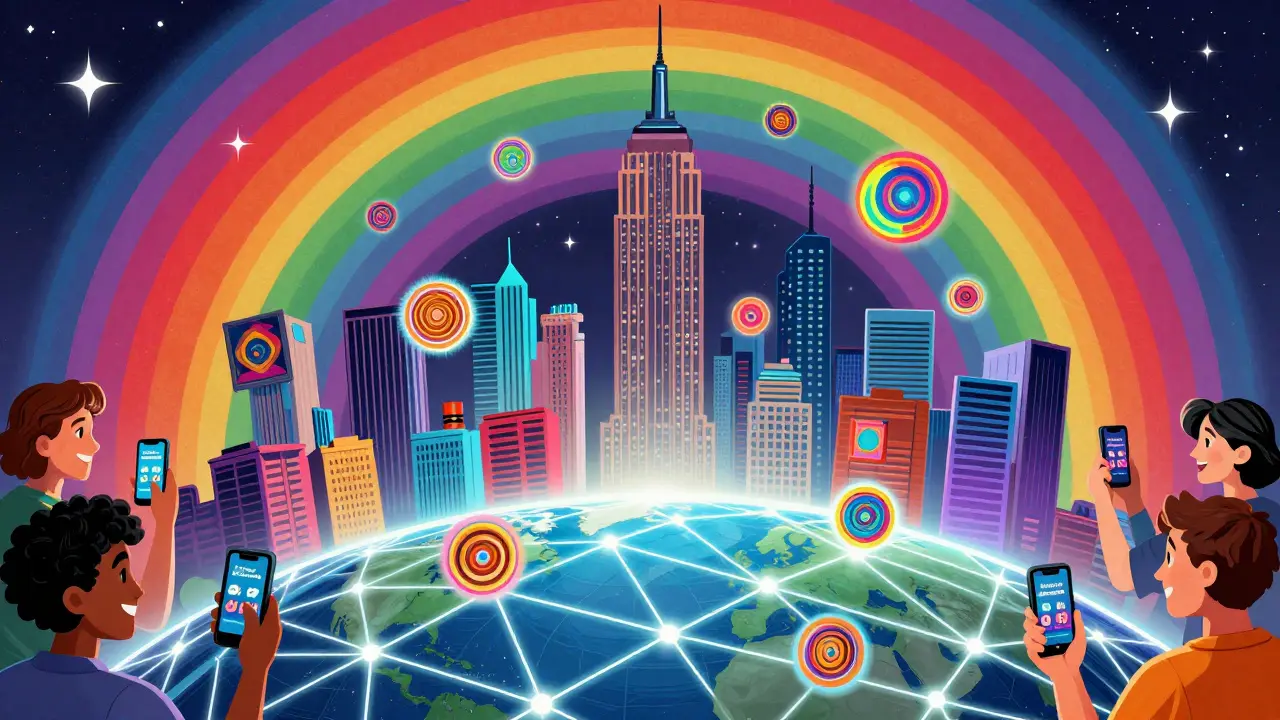
Imagine owning a piece of a skyscraper in New York, a barrel of crude oil, or even a rare Picasso - not through a bank or a broker, but as a digital token on a blockchain. That’s what real world asset tokenization does. It turns physical or legal assets into digital tokens that can be bought, sold, and traded like cryptocurrency. No middlemen. No paperwork stacks. Just smart contracts and blockchain ledgers doing the heavy lifting.
What Exactly Gets Tokenized?
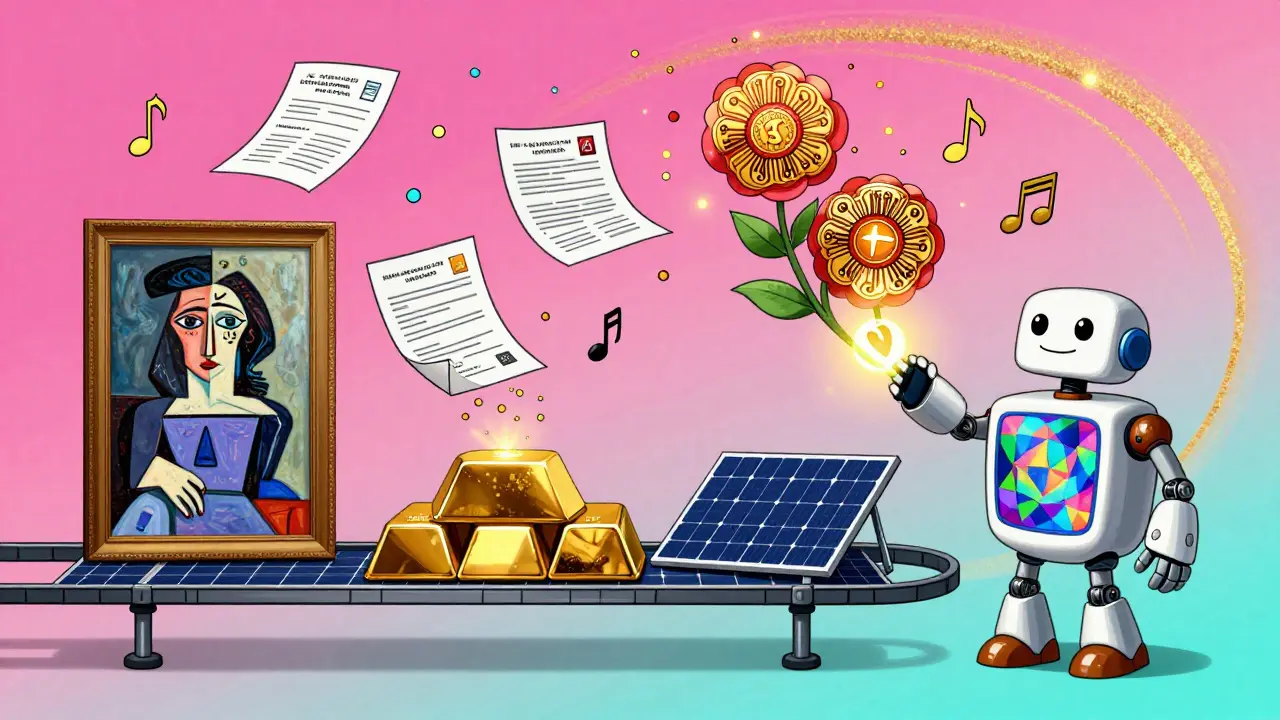
Real world asset tokenization isn’t just about real estate. It covers almost anything with value. You can tokenize:- Real estate - apartments, office buildings, even farmland
- Commodities - gold, oil, wheat, copper
- Art and collectibles - paintings, vintage cars, rare watches
- Financial instruments - bonds, stocks, private equity
- Intellectual property - music royalties, patents, film rights
- Infrastructure - solar farms, wind turbines, cell towers
- Even intangible rights - water rights, mineral extraction permits
Each of these assets gets mapped to a digital token. That token isn’t just a picture or a claim - it’s a verifiable, tamper-proof record on a blockchain that says: "This person owns X% of this asset."
How Does It Work?
Tokenization doesn’t happen in one step. It’s a process with clear stages:- Asset selection - Not everything is a good candidate. Assets need clear ownership, stable value, and legal enforceability. A rare painting? Yes. A used toaster? Not so much.
- Legal structuring - Who owns the asset legally? Is it held in a trust? A company? This step makes sure the digital token matches up with real-world law. Without this, the token is just a fancy digital sticker.
- Token design - Will it be a fungible token (like ETH or USDC) or an NFT? Fungible tokens work for things like shares in a building. NFTs are better for unique items like a single sculpture.
- Blockchain choice - Ethereum is common, but others like Polygon, Solana, or even private blockchains are used depending on speed, cost, and regulation.
- Smart contract deployment - This is the code that automates everything: who can buy, how dividends are paid, how ownership transfers. It runs on the blockchain and can’t be changed once live.
- Off-chain data feeds - Tokens need real-time info. If you’re tokenizing oil, you need live price feeds. That’s done through secure oracles - trusted data bridges between the blockchain and the real world.
Two Main Ways to Do It
There are two big models for how these tokens are structured:Tokenized SPV (Special Purpose Vehicle) - This is the most common approach. The asset (say, a commercial building) is owned by a legal entity - like a limited company or a trust. That entity then issues tokens. Investors buy tokens in the company, not the building directly. It’s indirect, but it fits neatly into existing financial regulations. Most regulated platforms use this method.
Direct Asset Tokenization - Here, the asset itself is tokenized. The token is the legal claim. No middle entity. It sounds clean, but it’s messy legally. Who enforces ownership? What happens if the asset gets seized? Most regulators aren’t ready for this. It’s rare and mostly used in experimental or unregulated settings.
Why Is This a Big Deal?
Tokenization changes how money moves. Here’s why it matters:- Fractional ownership - You don’t need $10 million to buy a building. With tokenization, you can buy $100 worth of it. That opens up investing to regular people.
- 24/7 trading - Unlike stocks that close at 4 p.m., tokenized assets trade nonstop. Global markets never sleep.
- Lower fees - No brokers, no clearinghouses, no custodians. The blockchain handles settlement automatically.
- Transparency - Every transaction is public and permanent. You can trace every owner since the asset was tokenized.
- Liquidity - Illiquid assets like art or farmland become tradeable. Suddenly, you can sell your share of a vineyard in Napa without finding a buyer who wants a whole vineyard.
For example, a startup in Switzerland tokenized a historic hotel. Instead of one investor putting in $50 million, 5,000 people from 30 countries bought small slices. Now, rental income flows directly to their wallets every month. No bank needed.
The Challenges
It’s not all smooth sailing. Here’s what’s holding it back:- Regulation - Every country treats this differently. The U.S. sees most tokenized assets as securities. The EU has MiCA. Singapore is welcoming. But if you’re not compliant, you risk fines or shutdowns.
- Oracles - If the data feed saying "gold is $2,300/oz" is hacked or wrong, the whole system breaks. Oracle security is critical.
- Smart contract bugs - Code isn’t perfect. A glitch could freeze funds or let someone steal ownership. Audits are non-negotiable.
- Adoption - Most people still don’t get it. Banks, pension funds, and family offices are watching - but moving slowly. Education is the biggest barrier.
According to Chainlink, the total value of all real-world assets in the world is over $100 trillion. Even if only 5% gets tokenized, that’s $5 trillion in new markets. That’s bigger than the entire crypto market today.
Who’s Doing It Right?
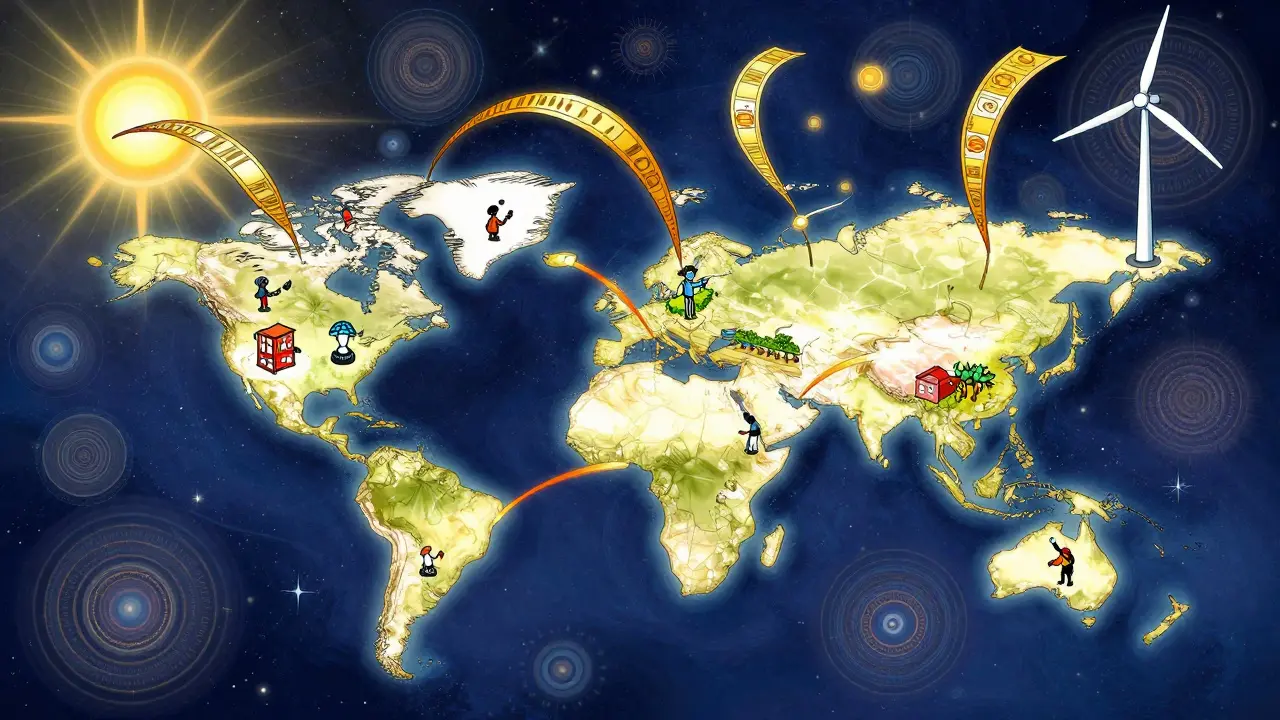
Institutional players are stepping in. BlackRock and Fidelity are exploring tokenized bonds. Swiss banks are launching tokenized gold funds. The U.S. state of Wyoming has passed laws recognizing tokenized assets as legal property. Singapore’s MAS has approved tokenized bond platforms. Even the World Bank has tested tokenized bonds for infrastructure projects.Platforms like Brickken, Securitize, and Maple Finance are building the tools that let institutions tokenize real estate, loans, and private credit. They’re not replacing Wall Street - they’re upgrading it.
What’s Next?
The next 2-5 years will be about regulation catching up and infrastructure maturing. Expect:- More countries to create clear rules for tokenized assets
- Banks offering tokenized versions of traditional products (mortgages, ETFs, pensions)
- Integration with DeFi - tokenized real estate as collateral for loans
- Mobile apps that let you buy a slice of a solar farm with a tap
Real world asset tokenization isn’t about replacing banks. It’s about making finance faster, fairer, and open to everyone. You won’t need a lawyer to buy a share of a wind farm anymore. Just a wallet, a token, and a blockchain.
What assets can be tokenized?
Almost any asset with clear ownership and value can be tokenized. Common examples include real estate, gold, artwork, bonds, stocks, farmland, music royalties, patents, infrastructure like solar farms, and even water rights. The key is legal enforceability - the asset must have a recognized owner and rights that can be transferred.
Is RWA tokenization the same as NFTs?
Not exactly. NFTs (non-fungible tokens) represent unique items - like a single painting or a rare sneaker. RWA tokenization often uses fungible tokens (like ERC-20), which are interchangeable, for things like shares in a building. But NFTs can also be used for tokenizing unique assets like a specific piece of land or a vintage car. So NFTs are one tool in the RWA toolkit.
Can I really own a fraction of a building with a token?
Yes - if the legal structure is set up correctly. In a tokenized SPV model, the building is owned by a legal entity (like a trust), and tokens represent shares in that entity. Owning 10 tokens might mean you own 0.1% of the building. You get proportional rent, profits, or resale value. This is legally binding in jurisdictions that recognize digital securities.
Why do I need oracles for tokenized assets?
Blockchains can’t access real-world data on their own. If you’re tokenizing oil, the smart contract needs to know the current price. Oracles are trusted third-party services that feed real-time data (like commodity prices, property valuations, or rental income) onto the blockchain. If the oracle is hacked or inaccurate, the whole system fails - so security here is critical.
Is RWA tokenization safe?
It’s as safe as the underlying asset and the system around it. Smart contracts must be audited. Oracles must be reliable. Legal structures must hold up in court. A poorly built tokenized bond is risky. But when done right - with regulation, audits, and secure infrastructure - it’s more secure than paper-based systems because every transaction is recorded permanently and can’t be altered.
How is this different from ETFs or REITs?
ETFs and REITs are centralized. You own shares in a fund managed by a company. With tokenization, you own a direct digital claim on the asset, often with automated payouts and global 24/7 trading. There’s less bureaucracy, lower fees, and more transparency. Think of it as the next evolution: same benefits, but built on open, decentralized infrastructure.
Can I tokenize my own house?
Technically yes - but only if your local laws allow it and you set up a legal entity to hold the property. In places like Wyoming or Switzerland, it’s possible. In most places, you’d need a lawyer, a custodian, and a compliant platform. It’s not something you can do on your phone today. But it’s coming.
Who regulates RWA tokenization?
It depends on location. In the U.S., the SEC treats most tokenized assets as securities. In the EU, MiCA (Markets in Crypto-Assets) regulates them. Switzerland’s FINMA has clear guidelines. Singapore’s MAS is proactive. There’s no global rule yet, so platforms often target jurisdictions with clear frameworks.
Is RWA tokenization just for rich people?
No - that’s the whole point. Before tokenization, only institutions or ultra-high-net-worth individuals could invest in private equity, real estate, or fine art. Now, someone with $50 can buy a fraction of a commercial property. It’s democratizing access to assets that were previously locked away.
Will this replace traditional finance?
Not replace - upgrade. Banks, brokers, and clearinghouses aren’t disappearing. But they’re being forced to adapt. Tokenization makes settlement faster, reduces counterparty risk, cuts costs, and opens markets. Traditional finance is adopting it - not fighting it. The future is hybrid: regulated, tokenized, and global.
Sharon Tuck
March 8, 2026 AT 16:19Love how this breaks it down so clearly! I’ve been diving into tokenized real estate lately, and honestly? It feels like the first time I understood how blockchain could actually help regular folks. No more gatekeeping by hedge funds.
My cousin in Toronto just bought $200 worth of a downtown office building-she gets rent updates in her app every month. Wild, right?
Jennifer Pilot
March 10, 2026 AT 02:51While I appreciate the conceptual elegance of this framework, I must insist that the underlying ontological assumptions of tokenized asset ownership remain fundamentally ungrounded in jurisprudential reality.
The notion that a blockchain ledger-however immutable-can supplant centuries of statutory property law is not merely optimistic; it is epistemologically reckless.
And don’t get me started on oracles… who audits the auditors? Who ensures the data feed isn’t manipulated by a single centralized node masquerading as ‘decentralized’?
Also: ‘$100 worth of a building’? Please. That’s not ownership-it’s a digital lottery ticket with tax implications.
And punctuation? I’ve seen better grammar in a Wikipedia edit war.
Ian Thomas
March 10, 2026 AT 08:53So let me get this straight… you’re telling me that instead of a guy in a suit signing a paper, now I need to trust a piece of code written by a 19-year-old in Estonia who thinks ‘pragma solidity’ is a dating app?
And if the oracle says oil is $2,300 but the actual barrel’s in a warehouse in Houston with a leak? Who pays? The blockchain? It doesn’t have a bank account.
Also, ‘democratizing finance’? Cool. So now I can lose $50 on a solar farm… while a VC in Palo Alto loses $50 million. Same outcome. Different emoji.
Austin King
March 10, 2026 AT 09:52This is actually really exciting. I’ve been waiting for something like this to make investing feel less like a club for rich people.
Imagine if your kid could save $10 a week and own a tiny piece of a wind farm by 18? That’s not finance-it’s legacy.
And yeah, there are risks. But so was the internet in 1995. We didn’t give up on it.
Bryanna Barnett
March 12, 2026 AT 04:34ok but like… if i can buy a slice of a building, can i also like… take a selfie on the rooftop? 🤔
also why does every article say ‘tokenization’ like it’s a new word? we’ve been doing this with REITs for decades. it’s just… blockchain-y now.
Josh Moorcroft-Jones
March 13, 2026 AT 10:31Let’s be brutally honest here-this entire concept is a regulatory nightmare wrapped in a marketing buzzword, stuffed inside a technical overcomplication, and served with a side of crypto bro hype.
First: legal structuring? Please. You think a Swiss trust is going to hold up in a Texas court? Or a Nigerian court? Or a court in a country that doesn’t even recognize digital signatures?
Second: smart contracts? You know how many times ‘unintended consequences’ have blown up DeFi protocols? Over 300 in the last five years. And you’re telling me we’re going to trust this with real estate? With water rights? With *mineral extraction permits*?
Third: oracles? Oh, you mean those third-party APIs that have been hacked 17 times this year alone? The ones that once reported Bitcoin was $1 million because a single node went offline?
Fourth: liquidity? You think people are going to trade shares of a vineyard like they trade Dogecoin? No. They’re going to hold it. Because it’s illiquid. Just like before. Only now, with more gas fees.
Fifth: ‘democratizing finance’? You mean letting people invest in something they don’t understand, with less protection, and no recourse when things go sideways? That’s not inclusion. That’s exploitation with a blockchain logo.
And don’t even get me started on the fact that every platform claims to be ‘regulated’… but only in the jurisdiction that lets them do the most shady stuff. It’s like calling a casino ‘regulated’ because it’s licensed in Curacao.
This isn’t the future of finance. It’s the next Ponzi scheme with a whitepaper.
Sherry Kirkham
March 15, 2026 AT 07:07Tokenization isn’t about tech. It’s about power.
Who controls the ledger? Who sets the rules? Who gets the fees?
If this just moves control from banks to coders, we’ve won nothing.
True decentralization means ownership without intermediaries-period.
Most of this is theater.
jay baravkar
March 15, 2026 AT 16:00THIS. IS. GAME. CHANGING. 🚀
I just bought $50 of a solar farm in Arizona. My phone pings me every time it generates power. I get paid in crypto. I feel like a tiny part of the future. 😊
It’s not perfect-but it’s real. And it’s here.