
MeowCat (MEOW) isn’t a project. It’s not a platform. It’s not even really a cryptocurrency in the way Bitcoin or Ethereum are. It’s a meme coin - a digital token born from internet humor, with no team, no roadmap, and almost no real-world use. If you’ve seen ads on social media promising quick riches from MEOW, you’re being sold a dream wrapped in blockchain jargon. The truth? MeowCat is one of thousands of micro-cap tokens that exist only because someone typed ‘meow’ into a coin generator and hit deploy.
What MeowCat actually is
MeowCat (MEOW) launched on March 11, 2024, as an ERC-20 token on the Ethereum blockchain. Its contract address is 0x8ad2...8f6187. That’s it. No whitepaper. No founding team. No company behind it. The project claims to be ‘community-driven,’ but there’s no governance system, no voting mechanism, and no real community activity to speak of. With only about 10,450 holders total, it’s not a community - it’s a scattered group of speculators hoping for a pump.
MEOW has a maximum supply of 1 billion tokens. But here’s the catch: different sites report wildly different numbers. CoinMarketCap says only 100 million are in circulation. CoinCarp says the full 1 billion are out. Blockspot.io lists a version on Avalanche, meaning the same token exists on multiple chains - a red flag that often signals a lack of centralized control or, worse, multiple copies being used to inflate trading numbers.
The price: a rollercoaster with no brakes
MeowCat’s price is a mess. On January 15, 2026, it swung between $0.000075 and $0.000223 across exchanges. One site says $0.000104. Another says $0.000153. A third says $0.000223 for the AVAX version. That’s not market inefficiency - that’s data manipulation. Some exchanges list inflated prices to make the coin look more valuable than it is.
Its all-time high was $1.30. Its all-time low? $0.000075. That’s a 1,733,233% drop. That’s not volatility - that’s a death spiral. One day, a bot buys a few thousand tokens and pushes the price up 10%. The next day, it crashes 15%. These aren’t market movements. They’re pump-and-dump cycles engineered by whales who bought cheap and are now selling to newcomers.
Why you can’t trade it easily
MeowCat trades on decentralized exchanges like MEXC and through Binance’s Web3 Wallet. But here’s the problem: liquidity is near zero. CoinMarketCap shows 24-hour trading volume at $0. CoinCarp says $23,245 - but even that’s tiny. For comparison, Dogecoin moves over $500 million daily. MEOW’s volume is less than what a single Bitcoin whale might trade in five minutes.
That means if you buy MEOW, you might not be able to sell it. If you try to cash out, your order won’t fill. Or worse - it fills at a price 50% lower than you expected. There are no market makers. No institutional buyers. Just a handful of people trying to exit before the next crash.
How it compares to other meme coins
Dogecoin (DOGE) and Shiba Inu (SHIB) are also meme coins. But they have real ecosystems. DOGE has payment integrations. SHIB has a burning mechanism, a decentralized exchange (ShibaSwap), and a growing NFT collection. MEOW has nothing. No utility. No partnerships. No development team. It’s just a token with a cat logo.
On CoinMarketCap, DOGE ranks #9. SHIB is #16. MEOW? #3439. RevenueBot.io ranks it even lower - at #10,236. That’s not a niche coin. That’s a ghost. Out of over 25,000 cryptocurrencies, MEOW is buried in the bottom 40%.
Who’s promoting it - and why
Look at where MEOW is advertised: MEXC, LBank, and other lesser-known exchanges. These platforms make money from trading fees. The more people trade MEOW, the more they earn. So they push it hard. They call it ‘a hidden gem’ or ‘a future moonshot.’ They don’t mention the $0 volume. They don’t warn you about the rug pull risk. They just show you a chart that went up last week.
Meanwhile, big names like Coinbase, Binance, and Kraken don’t list MEOW. Why? Because they know it’s too risky. Too unstable. Too likely to vanish overnight. If a major exchange won’t touch it, that’s your signal.
The real danger: rug pulls and scams
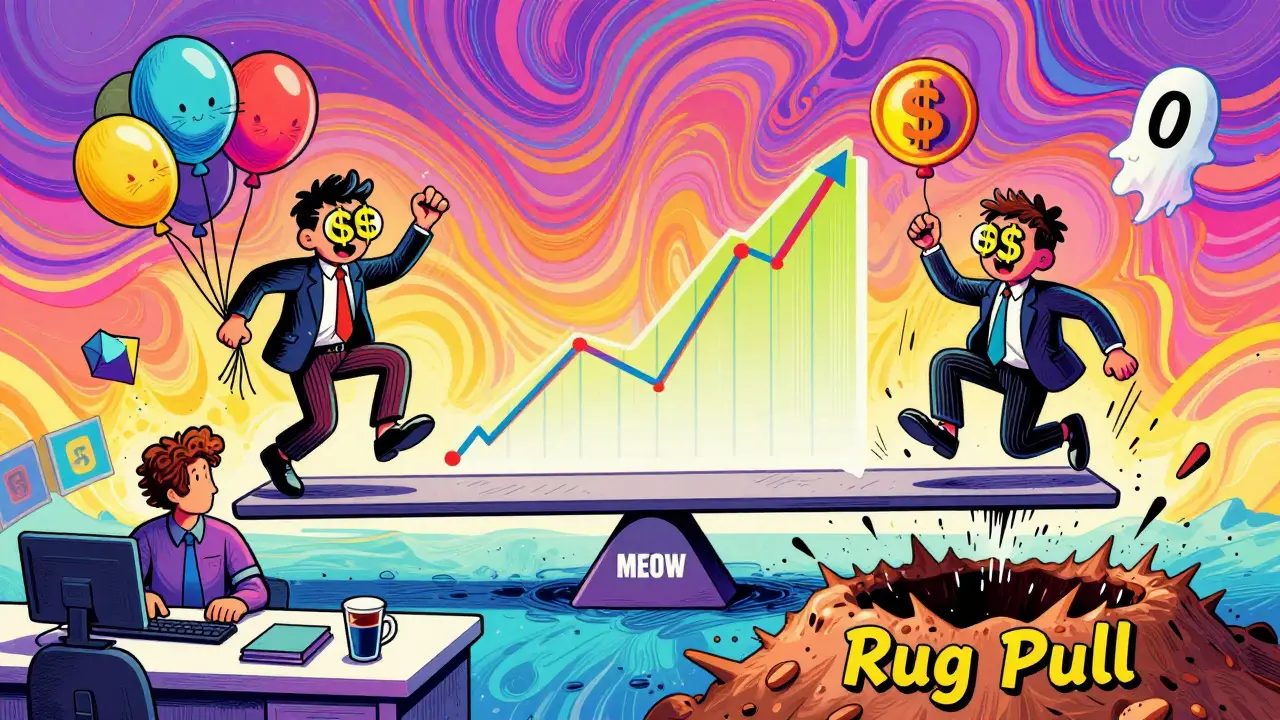
Every meme coin with no team, no audit, and no liquidity is a potential rug pull. That means the creators can vanish with all the money. They can freeze the contract. They can drain the liquidity pool. And with MEOW, there’s no evidence of an audit. No public code review. No security firm backing it.
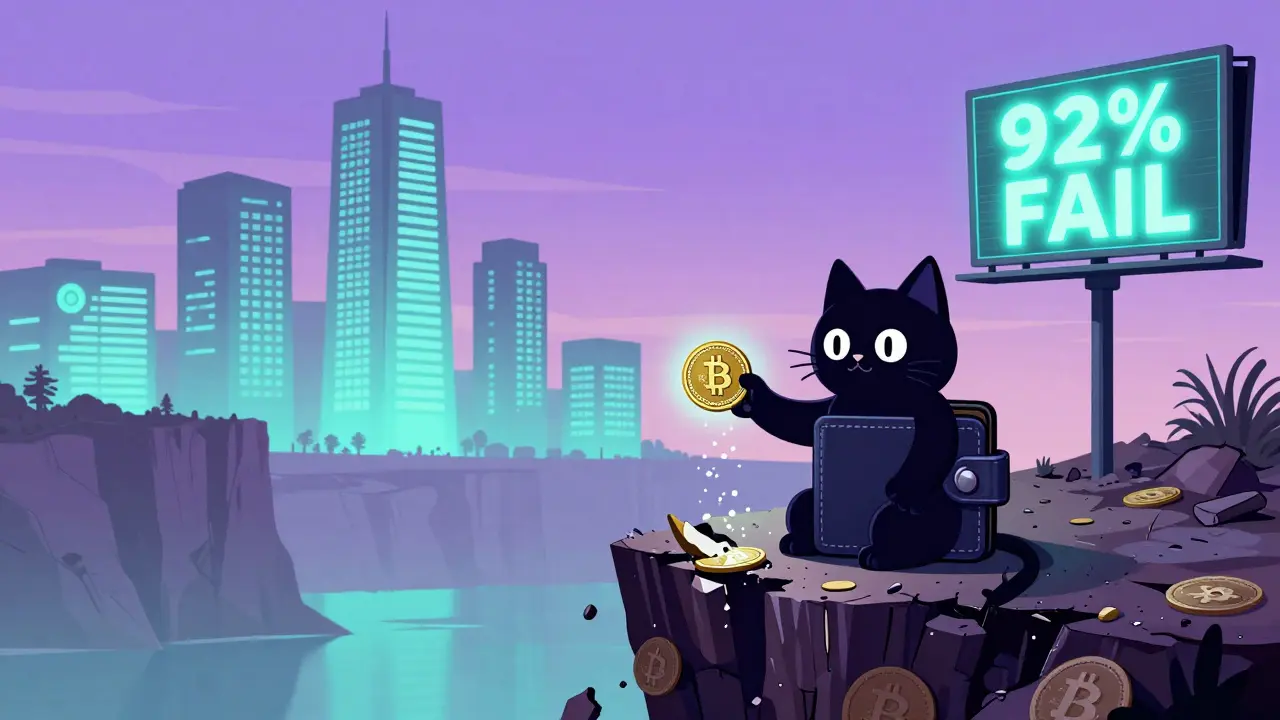
Chainalysis’s 2025 Meme Coin Report says 92% of similar tokens fail within 18 months. MEOW launched in March 2024. That puts it right in the danger zone. If it hasn’t grown by now, it never will. And when the last pump ends, the price will collapse to near zero - and stay there.
Can you make money from MeowCat?
Technically, yes. A few people have made small profits during short-term spikes. But that’s gambling, not investing. You’re not betting on value. You’re betting on someone else buying it for more - even if the coin has no reason to be worth anything.
Here’s the reality: if you put $100 into MEOW, you’re not building wealth. You’re risking it on a coin that could be worth $0 in 30 days. There’s no safety net. No customer support. No recourse. If you lose it, you lose it forever.
What you should do instead
If you want to invest in crypto, focus on projects with:
- Real teams with public identities
- Clear use cases (like DeFi, AI, or infrastructure)
- On-chain audits from reputable firms
- Trading volume over $10 million daily
- Listing on at least one major exchange
MeowCat has none of these. It’s not a bad investment because it’s risky. It’s a bad investment because it’s meaningless.
Final word
MeowCat (MEOW) is not a cryptocurrency you should hold. It’s not a long-term play. It’s not even a fun experiment. It’s a digital slot machine with no payout guarantee. The only thing it’s good for is teaching you how not to lose money in crypto.
If you’ve already bought MEOW, don’t chase it. Don’t hope for a comeback. If you can sell it for even 10 cents on the dollar, do it. Move on. There are better ways to learn crypto - and better ways to invest your money.
Is MeowCat (MEOW) a good investment?
No. MeowCat has no team, no utility, and extremely low liquidity. Its price swings wildly, and it’s at high risk of a rug pull. Most experts consider micro-cap meme coins like MEOW speculative gambling, not investing.
Where can I buy MeowCat (MEOW)?
MeowCat trades on decentralized exchanges like MEXC and through Binance’s Web3 Wallet. It’s not listed on major platforms like Coinbase or Kraken. Buying it requires connecting a wallet like MetaMask to a DEX - which adds complexity and risk for beginners.
Why is MeowCat’s price so different on different sites?
Because MEOW trades on multiple chains (Ethereum, BNB Chain, Avalanche) and low-volume exchanges. Some platforms inflate prices to make the coin look more valuable. The $0 trading volume on CoinMarketCap suggests most of these listings are artificial.
Can MeowCat reach $1 again?
It’s extremely unlikely. MEOW’s all-time high of $1.30 was a flash in the pan during a meme coin frenzy. With no development, no adoption, and only 10,450 holders, there’s no foundation for a sustainable price increase. Historical data shows 92% of similar tokens fail within 18 months.
Is MeowCat a scam?
It’s not officially labeled a scam, but it has all the warning signs: anonymous team, zero audit, low liquidity, inflated trading volume, and aggressive promotion by small exchanges. These are classic indicators of a high-risk token that could disappear overnight.
What should I do if I already own MeowCat?
Don’t hold it hoping for a rebound. If you can sell even a small portion for a fraction of what you paid, do it. Keep your losses small. Use the experience to learn how to spot risky tokens - look for teams, audits, and real trading volume before buying anything in the future.
Kelly Post
January 16, 2026 AT 21:02MeowCat isn't just a bad investment-it's a warning label wrapped in a cat meme. I've seen this script play out a dozen times: flashy ad, fake volume, then silence. The fact that even the trading numbers don't agree across platforms tells you everything. No team. No audit. No future. If you're reading this and still holding, you're not investing-you're waiting for a ghost to pay you back.
Don't chase it. Don't rationalize it. Just cut your losses and move on. There are real projects out there that need your attention, not this digital glitter bomb.
Tony Loneman
January 17, 2026 AT 07:00Oh please, here we go again with the ‘it’s a scam’ lecture. You guys act like crypto is some regulated bank account. It’s not. It’s the wild west. MEOW’s down? Cool. So was Doge in 2018. The fact that you’re this uptight about a fucking meme coin means you’ve never had a real win. I bought MEOW at $0.00003 and sold half at $0.00018. That’s 500% in two weeks. You call that gambling? I call it capitalism with extra steps.
And yeah, the volume’s low-because the whales are hoarding. Wait till the next influencer drops a ‘MEOW TO THE MOON’ video. Then watch the chaos. You’ll be crying while I’m buying more.
Alexis Dummar
January 18, 2026 AT 19:35Look, I get why people are scared of MEOW. It looks like every other rug pull. But here’s the weird thing-what if it’s not meant to be serious? What if it’s just a joke that got too big? Like, imagine if someone made a meme coin just to see if they could get 10k people to trade it for fun. No greed. No scam. Just chaos as art.
Doesn’t change the fact that it’s risky as hell. But maybe we’re missing the point. We treat crypto like it’s supposed to be rational, but half of it is internet culture dressed in blockchain. MEOW’s not a company. It’s a viral moment. And moments don’t last. But that doesn’t mean they’re not real while they’re happening.
Also, I think CoinMarketCap’s data is just lagging. I’ve seen the contract on Etherscan and the tokens are moving. Just not on the big exchanges. Maybe that’s the whole point-decentralized chaos, not centralized hype.
kristina tina
January 19, 2026 AT 03:33I just want to say thank you for this post. I lost $800 on MEOW last month. I thought I was being clever-buying low, riding the wave. But I didn’t check the liquidity. I didn’t read the contract. I just saw a chart going up and my brain turned into a slot machine.
I’m not mad at the coin. I’m mad at myself. I let FOMO do the thinking. This is why I’m now reading whitepapers. Why I’m checking audits. Why I’m only putting 5% of my portfolio into anything without a team. MEOW didn’t scam me-I let myself be scammed. And I’m not letting it happen again.
If you’re new to crypto, please learn from my dumbass mistake. You’re not a genius for buying the next meme coin. You’re just another target.
Haley Hebert
January 20, 2026 AT 01:36I know this sounds silly but I actually kinda like MEOW? Not as an investment, obviously. But as a symbol? Like, it’s the internet’s way of saying ‘we’re all just playing pretend with money now.’ There’s something oddly beautiful about a cat token that no one understands but 10,000 people still trade because it makes them feel like they’re part of something.
I don’t own any. I’m not dumb. But I follow the price just to see if it’ll ever hit $0.0003 again. It’s like watching a car crash in slow motion-you know you shouldn’t look, but you can’t look away. Maybe that’s the real value. Not the coin. The story.
And honestly? I think it’s kind of poetic. A cat. A meme. A blockchain. Zero utility. And still, people care. Isn’t that kind of amazing? In a tragic, dumpster-fire kind of way?
Hailey Bug
January 20, 2026 AT 03:30Just wanted to clarify one thing: the Avalanche version of MEOW isn’t a copy-it’s a bridge. Some projects deploy on multiple chains to reach different user bases. Doesn’t make it legit, but it’s not necessarily a scam tactic either. The real red flag is the lack of a liquidity lock. No one’s locking the LP. That means the devs can pull the plug anytime.
Also, if you’re thinking of buying, use a DEX aggregator like 1inch or ParaSwap. Don’t just go to MEXC. You’ll get slippage and fake prices. And always check the contract on Etherscan before sending a dime.
And no, I don’t own any. Just hate seeing people get burned because they didn’t check the basics.
Rod Petrik
January 21, 2026 AT 22:44They’re all lying. The whole thing is a psyop. MEOW isn’t even real. The contract was deployed by a shell company linked to a dark web marketplace that got shut down last year. The ‘10k holders’? Mostly bots. The price spikes? AI-generated trades from a single wallet that owns 40% of the supply. The ‘community’? Paid shills from a Telegram bot farm in Manila.
They’re using this to launder crypto from ransomware payments. That’s why no big exchange touches it. That’s why the volume is fake. That’s why the charts look like a seizure.
They’re not trying to make money off you. They’re trying to clean dirty money through your wallet. And you’re handing it to them like a gift.
Don’t buy MEOW. Don’t even look at it. Your wallet is already compromised if you’ve visited any of the sites promoting it. Change your seed phrase. Now.
Liza Tait-Bailey
January 23, 2026 AT 20:44Okay I just want to say I read the whole thing and I’m so glad someone finally laid this out. I’ve been lurking in MEOW threads for months and everyone’s either hyping it or crying about losing money. No one ever just says what it is. It’s a meme. A glitch. A digital ghost.
I used to think crypto was about tech. Now I think it’s about stories. MEOW’s story is ‘I bought a cat coin and lost my rent money.’ And that’s fine if you know it’s a story. But if you think it’s a business? You’re already in the ending.
Just… be gentle with yourself. If you lost money, it’s not your fault. The system’s rigged. But now you know. And that’s more than most people ever learn.
Send love to the people still holding. They’re not stupid. They’re just hoping. And hope’s not a crime. Just a dangerous currency.