
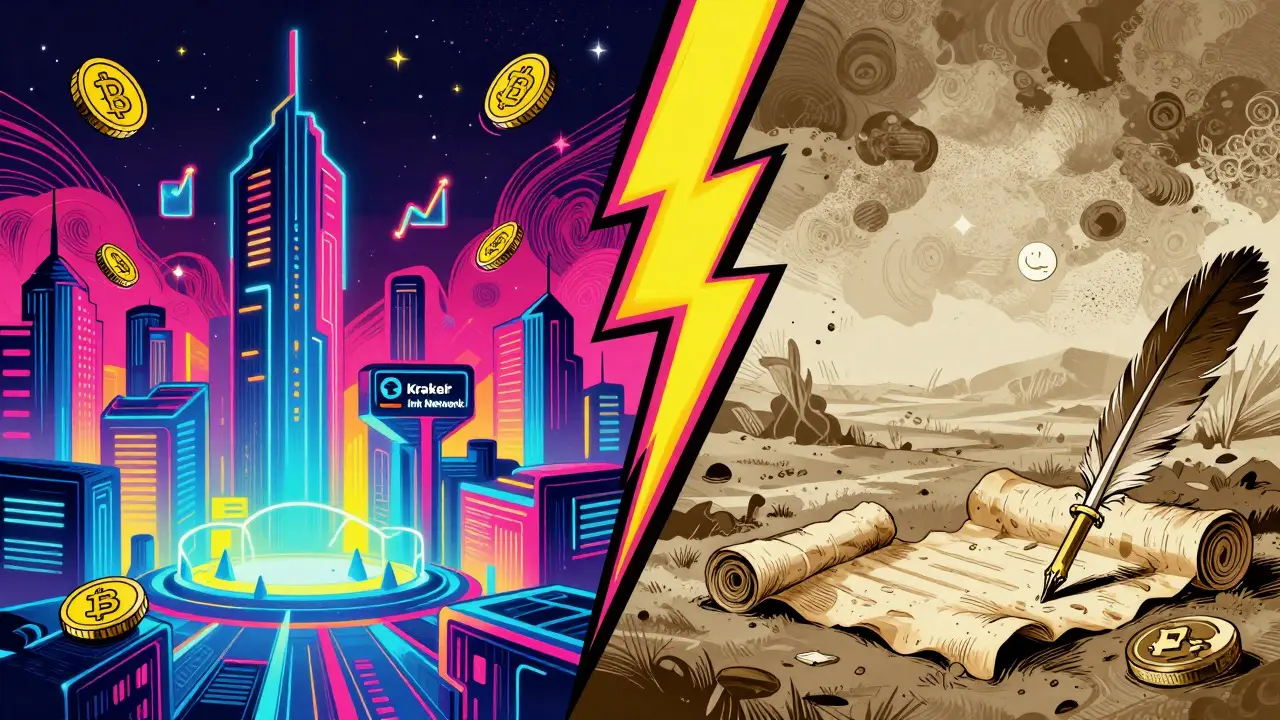
There is a major mix-up happening right now in the crypto world involving the ticker INK. If you are looking at price charts or reading news about "Ink," you might be looking at two completely different projects that share the same name and symbol. One is a brand-new, high-speed blockchain built by the giant exchange Kraken. The other is an older, largely inactive project focused on creative industries. Confusing the two could cost you money or lead to wasted time.
To navigate this, we need to separate these two entities immediately. This guide breaks down exactly what each one is, how they work, and which one actually matters for your portfolio today.
The Two Faces of INK: A Critical Distinction
Before diving into specs, let’s clear the air. When people talk about Ink (INK), they are usually referring to one of two things:
- Ink Network (Kraken’s Project): A modern Ethereum Layer-2 blockchain designed for decentralized finance (DeFi). It uses the INK utility token but relies on ETH for gas fees. This is the active, growing project backed by major industry players.
- Legacy Ink (Creative Industry Token): An older token from the mid-2010s aimed at content creators and intellectual property rights. It has very low trading volume and limited adoption today.
If you see a price chart showing a market cap of only $13,000, you are looking at the legacy token. If you see discussions about "Superchain," "Aave," or "Kraken," you are looking at the new Ink Network. Always check the contract address before buying.
Deep Dive: Kraken’s Ink Network
Ink Network is an Ethereum Layer-2 scaling solution incubated by Kraken, the major cryptocurrency exchange with over 10 million users. Launched on the Ethereum mainnet in December 2024, Ink was created with a specific mission: to become the "house of DeFi for the Superchain."
Kraken didn’t just build another generic chain. They built Ink to bridge the gap between centralized exchanges (CEXs) and decentralized finance. Most retail users find DeFi confusing and slow. Ink aims to fix that by offering speeds and costs similar to traditional exchanges but with the transparency and control of blockchain technology.
Technology Stack: Built on Optimism
Ink runs on Optimism’s OP Stack. This is a modular framework that allows developers to create optimistic rollups-chains that batch transactions off-chain and post data to Ethereum for security. By using the OP Stack, Ink becomes part of the Optimism Superchain, a network of interconnected blockchains that can communicate seamlessly.
This architecture brings several concrete benefits:
- EVM Compatibility: Developers can use standard Ethereum tools like Solidity and Hardhat. No need to learn a new programming language.
- High Speed: Block times are approximately one second. Transactions feel instant.
- Low Costs: Transaction fees are typically below $0.01. This makes micro-trades and frequent interactions viable.
- Shared Security: As part of the Superchain, it inherits robust security assumptions from the broader Optimism ecosystem.
Crucially, Ink uses ETH as its gas token, not INK. This means you pay for transaction fees in Ethereum, keeping the cost structure stable and familiar to existing crypto users.
The INK Utility Token
So, if ETH pays for gas, what does the INK token do?
Launched in mid-June 2025 by the independent Ink Foundation, the INK token is a pure utility asset with a fixed supply of 1 billion tokens. There is no inflation, no minting, and no governance power over the L2 protocol itself. Instead, INK is used to incentivize participation in on-chain capital markets.
The distribution model was unique: 100% of the supply was allocated via airdrops to early protocol users. This "liquidity-first" approach rewards those who provide liquidity and use the network, rather than rewarding venture capitalists or team members upfront. You earn INK by interacting with protocols like Tydro, an Aave-powered lending platform built specifically on Ink.
Understanding the Legacy Ink Token
Now, let’s look at the other fish in the pond. The legacy Ink (INK) creative-industry token predates Kraken’s project by years. It was designed to solve fragmentation in the global creative industry, aiming to manage intellectual property rights and facilitate cultural asset transactions across different legal jurisdictions.
Technologically, it is ambiguous. Some sources claim it sits on the Qtum blockchain, while others mention an ERC-20 version on Ethereum. Regardless of the underlying tech, its current market status tells a stark story.
As of mid-2026, the legacy INK token has a total supply of 1 billion, with roughly 463 million in circulation. However, its market cap hovers around $13,000, and daily trading volume is often less than $5,000. It trades on only a handful of smaller exchanges. For most investors, this token represents a high-risk, low-liquidity asset with minimal real-world adoption compared to its ambitious early promises.
Comparison: Ink Network vs. Legacy Ink
| Feature | Ink Network (Kraken) | Legacy Ink (Creative) |
|---|---|---|
| Primary Focus | Decentralized Finance (DeFi), Trading, Lending | Creative Industries, IP Rights, Content Monetization |
| Blockchain Type | Ethereum Layer-2 (OP Stack) | Consortium/Public Chain (Qtum/Ethereum hybrid) |
| Gas Token | ETH | N/A (Native chain mechanics) |
| Token Supply | 1 Billion (Fixed) | 1 Billion (Fixed) |
| Backer | Kraken Exchange / Ink Foundation | Independent / Early-stage consortium |
| Market Status (2026) | Growing TVL, Active DeFi Ecosystem | Micro-cap, Low Volume, Niche Adoption |
Why Ink Network Matters for DeFi
The rise of Ink Network isn’t just about another layer-2 chain; it’s about accessibility. Kraken’s goal is to onboard its 10+ million users into DeFi without the friction that usually keeps them out. Friction includes high gas fees, complex wallet setups, and slow transaction confirmations.
Ink addresses this by integrating deeply with established protocols. For example, the launch of Tydro, an Aave-based liquidity protocol, allows users to lend and borrow assets directly on the chain. The unified margin system lets traders combine spot and perpetual futures positions, managing risk more efficiently than on fragmented platforms.
For developers, the appeal is clear. You get the security of Ethereum, the interoperability of the Superchain, and a built-in user base from Kraken. Tools like Thirdweb and Gem Wallet already support Ink, making integration straightforward.
Risks and Considerations
No investment is without risk. Here is what you need to watch out for:
- Data Confusion: Aggregators like CoinGecko or CoinMarketCap sometimes mix up the two INK tokens. Always verify the contract address. The Kraken Ink token is distinct from the legacy creative token.
- Liquidity Risk: While Ink Network is growing, it is still newer than giants like Arbitrum or Base. Liquidity depths in some pools may be shallow during volatile market conditions.
- Smart Contract Risk: Like all DeFi protocols, Ink relies on smart contracts. Bugs or exploits in protocols like Tydro could impact funds. Always use audited platforms.
- Regulatory Uncertainty: As Kraken is a regulated entity, future regulations on CEX-L2 integrations could impact how Ink operates or who can access it.
How to Get Started with Ink Network
If you want to participate in the Ink ecosystem, here is a practical step-by-step guide:
- Set Up a Compatible Wallet: Use a wallet that supports the Optimism Superchain, such as MetaMask, Rabby, or Gem Wallet. Ensure you add the Ink Network RPC details if not automatically detected.
- Bridge Assets: Since Ink uses ETH for gas, you will need to bridge ETH from Ethereum mainnet or another L2 to Ink. Use official bridges or trusted aggregators like Orbiter or Synapse.
- Explore DeFi Protocols: Visit platforms like Tydro to understand how lending works. Start small. Deposit a balanced pair (e.g., USDT and ETH) to provide liquidity and potentially earn INK rewards.
- Verify Token Contracts: Before swapping or staking INK, double-check the contract address on official Ink documentation or the Ink Foundation website. Do not trust random links from social media.
Final Thoughts
The name "Ink" currently belongs to two very different stories. The legacy creative token is a relic of early blockchain experiments, offering little utility today. In contrast, Kraken’s Ink Network is a dynamic, fast-growing Layer-2 solution poised to change how millions interact with DeFi. By understanding the distinction, leveraging the speed of the OP Stack, and verifying your tokens, you can safely navigate this emerging ecosystem.
Is Ink Network the same as the old Ink creative token?
No, they are completely different projects. Ink Network is a new Ethereum Layer-2 built by Kraken for DeFi. The legacy Ink token is an older project focused on creative industries with very low market activity. Always check the contract address to avoid confusion.
Do I need INK tokens to pay for gas on Ink Network?
No. Ink Network uses ETH (Ethereum) as its gas token. The INK token is a utility token used for incentives, rewards, and participation in DeFi protocols like Tydro, but it does not pay for transaction fees.
What is the total supply of the Kraken INK token?
The total supply of the INK utility token is fixed at 1 billion tokens. There is no inflation, and no new tokens can be minted. All tokens were distributed via airdrop to early users.
Is Ink Network safe to use?
Ink Network is built on the Optimism OP Stack, inheriting strong security models from Ethereum. However, like all DeFi platforms, it carries smart contract risks. Always use reputable wallets, verify contract addresses, and start with small amounts to test the waters.
Who governs Ink Network?
Ink Network is stewarded by the Ink Foundation, an independent nonprofit entity that emerged from Kraken. While Kraken incubated the project, the Foundation handles high-level strategy and token issuance. The INK token itself does not have governance rights over the L2 protocol.
Rod Sidoroff
August 14, 2026 AT 12:26You are all missing the forest for the trees. The fact that Kraken is using ETH for gas while issuing a separate utility token with zero governance rights is not innovation, it is lazy architecture designed to keep retail users confused and compliant. Real decentralization requires sovereignty, not just another L2 wrapper that inherits security from Optimism while hoarding value in a fixed supply token that does nothing but sit there. It is a classic case of centralization masquerading as DeFi accessibility.
Niall O'Rourke
August 14, 2026 AT 13:58i mean sure rod you can call it lazy but isnt that just how crypto works now everything is an l2 and nobody actually reads the whitepapers anyway so why pretend like we care about sovereignty when we just want cheap trades
Jade Brown
August 16, 2026 AT 12:29Oh honey, please. You think this is about sovereignty? This is about liquidity capture. The INK token is a carrot on a stick for the Tydro lending protocol. It’s a brilliant, if somewhat cynical, mechanism to bootstrap TVL without diluting the core infrastructure. Most of you are looking at the tech stack and ignoring the economic incentives driving the user behavior. It’s a beautiful little trap, really, and I’m here for it because the yields on those early airdrop positions were absolutely stellar before the market corrected.
Jillian Groskreutz
August 17, 2026 AT 18:59Stop pretending this is some grand philosophical debate about decentralization! It is a product! Kraken built a fast chain for their users, they issued a token to reward usage, and they kept the gas in ETH to reduce friction! If you cannot understand the basic utility of a non-governance token in a high-throughput L2 environment, you probably should not be investing your life savings in speculative assets! Wake up!
Leah Humphrey
August 18, 2026 AT 12:40The OP Stack implementation is standard fare, but the integration with Aave via Tydro is interesting from a technical standpoint. However, relying on a single major exchange for initial liquidity depth creates a single point of failure that contradicts the ethos of decentralized finance. The legacy Ink token is dead weight, obviously, but confusing the two suggests aggregators are still failing at basic data hygiene.
Jennifer Ulmer
August 20, 2026 AT 01:23I think we need to look at this more broadly. Is the goal of DeFi to be purely decentralized or to be accessible? If Kraken can bring 10 million users into the ecosystem even if it is through a centralized gateway then perhaps that is a necessary step. The old Ink token was a dream that died. This new one is a machine that works. Maybe that is enough for now.
Carmene Jackson
August 21, 2026 AT 13:39I just feel so tired reading all this technical jargon. Nobody cares about the OP Stack or whatever. I just want to know if my money is safe. And honestly, seeing that the legacy token has a market cap of $13,000 makes me laugh. It feels like everyone is chasing the shiny new object while forgetting that half these projects will vanish in six months. It is exhausting.
Teri W
August 22, 2026 AT 01:39This entire situation is morally bankrupt. We have a giant exchange creating a token that confuses people who might accidentally buy the worthless legacy version. Where is the consumer protection? Where is the honesty? It is predatory design disguised as innovation. People lose money because of this ambiguity and the community just cheers for the next big thing. It is shameful.
Jay Johhnston
August 23, 2026 AT 02:54It is a valid concern regarding the confusion between the two tokens. In many markets, branding clarity is essential for trust. Perhaps the Ink Foundation could collaborate with aggregators to ensure distinct labeling. From a cultural perspective, the shift from creative IP to financial infrastructure reflects the broader evolution of blockchain technology. It is pragmatic, if less romantic.