
There’s no official record of an airdrop called The Recharge Incentive Drop. No project website, no whitepaper, no verified Twitter account, no mention on CoinGecko, CoinMarketCap, or even niche airdrop trackers like AirdropAlert or Earnifi. If you’ve seen this name pop up in a Discord server, Telegram group, or YouTube video, you’re not alone-but you’re also likely being shown something that doesn’t exist.
Crypto airdrops aren’t magic. They’re carefully planned marketing tools used by real blockchain teams to grow adoption. Legitimate airdrops have public documentation, clear rules, and verifiable histories. The Recharge Incentive Drop has none of that. And that’s the biggest red flag.
How Legitimate Airdrops Work
Real airdrops follow a pattern. Take Uniswap in 2020: they gave away 400 UNI tokens to anyone who had traded on their platform before September 1, 2020. The snapshot was public. The distribution was on-chain. The tokens were listed on major exchanges. People didn’t have to send crypto to claim them-they just got them in their wallets.
Or look at ENS. They airdropped .ETH domain names to users who had registered them before a certain date. No sign-up form. No wallet deposit. Just a claim link that worked because the blockchain recorded who owned what.
These projects didn’t need to trick people. They built real products first, then rewarded users who helped them grow. That’s the standard.
What You’ll See With “The Recharge Incentive Drop”
If someone’s pushing this airdrop, here’s what’s probably happening:
- You’re told to connect your wallet to a website that looks official-maybe even uses the same logo as a real project.
- You’re asked to complete tasks: follow a Twitter account, join a Telegram group, or share a post.
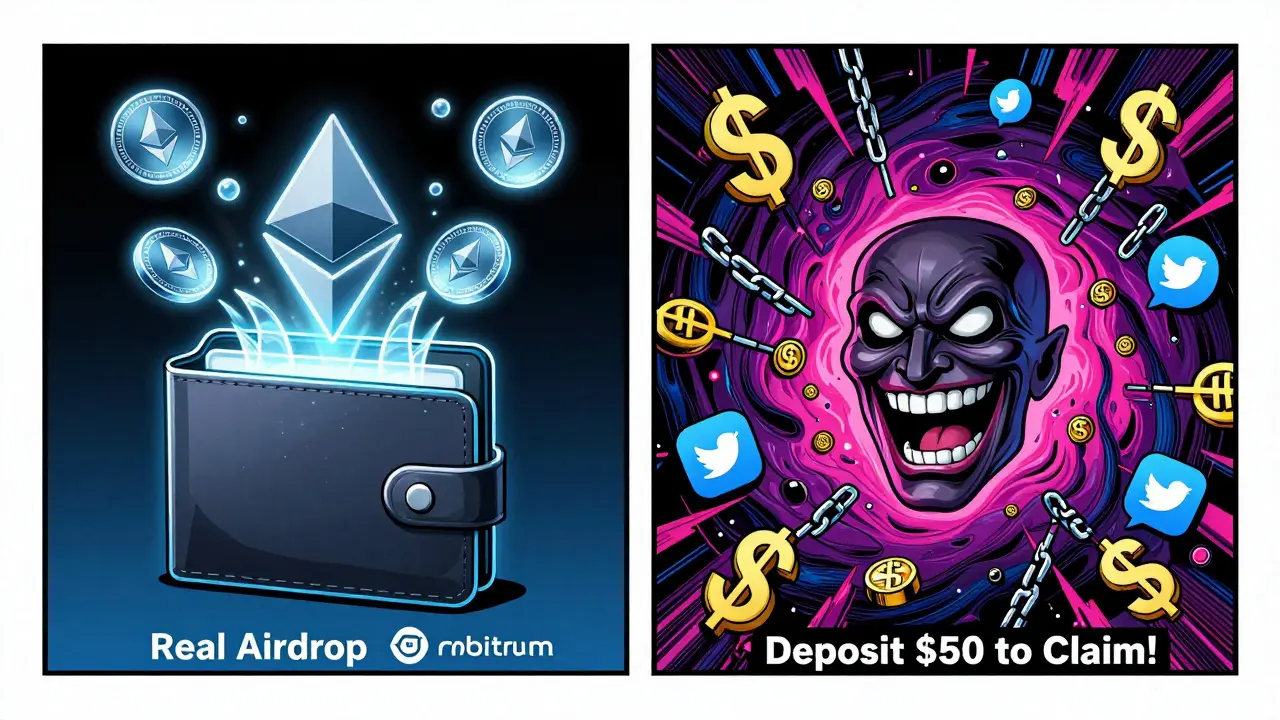
- Then comes the ask: “Deposit $50 worth of ETH or USDT to unlock your airdrop.”
- Or worse: “Send your tokens to this address and we’ll send back double.”
That’s not an airdrop. That’s a classic pump-and-dump trap. The “incentive” isn’t free tokens-it’s your money.
Why “Unknown Details” Is a Warning Sign
Legitimate projects don’t hide their terms. They publish them in plain text. They explain:
- Which wallet addresses qualify
- What tasks are required
- When the snapshot happens
- How many tokens will be distributed
- When and where tokens will be listed
If the only info you have is “The Recharge Incentive Drop airdrop by Unknown details,” you’re being sold a ghost. There’s no team, no roadmap, no history. It’s a name with no substance.
Real Airdrops Have Track Records
Let’s look at what real airdrops look like:
- Arbitrum airdropped ARB in 2021 to early users of its network. The distribution was transparent. You could check your eligibility on their official site using your wallet address.
- zkSync gave away ZK tokens to users who transacted on their testnet. The rules were posted on GitHub. The code was open. People could verify everything.
- Solana has given out dozens of airdrops to wallet holders who used DeFi apps on its network. Each one had a snapshot date, a public list of eligible addresses, and a clear claim process.
None of these required you to send crypto first. None of them asked for private keys. None of them used vague names like “Recharge Incentive Drop.”
How to Spot a Fake Airdrop
Here’s a quick checklist:
- Does it ask you to send funds? If yes, walk away.
- Is there a real website? Check the domain. Is it .eth? .xyz? Or a random .info or .site? Legit projects use clean domains.
- Can you verify the team? Look for LinkedIn profiles, GitHub commits, or past projects. If everyone’s anonymous, that’s not a startup-it’s a shell.
- Is there a token contract? Go to Etherscan or Solana Explorer. Search for the token name. If it’s not listed, or if it was created yesterday, it’s fake.
- Are there community discussions? Check Reddit, Twitter, or Discord. If no one else is talking about it, or if all the posts are from new accounts, that’s a sign.
What to Do Instead
If you want to find real airdrops, here’s what works:
- Use AirdropAlert or CoinMarketCap’s Airdrop Page. They list only verified opportunities.
- Follow projects on official Twitter and Discord. Don’t join random groups.
- Use testnets. Projects like Sui, Aptos, and Polygon zkEVM give out tokens to users who test their networks. You don’t need money-just a wallet and curiosity.
- Hold ETH, SOL, or other major coins. Many airdrops go to holders of top-tier assets.
The best airdrops don’t come from ads. They come from being active in real ecosystems.
Why This Keeps Happening
Scammers target airdrops because they’re easy. People hear “free money” and forget to check the source. In 2024, over $200 million was lost to fake airdrop scams, according to blockchain forensics firm Chainalysis. Most victims were new to crypto.
The name “The Recharge Incentive Drop” sounds technical. It uses words like “recharge” and “incentive” to sound like a real protocol. But that’s the trick. It’s designed to look smart, not to be smart.
There’s no such thing as an airdrop with “unknown details.” If you can’t find the rules, you can’t trust it.
Bottom Line
Don’t participate in The Recharge Incentive Drop. It doesn’t exist. Any site or person promoting it is trying to steal your crypto. Save your money. Save your keys. Walk away.
Real airdrops don’t need hype. They don’t need secret codes. They don’t need you to send them funds. They just need you to be part of the network-and if you’re already using it, you’ll know when the tokens arrive.
Is The Recharge Incentive Drop a real airdrop?
No, there is no legitimate project called The Recharge Incentive Drop. No official website, contract, or team exists. All references to it are likely scams designed to trick users into sending crypto.
Why do fake airdrops use names like this?
Fake airdrops use vague, tech-sounding names to sound official. Words like “incentive,” “recharge,” or “drop” are common in real crypto projects, so scammers borrow them to create confusion. The goal is to make you ignore red flags because the name sounds plausible.
Can I get rich from airdrops?
Some people have made money from real airdrops-Uniswap, Arbitrum, and ENS early users saw huge returns. But these were rare. Most airdrops give small amounts of low-value tokens. Don’t expect to get rich. Focus on learning, not profit.
What should I do if I already sent funds?
If you sent crypto to a fake airdrop, the funds are almost certainly gone. Blockchains are irreversible. Don’t fall for “recovery services”-they’re also scams. Report the scam to your wallet provider and local authorities if possible. Learn from it and move on.
How can I find real airdrops?
Stick to trusted sources: CoinMarketCap Airdrops, AirdropAlert, or official project channels. Look for airdrops tied to well-known blockchains like Ethereum, Solana, or Polygon. Never trust a link sent in DMs or random Discord channels. Always verify the contract address on Etherscan or Solana Explorer before interacting.
If you’re new to crypto, the best strategy isn’t chasing free tokens-it’s learning how the network works. Use testnets. Try swapping tokens on decentralized exchanges. Interact with wallets. The real rewards come from understanding, not from clicking a link that says “recharge.”
Tanvi Atal
March 3, 2026 AT 10:12Alyssa Herndon
March 3, 2026 AT 16:54It's weird how people still click on "Recharge Incentive Drop" like it's a secret code. It's not. It's a trap with a fancy name.
Elana Vorspan
March 3, 2026 AT 23:02Keep it simple: if it asks for ETH to get ETH, run. 💨
Sony Sebastian
March 4, 2026 AT 02:41Brian Lemke
March 4, 2026 AT 14:28Megan Lavery
March 5, 2026 AT 16:09Lesson learned: if it’s not on CoinMarketCap, it’s not real.
Mae Young
March 5, 2026 AT 17:25It’s not a scam. It’s performance art. And we’re all the unwilling audience.
Trenton White
March 7, 2026 AT 02:26Cheryl Fenner Brown
March 7, 2026 AT 18:08Arya Dev
March 9, 2026 AT 17:49