
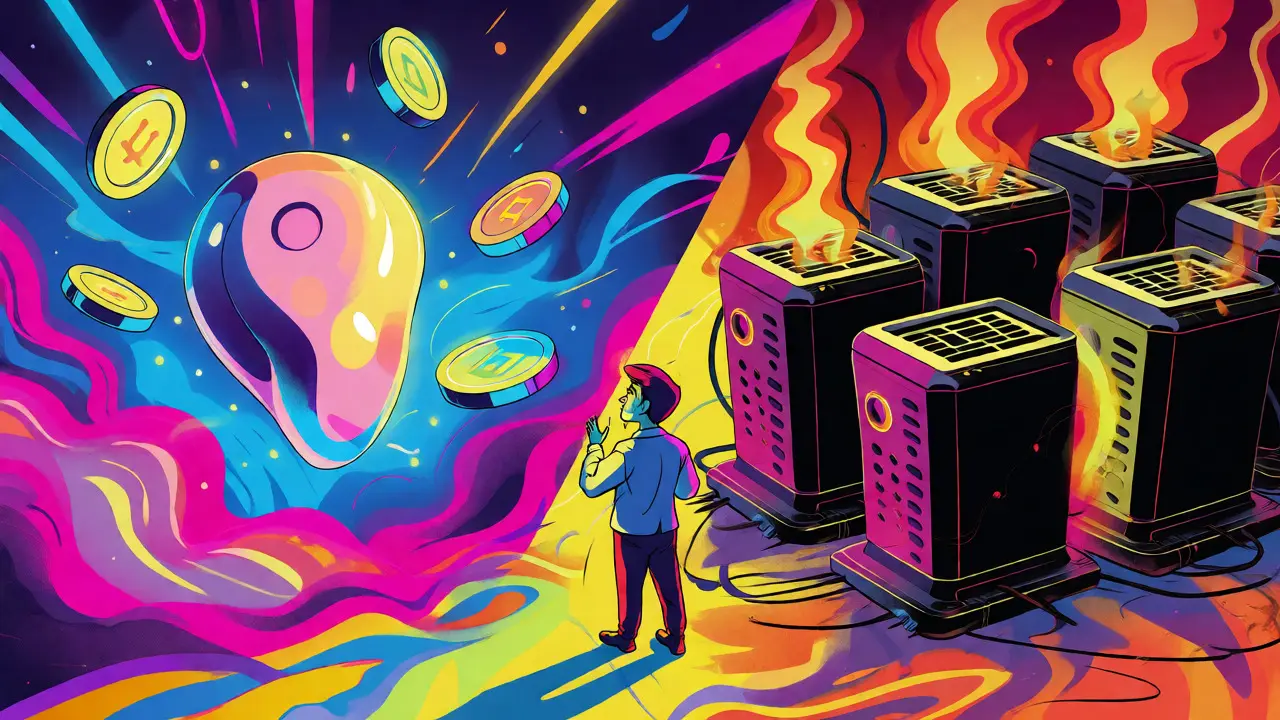
You stare at your screen, wondering where to put your next $10,000. Do you buy a loud, hot machine that eats electricity for breakfast? Or do you lock up some coins and let the network pay you interest? The choice between staking and mining isn't just about tech specs anymore. It's about risk, capital, and whether you want a hobby or a business.
In 2026, the landscape has shifted hard. Ethereum’s move to Proof-of-Stake back in 2022 wasn't just a tech update; it was a signal. Now, most new blockchains use staking. Mining is still alive, mostly on Bitcoin, but it’s become an industrial game. If you’re an individual investor, the math has changed. Let’s break down who wins when you look at the actual numbers, not just the hype.
The Core Difference: Hardware vs. Capital
Mining is physical. You need specialized hardware, like ASICs for Bitcoin or GPUs for other coins, to solve complex puzzles. These machines burn power-lots of it. Your profit depends entirely on two things: how cheap your electricity is and how efficient your gear is. If the price of Bitcoin drops or the network difficulty spikes, your machine might cost more to run than it earns. It’s high stakes, literally.
Staking is digital. You lock up your existing cryptocurrency tokens in a wallet to help validate transactions. No fans, no heat, no noise. You’re essentially becoming a bank for the blockchain. In return, the protocol pays you rewards from transaction fees and new token issuance. The barrier to entry is low. You don’t need a garage full of equipment; you just need the coins and a stable internet connection.
| Feature | Staking (Proof-of-Stake) | Mining (Proof-of-Work) |
|---|---|---|
| Initial Cost | Cost of tokens + small gas fees | $10k-$100k+ for hardware + setup |
| Running Costs | Negligible (internet only) | High (electricity, cooling, maintenance) |
| Typical APR | 3% - 11% | 5% - 25% (highly volatile) |
| Risk Profile | Price volatility + slashing risks | Hardware obsolescence + energy costs |
| Effort Level | Low (set and forget) | High (monitoring, repairs, upgrades) |
Why Staking Dominates for Retail Investors
Let’s talk real numbers. As of late 2025 and early 2026, Ethereum staking yields hover around 3-6% annually. Sounds low compared to stock market averages? Maybe. But consider the effort. You can stake ETH through exchanges like Coinbase or Kraken with a few clicks. Or, if you have 32 ETH (roughly $70k-$90k depending on the market), you can solo stake. The returns are predictable. They don’t crash because a fan broke or your electric bill doubled.
Smaller networks offer higher yields. Networks like Solana or Polkadot often provide 7-11% APR. Why? Because they are newer and need more security incentives. But here’s the catch: these coins are more volatile. A 10% yield means nothing if the token price drops 20%. Still, for many, this is the preferred path. It’s passive income in the truest sense. You sleep well while your assets earn.
Accessibility is the killer feature. You don’t need a degree in electrical engineering. You don’t need to understand hash rates or nonces. You need a digital wallet and basic caution. Most beginners can set up a staking position in under an hour. Compare that to mining, where you spend weeks researching ASIC efficiency ratings and negotiating local utility rates.
The Mining Reality Check
Mining isn’t dead, but it’s not for everyone. If you live in a region with subsidized renewable energy-like parts of Texas or Scandinavia-you might still make money. Industrial miners like Marathon Digital and Riot Blockchain thrive because they have scale. They negotiate bulk electricity deals that you can’t get as a home miner.
For individuals, the margins are razor-thin. A typical home mining rig might generate 5-10% APR after expenses. But that number is fragile. One bad month of weather affecting hydro-power prices, or one sudden spike in network difficulty, and you’re operating at a loss. Plus, hardware ages fast. An ASIC bought today might be obsolete in three years. You’re constantly racing against technology.
Cloud mining sounds appealing-renting hash power without owning the box-but be careful. Many platforms promising 100%+ returns are scams. Legitimate providers like ECOS offer modest, realistic returns. If a deal sounds too good to be true, it usually is. Stick to established names and read the fine print on contract lengths.

Risk Assessment: What Could Go Wrong?
Both methods carry risks, but they are different animals.
- Staking Risks: The biggest threat is "slashing." If your validator node goes offline or acts maliciously, the network penalizes you by taking a chunk of your staked funds. This is rare for casual users using major exchanges, but real for solo stakers. Also, liquidity is an issue. Some networks require you to lock tokens for days or weeks. If the market crashes during a lockup, you can’t sell until it ends.
- Mining Risks: Hardware failure is constant. Fans die, boards fry. Then there’s regulatory risk. Governments are cracking down on energy-intensive operations. If your city bans commercial mining rigs, your asset becomes scrap metal. Finally, obsolescence. When a new chip comes out, your old one loses value overnight.
From a portfolio perspective, staking offers better risk-adjusted returns for most people. It aligns with environmental trends, which matters more to institutional investors every year. Banks and ETFs prefer staking because it’s cleaner and easier to audit.
Which Should You Choose?
If you have less than $10,000 to invest, skip mining. The overhead will eat you alive. Buy some ETH, SOL, or ADA, and stake them. Use liquid staking protocols like Lido if you want flexibility. This lets you trade your staked tokens even while they earn rewards.
If you have $50,000+ and access to cheap power, mining might still work. Look into Bitcoin mining specifically, as it’s the most stable Proof-of-Work chain. Avoid altcoin mining unless you’re a speculator who enjoys the chaos. For everyone else, staking is the clear winner. It’s simpler, cheaper, and increasingly supported by regulators.
Hybrid strategies exist, too. Some sophisticated investors keep 80% of their crypto in staking for steady growth and allocate 20% to speculative mining setups during bull markets. This balances stability with upside potential. But for 90% of readers, pure staking is the smarter play in 2026.
Is staking safer than mining?
Generally, yes. Staking avoids the physical risks of hardware failure and the operational risks of rising electricity costs. However, staking introduces smart contract risks and potential penalties (slashing) if validators misbehave. For most retail investors, staking via reputable exchanges minimizes these technical risks significantly compared to managing a mining farm.
Can I mine Bitcoin by staking?
No. Bitcoin uses Proof-of-Work, which requires mining. You cannot stake Bitcoin directly on its native chain. To earn yield on BTC, you typically lend it out or participate in wrapped Bitcoin staking solutions on other chains, which adds counterparty risk.
What is the minimum amount needed for staking?
It varies. Solo staking on Ethereum requires 32 ETH. However, most users stake through exchanges or pools, where you can start with as little as $10 or $20. Liquid staking protocols also allow fractional staking with minimal barriers.
Are cloud mining contracts profitable?
Rarely for retail investors. After accounting for fees and electricity costs passed to you, profits are often negligible. Many contracts promise high returns but fail to deliver due to hidden costs or changing market conditions. Always calculate the break-even point before signing up.
How does taxes affect staking vs mining?
In many jurisdictions, both are taxed as ordinary income upon receipt. However, mining may involve additional deductions for equipment depreciation and electricity costs, which staking lacks. Consult a tax professional, as rules vary significantly by country and change frequently.