
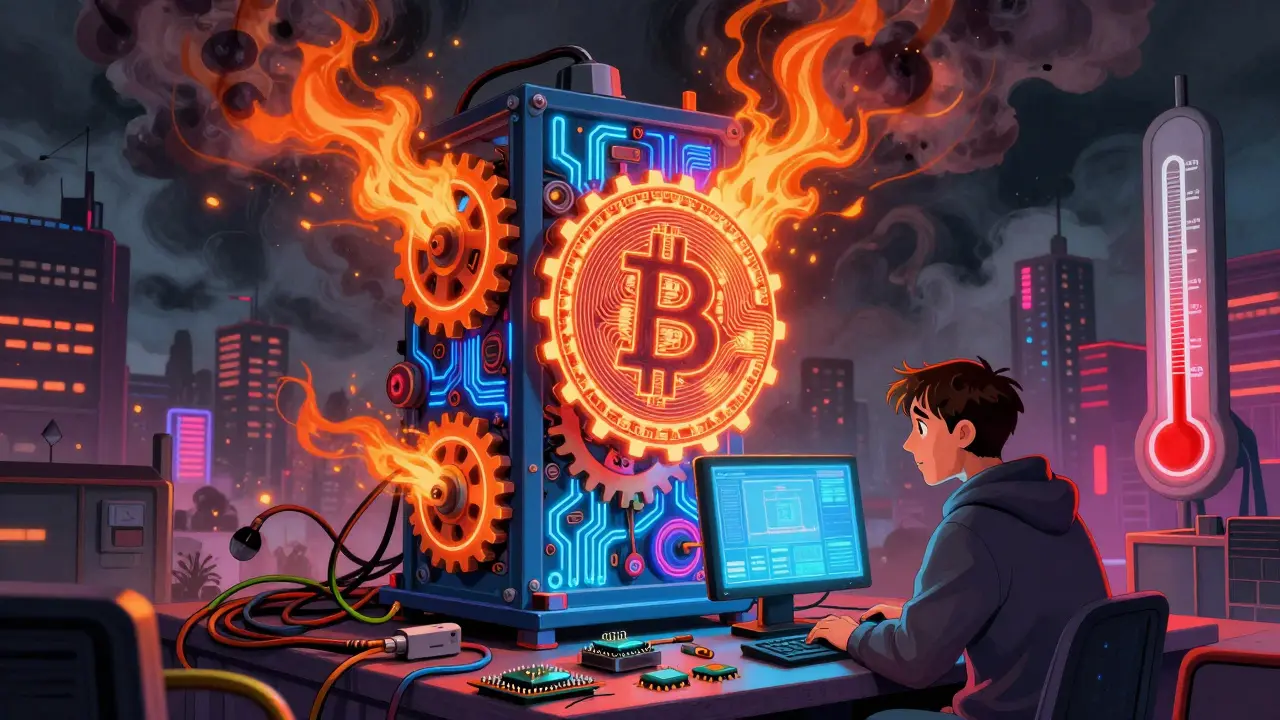
When you hear about blockchain security, two words keep popping up: staking and mining. They’re both ways to keep networks like Bitcoin and Ethereum running, but they work in completely different ways. One burns electricity like a furnace. The other just asks you to hold onto your coins. If you’ve ever wondered which one is better - or even which one you should be doing - here’s the real breakdown, no fluff, no hype.
How Mining Actually Works
Mining is the original method. It started with Bitcoin in 2009. The idea was simple: solve hard math problems to verify transactions, and get paid in Bitcoin for your effort. This is called proof-of-work (PoW). But don’t let the word "work" fool you. This isn’t typing or lifting weights. It’s brute-force computing.Miners use specialized hardware - usually ASICs (Application-Specific Integrated Circuits) - to guess the solution to these puzzles. The first one to get it right adds the next block to the chain and collects the reward. For Bitcoin, that’s currently 3.125 BTC per block (as of 2026). Sounds great, right? Except the competition is insane.
Bitcoin’s network difficulty hit 63.2 trillion in early 2023. That means your average home computer would take thousands of years to solve one puzzle. You need machines like the Bitmain Antminer S19 XP Hyd, which costs around $4,500 and uses 3,060 watts of power. That’s more than your entire home fridge, AC unit, and TV combined. And even then, you’re not guaranteed to win. Most miners join pools because going solo is like buying one lottery ticket in a drawing with millions of players.
Then there’s the electricity bill. To make mining profitable, you need power under $0.08 per kWh. In places like Texas or Iceland, where energy is cheap and renewable, mining farms thrive. But in most cities? You’re losing money. One Reddit user with a $9,200 GPU rig spent $1,800 on electricity over 18 months and only earned $6,400 in Bitcoin - after accounting for hardware depreciation, he was still down $4,600.
And hardware doesn’t last. ASICs lose 50-70% of their value within a year. When a new chip comes out, your old rig becomes a paperweight. Add in regulatory risks - China banned mining in 2021, and New York put a two-year freeze on PoW operations - and you’ve got a high-risk, high-effort business.
How Staking Changed Everything
Staking is the new kid on the block. It doesn’t need powerful machines. It doesn’t need massive power bills. It just needs you to lock up your cryptocurrency.This is called proof-of-stake (PoS). Instead of solving puzzles, you prove you’re committed by holding coins as collateral. The network picks validators based on how much you stake and how long you’ve held it. If you behave, you earn rewards. If you go offline or try to cheat, you lose part of your stake - a penalty called "slashing."
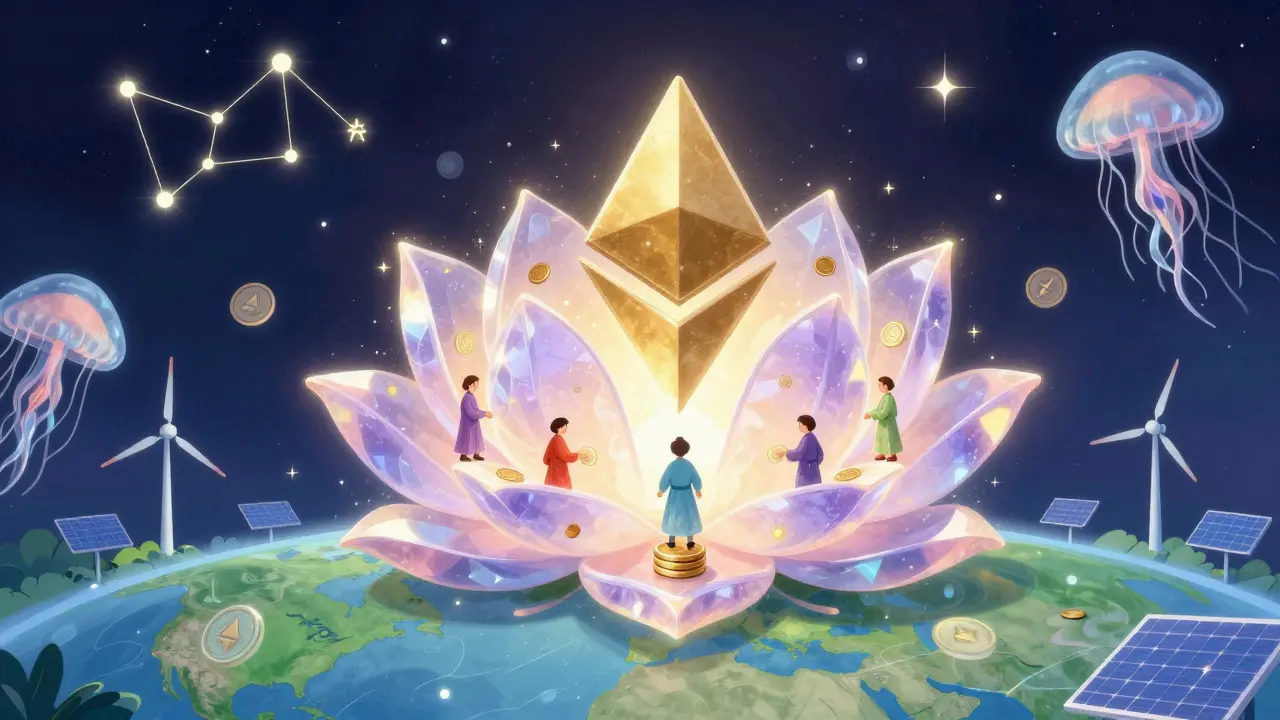
Ethereum’s shift from mining to staking in September 2022 - known as "The Merge" - was the turning point. Before, Ethereum used as much energy as Norway. After? It dropped by 99.95%. That’s not a typo. From 78.9 terawatt-hours per year to 0.0026. The entire network now runs on the power of a single household.
To become a solo validator on Ethereum, you need 32 ETH. At $1,840 per ETH in late 2023, that’s $58,880. Sounds expensive? It is. But here’s the twist: you don’t need to put up that much yourself. Platforms like Lido, Coinbase, and Kraken let you stake as little as $10. They pool your coins with others and give you a share of the rewards. You even get a token (like stETH) that represents your stake and can be traded or used in other DeFi apps.
What do you earn? Ethereum staking gives you roughly 3-4.2% APY. Solana offers 6-8%. Some liquid staking protocols like Marinade on Solana hit 10-12%. That’s better than most savings accounts. And you don’t need to touch a single wire. Just log in to your wallet, click "stake," and walk away.
Energy Use: The Biggest Difference
Let’s get real about environmental impact.Bitcoin mining alone used over 120 terawatt-hours in 2023. That’s more than Argentina or Norway. The Cambridge Bitcoin Electricity Consumption Index says it’s like running 13 million homes nonstop. And while 57% of that energy now comes from renewables - mostly hydro, wind, and flared gas - it’s still an enormous amount of power.
Ethereum? After staking took over, its energy use dropped to 0.0026 TWh/year. That’s less than a single data center. And it’s not just Ethereum. Cardano, Solana, Polkadot - all PoS networks - use about the same energy as your phone charger.
That’s why Gartner predicts 80% of new enterprise blockchains will use staking by 2025. Companies care about ESG scores. Investors don’t want to fund energy hogs. Even the EU’s MiCA regulation treats staking rewards as taxable income - but doesn’t touch PoW mining because it’s becoming too politically toxic.
Hardware and Entry Barriers
Mining requires a serious setup. You need:- ASIC or GPU rigs
- Proper cooling (fans, air conditioning, even liquid cooling)
- Reliable internet and a dedicated space
- Technical knowledge to configure pools and monitor performance
It’s not plug-and-play. CoinBureau estimates it takes 40-60 hours for a beginner to set up a profitable mining rig. And even then, profitability flips with Bitcoin’s price and electricity rates.
Staking? You can do it on a $50 Raspberry Pi 4. Or better yet - just use Coinbase. Open the app, click "Stake," deposit your ETH, and you’re done. No wiring. No noise. No overheating. Consensys says solo staking setup takes 5-10 hours. Exchange staking? Three minutes.
And the barrier isn’t just technical - it’s financial. Mining rigs cost $2,000 to $10,000. Staking? You can start with $10. That’s why Ethereum’s staked supply jumped from 0.5 million ETH in 2020 to over 25 million ETH by 2023. Retail users finally had a seat at the table.
Risks: What Can Go Wrong
Mining risks are obvious: hardware failure, power outages, falling prices, regulation. ASICs die. Electricity spikes. Governments shut you down. HashR8’s 2022 study found 37% of ASICs fail prematurely. Customer support? Often non-existent.Staking has its own dangers. Slashing penalties are real. In Q1 2023, Ethereum slashed 1,832 validators for downtime or misbehavior - totaling 1,737 ETH lost. Most of those weren’t hackers. They were regular people whose validator clients crashed or weren’t updated.
Then there’s centralization. Lido, Coinbase, and Kraken control 31.2% of all staked ETH. That’s a lot of power in three hands. Critics say this defeats the purpose of decentralization. And if one of them gets hacked or goes offline? You could lose access to your staked assets.
There’s also liquidity risk. Staked ETH is locked for months. Even if you request to withdraw, Ethereum’s exit queue had over 16,000 validators waiting in July 2023 - with a 15-day wait time. You can’t just sell your staked coins if the market crashes.
Who Wins? The Real Verdict
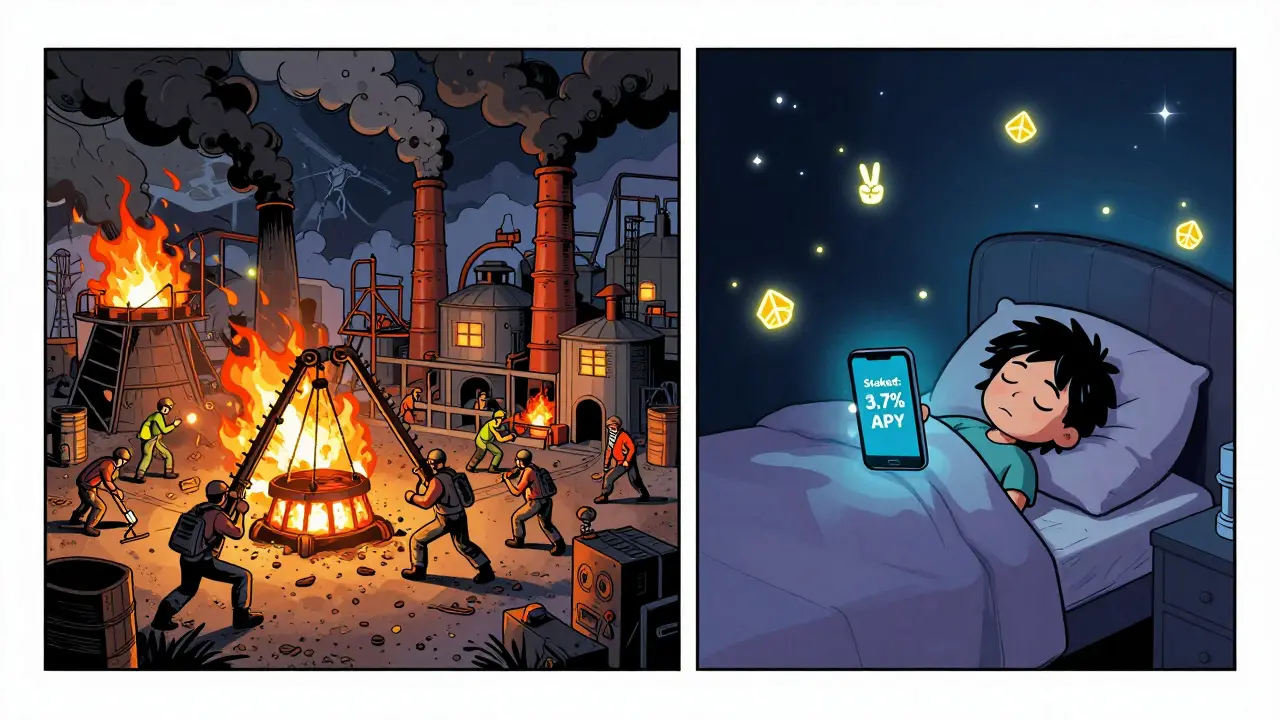
If you’re a tech enthusiast with $10,000 to burn on hardware and live where electricity is cheap? Mining might still make sense - if you’re in it for the long haul and enjoy tinkering.But for 95% of people? Staking wins.
It’s cheaper. It’s easier. It’s greener. You don’t need to be a computer engineer. You don’t need to buy a machine. You don’t need to worry about cooling or noise. You just hold your crypto, earn rewards, and sleep better knowing you’re not burning the planet.
And the trend is clear. Bitcoin mining is still alive - mostly because it’s the OG and has institutional backing. But new projects? Almost all of them use staking. Ethereum, Solana, Cardano, Polygon - they’re all PoS. Even Ripple and Algorand never used mining. The future isn’t loud, hot, and power-hungry. It’s quiet, digital, and efficient.
So if you’re asking yourself whether to mine or stake - the answer isn’t about which one pays more. It’s about which one fits your life. Most people don’t need a data center. They just need a wallet.
What’s Next?
Ethereum’s next upgrade, "The Surge," will allow up to a million validators - making staking even more decentralized. Meanwhile, Bitcoin miners are turning to excess wind and hydro power to stay viable. Liquid staking tokens like stETH and rsETH are becoming bridges between staking and DeFi, letting you earn yield while still using your assets.But the big shift isn’t just technical. It’s cultural. People are done with energy waste. They want blockchain that works without harming the planet. Staking delivers that. Mining? It’s becoming a relic - not because it’s broken, but because something better came along.
Is staking safer than mining?
Staking is safer in terms of environmental impact, cost, and accessibility. But it has its own risks: slashing penalties for downtime, centralization through large staking pools, and locked funds. Mining carries hardware depreciation, electricity cost volatility, and regulatory risks. Neither is "safe," but staking has fewer moving parts for average users.
Can I mine Ethereum anymore?
No. Ethereum fully switched to proof-of-stake in September 2022. Mining Ethereum is impossible now. Any service claiming to offer Ethereum mining is either outdated or a scam. If you’re still mining, you’re likely mining another coin like Bitcoin or Ravencoin.
How much do I need to start staking?
You need 32 ETH to run a solo validator on Ethereum - about $58,000 as of 2026. But most people use exchanges like Coinbase or platforms like Lido, where you can stake as little as $10. These services pool your ETH with others and give you a proportional share of rewards.
Which gives better returns: mining or staking?
Staking usually offers more predictable returns with lower risk. Ethereum staking yields 3-4.2% APY. Solana offers 6-8%. Mining returns fluctuate wildly based on Bitcoin’s price, electricity costs, and hardware efficiency. Most home miners lose money after accounting for depreciation and power. Only large-scale operations with cheap energy break even.
Is staking taxable?
Yes. In the EU, staking rewards are taxed as income when you receive them under MiCA regulations. In the U.S., the IRS treats staking rewards as taxable income at fair market value on the day you receive them. Always track your rewards and report them - whether you use an exchange or a solo validator.
Will mining disappear completely?
Not soon. Bitcoin, the largest PoW chain, still has over $10 billion in annual security spending from mining rewards. As long as Bitcoin remains dominant, mining will continue. But new blockchains are overwhelmingly choosing staking. Mining is becoming a niche, energy-intensive relic - not the future.
Pradip Solanki
March 22, 2026 AT 20:01Brad Zenner
March 24, 2026 AT 18:50Tony Phillips
March 25, 2026 AT 22:21Abhishek Thakur
March 26, 2026 AT 10:06Jackie Crusenberry
March 26, 2026 AT 13:40YANG YUE
March 28, 2026 AT 09:40Anna Lee
March 29, 2026 AT 17:16Shana Brown
March 31, 2026 AT 09:57Marie Mapilar
April 1, 2026 AT 09:32