
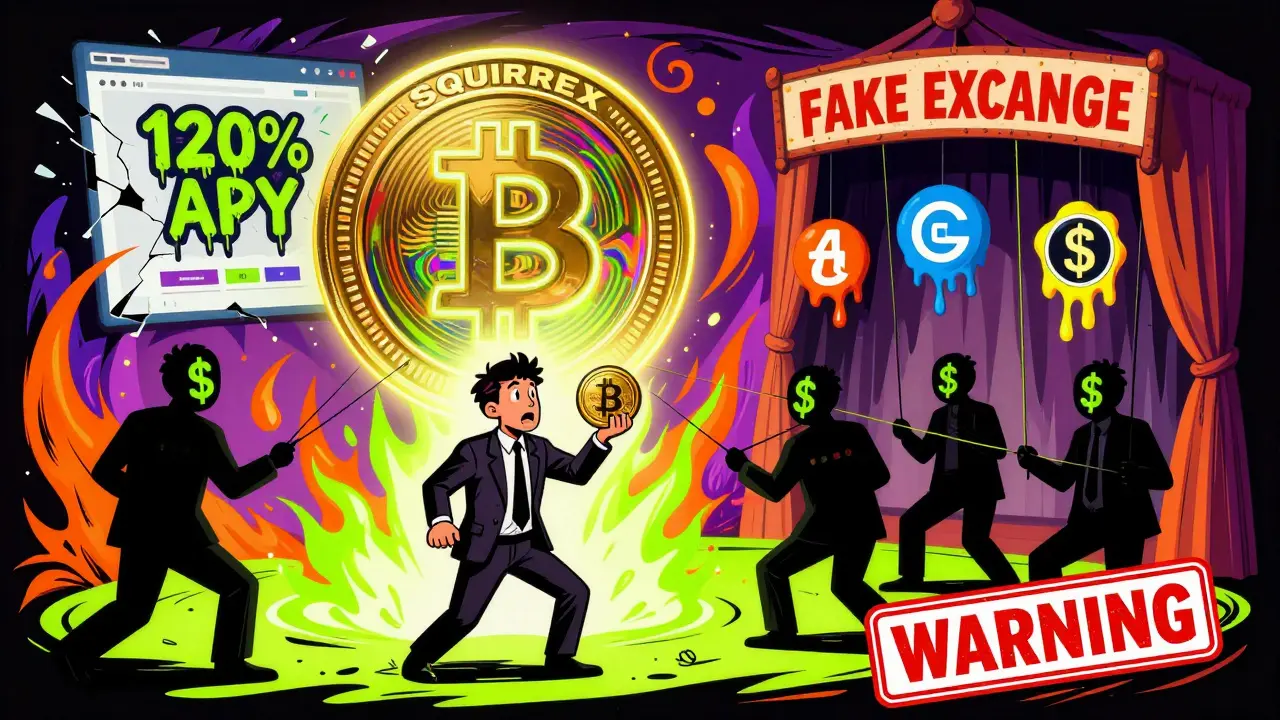
There is no such thing as a legitimate Squirrex Exchange. Not now. Not ever. If you’ve seen ads for it on social media, heard about it from a "friend" who "made bank," or stumbled across a website promising 120% APY on staking or zero trading fees - you’re being targeted by a sophisticated, dangerous scam. This isn’t a review of a flawed platform. This is a warning. Squirrex Exchange is a fraudulent operation that stole millions from real people, and it’s still out there in disguised forms.
It’s Not a Crypto Exchange - It’s a Pig Butchering Scam
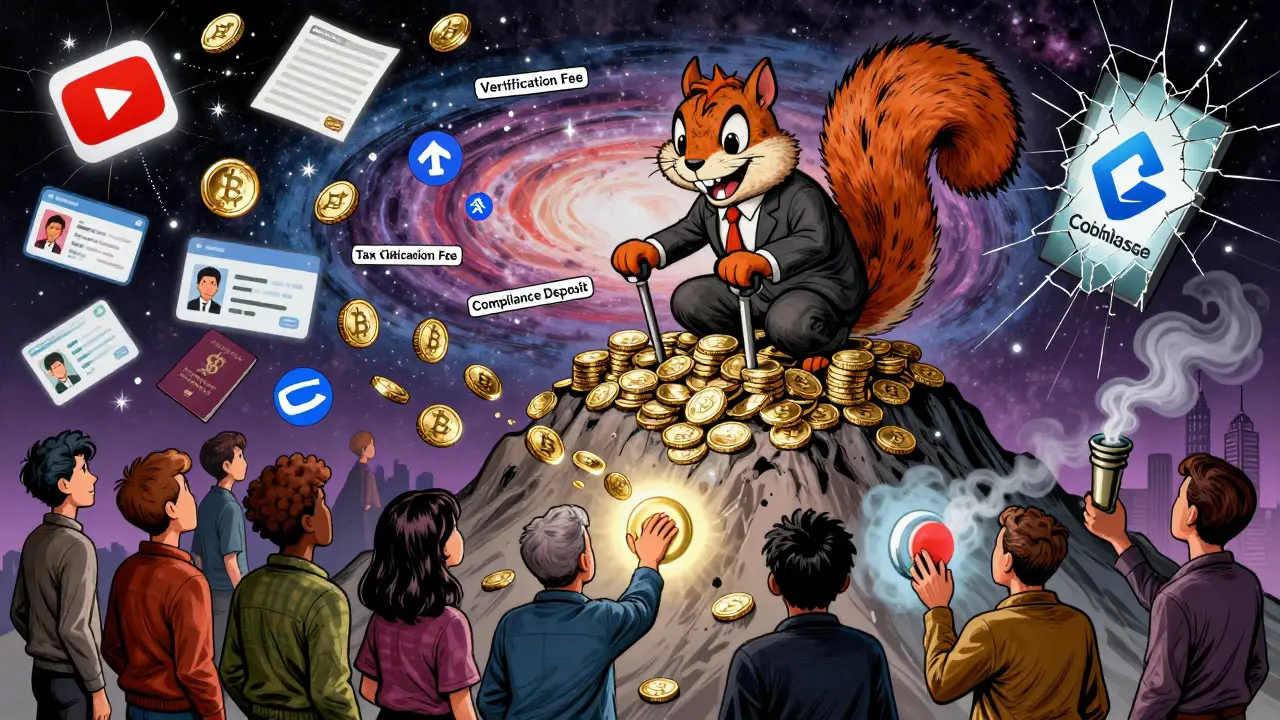
Squirrex Exchange doesn’t trade cryptocurrency. It doesn’t hold assets. It doesn’t have a team, a headquarters, or a real business license. It’s a digital trap designed to look like a legitimate exchange. The website was cloned to mimic Coinbase’s interface. It used fake videos of well-known figures like Cathie Wood and Changpeng Zhao to build trust. These weren’t low-effort memes - they were professionally edited clips, aired on YouTube and TikTok, targeting new investors who didn’t know what to look for.Here’s how it worked: You’d deposit $500 in Bitcoin or Ethereum. Within hours, your account would show $2,500. A "bonus." A "welcome reward." The platform even let you withdraw $50 or $100 - just enough to feel safe. Then came the trap. When you tried to pull out more, they demanded a "verification fee," a "tax clearance," or a "compliance deposit." The more you paid, the more they asked for. By the time you realized something was wrong, your account was frozen. Customer support vanished. The website went dark.
Regulators Have Already Warned You
You don’t need to guess whether this is real. Authorities have already spoken. The UK’s Financial Conduct Authority (FCA) added Squirrex to its official warning list in October 2025, alongside 146 other unregistered crypto operations. The U.S. Securities and Exchange Commission (SEC) issued a public alert in September 2025, calling Squirrex Exchange one of 32 fake platforms using cloned websites and fake support teams. Canada’s Anti-Fraud Centre logged over 1,800 complaints in just nine months - totaling nearly $5 million in losses.The domain squirrex[.]com was registered in May 2025 with WHOIS privacy turned on - a red flag used by 95% of scam sites. Its server IP is shared with 17 other known fraud platforms. The SSL certificate? Issued to "squirrexcustomer[.]com," not the real domain. That’s not a mistake. That’s proof of fraud.
Why It Looked So Real
What made Squirrex dangerous wasn’t just its lies - it was how well it mimicked the real thing. It had:- A clean, modern UI that looked like Coinbase’s 2024 redesign
- Fake "KYC verification" that collected your ID, utility bills, and even bank login details
- Mock trading charts with fake volume numbers
- YouTube ads featuring actors pretending to be "verified users"
- A mobile app that briefly appeared on third-party Android stores before being pulled
The app was worse. Once installed, it tried to overlay banking apps like Chase or Revolut to steal your login credentials. It recorded your screen. It accessed your contacts. It was designed to harvest as much personal data as possible - not to trade crypto, but to enable identity theft.
The Numbers Don’t Add Up
Squirrex claimed to manage $287 million in assets. That’s impossible. No legitimate exchange operates without proof of reserves. Kraken and Coinbase publish monthly Merkle tree audits. Squirrex had none. Its "staking" program promised 120% annual returns. That’s mathematically impossible. Even the European Banking Authority called it a classic Ponzi structure. No crypto asset generates that kind of yield. Not even Bitcoin mining or DeFi protocols.And here’s the kicker: Squirrex didn’t even accept fiat deposits. You couldn’t buy crypto with a credit card or bank transfer. You had to already own Bitcoin or Ethereum to "invest." That’s a textbook scam trait - 78% of fraudulent exchanges operate this way. Legit platforms like Kraken, Coinbase, or Binance US let you deposit dollars, euros, or pounds. Squirrex didn’t care about on-ramps. It only cared about taking your crypto and running.
What Happened to Victims?
Over 400 victims shared their stories across Reddit, Trustpilot, and the Crypto Victims Alliance. Here’s what they all said:- 94% successfully withdrew small amounts ($100 or less) to build trust
- 89% were asked for increasingly sensitive documents - utility bills, bank statements, even passport photos
- 76% received robotic replies like "Your account is under regulatory review"
- 87% lost everything after trying to withdraw more than $1,000
One user on Reddit, u/CryptoNewbie2025, deposited $1,000. His account showed $5,000. When he tried to withdraw $500 profit, they demanded a $1,200 "tax fee." He paid. Then they asked for another $2,000. He stopped. His account vanished. He lost $3,200.
The Aftermath: Seized, But Not Gone
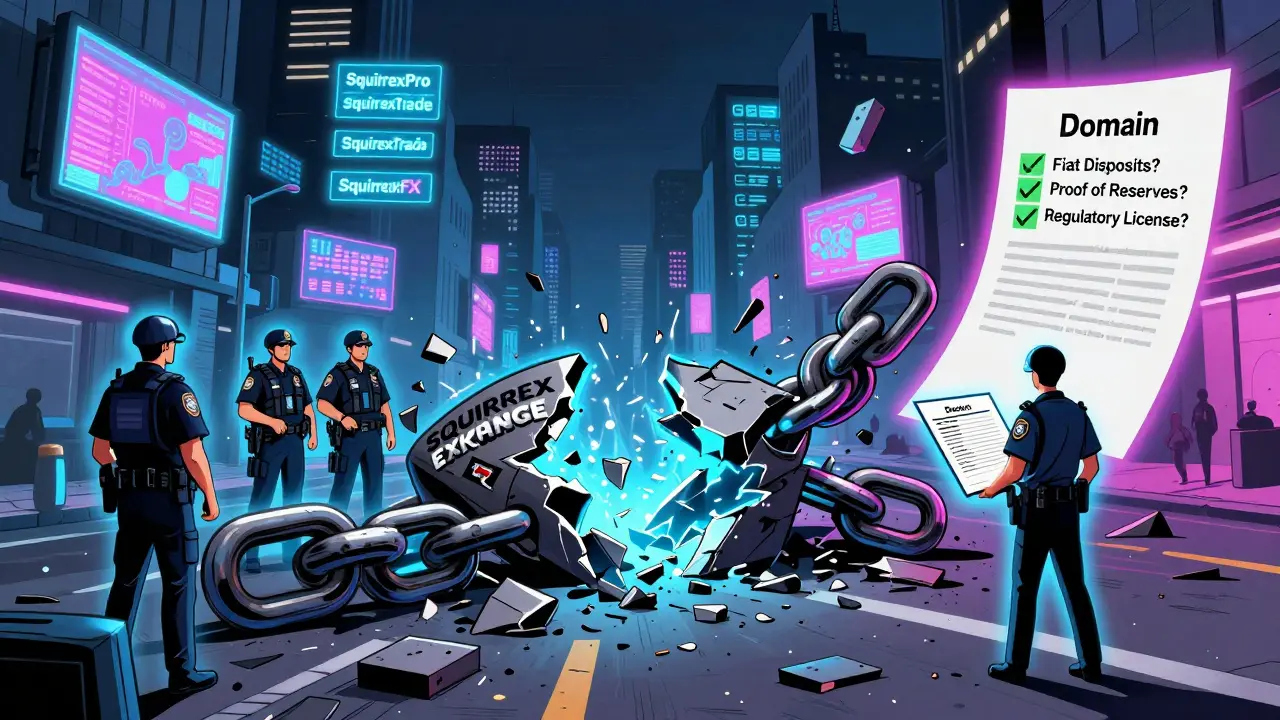
In October 2025, U.S. Homeland Security seized the main squirrex[.]com domain. But by then, 14 mirror domains were already redirecting users to the same scam infrastructure. These clones are still active. They change names - SquirrexPro, SquirrexTrade, SquirrexFX - but the code, the servers, the scams are identical.Law enforcement in 12 countries are working with Interpol on Operation DarkHub. But recovery? Nearly impossible. Only 3% of funds from Squirrex-related scams have been traced back. Compare that to 12% for scams involving regulated exchanges. Why? Because Squirrex moved stolen funds through privacy coins like Monero and Zcash - currencies designed to hide transactions.
What You Should Do Now
If you used Squirrex Exchange:- Stop sending any more money
- File a report with the SEC’s claims portal (deadline was November 30, 2025 - but check for extensions)
- Report it to your local financial regulator
- Change passwords on all accounts that used the same login details
- Scan your devices for malware - especially if you installed the app
If you’re thinking about using it:
- Don’t.
- Never trust a platform with no regulatory license
- Never trust 100%+ APY staking
- Never trust a site that asks for ID before you can withdraw
- Always check the FCA, SEC, or your country’s financial watchdog before depositing anything
How to Spot a Fake Exchange
Here’s a quick checklist:- ✅ Does it allow fiat deposits (USD, EUR, CAD)?
- ✅ Does it publish proof of reserves monthly?
- ✅ Is it registered with your country’s financial authority?
- ✅ Does its SSL certificate match its domain name?
- ✅ Are its customer support emails from a real company domain (e.g., [email protected])?
- ❌ Does it promise "guaranteed returns" or "risk-free staking"?
- ❌ Does it pressure you to deposit "quickly" or "before the offer ends"?
- ❌ Does it use celebrity endorsements that look "off"?
If even one answer is "no," walk away.
Is Squirrex Exchange real or fake?
Squirrex Exchange is fake. It’s a fraudulent crypto platform that operated from May to October 2025. It was never licensed, never audited, and never held user funds in reserve. Multiple global regulators - including the FCA, SEC, and CAFC - have issued public warnings. Its domain was seized by U.S. Homeland Security. It is a scam.
Can I get my money back from Squirrex Exchange?
The chances are extremely low. Only 3% of funds lost to Squirrex have been recovered through blockchain tracing. The SEC set up a claims portal with a November 30, 2025 deadline, but historical data shows recovery rates for these scams average under 5%. The money was moved through privacy coins and mixed across dozens of wallets. Full recovery is unlikely. Prevention is the only real protection.
Why did Squirrex Exchange look so professional?
Scammers today use professional designers, UI/UX experts, and even former fintech employees to build convincing fake platforms. Squirrex cloned Coinbase’s 2024 interface, used deepfake videos of real CEOs, and created fake social media accounts with thousands of followers. These aren’t amateur operations - they’re organized criminal networks with budgets, tech teams, and marketing campaigns. That’s why so many people got fooled.
Is there a legitimate company called Squirrel?
Yes - but it’s not a crypto exchange. Squirrel is a legitimate New Zealand P2P lending platform that handles traditional loans, not cryptocurrency. It was founded in 2015 and has processed over $1 billion in loans. Squirrex Exchange deliberately used a similar name to confuse people. This is a common scam tactic - known as "name spoofing" - and it’s behind nearly 70% of crypto fraud cases in 2025.
What should I use instead of Squirrex Exchange?
Use regulated exchanges with public proof of reserves: Coinbase, Kraken, Binance US, or Gemini. These platforms are licensed in the U.S., EU, or UK. They publish monthly audits. They allow fiat deposits. They have real customer support. They don’t promise impossible returns. Stick to platforms that answer to regulators - not shadowy operators with cloned websites.
Desiree Foo
February 11, 2026 AT 08:19Let me be crystal clear: if you even considered putting money into Squirrex, you were already one click away from disaster. This wasn’t a risky investment-it was a trap laid by professional criminals with PhDs in human psychology. They didn’t just steal crypto; they stole trust, sleep, and dignity. I’ve seen too many people-friends, even strangers online-get hollowed out by these scams. No, there’s no sympathy for the gullible. There’s only urgency: warn people before they lose everything. This isn’t a cautionary tale. It’s a lifeline. Share it. Screaming it into the void might be the only thing that stops the next victim.
And for the love of all that’s holy, stop scrolling past these ads. They’re not "opportunities." They’re digital predators with perfectly rendered logos.
Kaz Selbie
February 11, 2026 AT 11:21Bro. I worked in fintech for 7 years. I’ve seen every scam in the book. Squirrex? Classic pig butchering-except they spent the budget on deepfakes and UI polish. Most scams look like a 2008 Geocities page. This thing looked like a Bloomberg terminal on espresso. That’s the scary part. They didn’t target the elderly or the clueless. They targeted people who thought they were smart. The ones who read whitepapers and follow crypto influencers. And that’s why it worked. You don’t outsmart a scam when it’s designed to flatter your ego. You just get owned.
Also, the mobile app? That wasn’t just malware. That was a full-on identity harvesting toolkit. They were collecting your bank login, your contacts, your kids’ birthdays. This wasn’t about crypto. It was about building a dossier for future fraud. Scary shit.
Robbi Hess
February 12, 2026 AT 05:32Oh. My. GOD. I just spent 45 minutes reading this whole thing and I’m still shaking. I thought I was being careful. I thought I knew what red flags looked like. But Squirrex? It had the UI of Coinbase, the confidence of a TED Talk, and the soul of a black hole. I deposited $800 into a fake platform last year-thankfully, I caught it before the "verification fee" demand. But I still have nightmares. The fake videos of Cathie Wood? I watched them three times thinking they were legit. I’m not even mad. I’m just… haunted.
Why do these people sleep at night? Who designs a system that preys on hope? I need therapy.
Keturah Hudson
February 13, 2026 AT 17:07As someone who grew up in a country where financial scams are common but rarely this sophisticated, I’m both horrified and fascinated. In my home country, scams were usually phone calls or fake lottery tickets. This? This is a Hollywood production. They hired actors, editors, UI designers, and even fake customer service reps with scripted responses. It’s not just theft-it’s performance art designed to destroy lives. I’ve shared this with my entire family. My cousin just lost $12k. She thought she was investing in the future. Now she’s terrified to even open her laptop. We need more education-not just about crypto, but about how evil can look so polished.
And yes, I cried reading about u/CryptoNewbie2025. That’s not a number. That’s someone’s life.
SAKTHIVEL A
February 13, 2026 AT 22:53It is imperative to elucidate the operational architecture of this fraudulent entity. Squirrex Exchange, by virtue of its non-compliance with Know Your Customer (KYC) protocols, absence of Proof of Reserves, and utilization of privacy coin obfuscation mechanisms, constitutes a quintessential Ponzi construct with predatory scalability. The integration of deepfake celebrity endorsements, coupled with a cloned UI derived from Coinbase’s 2024 iteration, evidences a high-fidelity socio-technical attack vector. Furthermore, the deliberate obfuscation of domain ownership via WHOIS privacy, alongside IP address collusion with seventeen other known fraudulent platforms, corroborates a centralized, transnational criminal syndicate. Regulatory intervention, while commendable, remains retroactive. Proactive detection via blockchain forensics and behavioral anomaly detection in user onboarding flows is the only viable countermeasure. We must institutionalize mandatory educational modules for retail investors before permitting access to any digital asset platform. The cost of inaction is not merely financial-it is existential.
krista muzer
February 14, 2026 AT 12:38okay so i just lost my entire savings to this thing and i feel so dumb but also like… why does it feel like everyone knew except me? i mean i saw the ads, i saw the videos, i even read the "reviews" on reddit and thought "hmm maybe this is legit?" and then they let me withdraw $50 and i was like "oh thank god it works!" and then they asked for $2k to unlock my $4k and i just… i gave it. i gave it all. now i’m living off ramen and my cat is mad at me. i just wanted to make a little extra money. why is this so hard? why do they make it look so real? i don’t even know who to talk to anymore. i just needed a break from my job. why does the world hate me like this?
ps: i’m sorry for the typos. i’ve been crying too much to type properly.
Tammy Chew
February 15, 2026 AT 03:16Let me just say this: Squirrex didn’t just steal money. It stole the illusion of safety. We live in a world where everything is branded, polished, and packaged to look trustworthy. That’s why this worked. They didn’t need to fool fools-they needed to fool people who thought they were too smart to be fooled. And now? We’re all paranoid. Every crypto site looks like a trap. Every "limited time offer" makes me sick. I used to believe in innovation. Now I believe in fear. And honestly? I think that’s what they wanted.
Also the SSL certificate mismatch? That’s not a glitch. That’s a middle finger to anyone who checks.
Claire Sannen
February 15, 2026 AT 15:17If you’re reading this and you’re feeling alone-please know you’re not. I’ve been there. I lost $3,500. I didn’t tell anyone for months. I thought I’d be judged. But the truth is, these scams don’t care about your intelligence, your income, or your experience. They care about your hope. That’s their target. And if you’re still here, still trying to understand, still asking questions-that means you’re healing. Reach out. Talk to someone. File the report. Even if you don’t get your money back, you’re helping others avoid this. You’re not broken. You’re brave.
And if you’re reading this and you haven’t lost anything yet? Please. Share this. Send it to your cousin. Your neighbor. Your coworker. One message could save someone’s future.
Elizabeth Choe
February 16, 2026 AT 15:49Y’all. I just got off the phone with my mom. She’s 68. She saw a TikTok ad for "Squirrex-earn 120% while you nap!" and she was about to send $2k. I screamed. Literally screamed. She didn’t even know what crypto was. But she saw a lady in a suit talking about "passive income" and thought it was safe. I had to hang up and cry for 20 minutes. This isn’t just about crypto. It’s about how easy it is to make older people feel like they’re missing out. They’re not tech-savvy. They’re not cynical. They just want to retire with dignity. And these monsters are targeting them like prey.
I’m not mad. I’m terrified. And I’m telling everyone I know. Every. Single. Person.
Crystal McCoun
February 16, 2026 AT 19:22Thank you for this. Truly. I’ve been following crypto for years, and I’ve seen scams come and go-but this one… this one felt personal. I didn’t lose money, but I lost trust. I used to believe that if a platform looked professional, it was safe. Now I check every domain, every certificate, every email. I’ve even started a small guide for my friends-simple, clear, no jargon. Just: "Does it let you deposit USD? Does it show audits? Does it use real support emails?" If the answer is no-close the tab. Don’t even think about it.
I know it’s hard to believe that something so polished could be fake. But the truth is, the more polished it is, the more dangerous it is. This isn’t a glitch in the system. It’s the system working exactly as intended.
Please. Keep sharing this. Someone’s life depends on it.