

When you think of decentralized exchanges, you probably picture Uniswap or PancakeSwap - big names with thousands of tokens and millions of users. But what if there was a DEX that was faster, cheaper, and nearly immune to the kind of exploits that plague Ethereum? That’s SaucerSwap v1 - a quiet powerhouse built on Hedera Hashgraph, not Ethereum. It doesn’t have the flashy marketing, but if you’re trading Hedera-native tokens, it might just be the best option you’ve never tried.
What Is SaucerSwap v1?
SaucerSwap v1 is a decentralized exchange (DEX) built entirely on the Hedera Hashgraph network. Launched in 2022, it was designed to solve the big problems most DeFi platforms face: slow transactions, expensive gas fees, and vulnerability to MEV (miner extractable value) attacks. Unlike Uniswap, which runs on Ethereum, SaucerSwap v1 uses Hedera’s unique consensus mechanism - a system that doesn’t rely on mining or staking. Instead, it uses a gossip protocol with a hashgraph structure, which allows for near-instant finality and extreme scalability.It’s not a new idea - it’s modeled after Uniswap V2’s constant product formula (x × y = k). But while Uniswap struggles with $1.20 per swap during peak times, SaucerSwap v1 charges less than $0.001 per transaction. That’s not a typo. It’s literally 1,200 times cheaper. And it settles in under three seconds, not minutes.
The protocol supports 38 coins and 93 trading pairs as of late 2025. That sounds small compared to Uniswap’s 2,500+, but that’s intentional. SaucerSwap v1 doesn’t try to be everything. It focuses on Hedera’s native ecosystem - especially tokens built with Hedera Token Service (HTS). The most active pair? USDC/WHBAR. It alone handles over half a million dollars in daily volume.
How It Works: No Order Book, No Middlemen
SaucerSwap v1 uses an automated market maker (AMM) model. That means there’s no order book. No buyers and sellers waiting to match. Instead, liquidity pools hold pairs of tokens - like USDC and WHBAR. When you swap one for the other, the algorithm adjusts the price based on how much of each token is in the pool.Every trade has a 0.30% fee. Here’s the breakdown: 0.25% goes straight to liquidity providers. The remaining 0.05% is used to buy back SAUCE tokens - the protocol’s native token - and redistribute them. This isn’t just a gimmick. It creates a feedback loop that rewards people who keep the pools full.
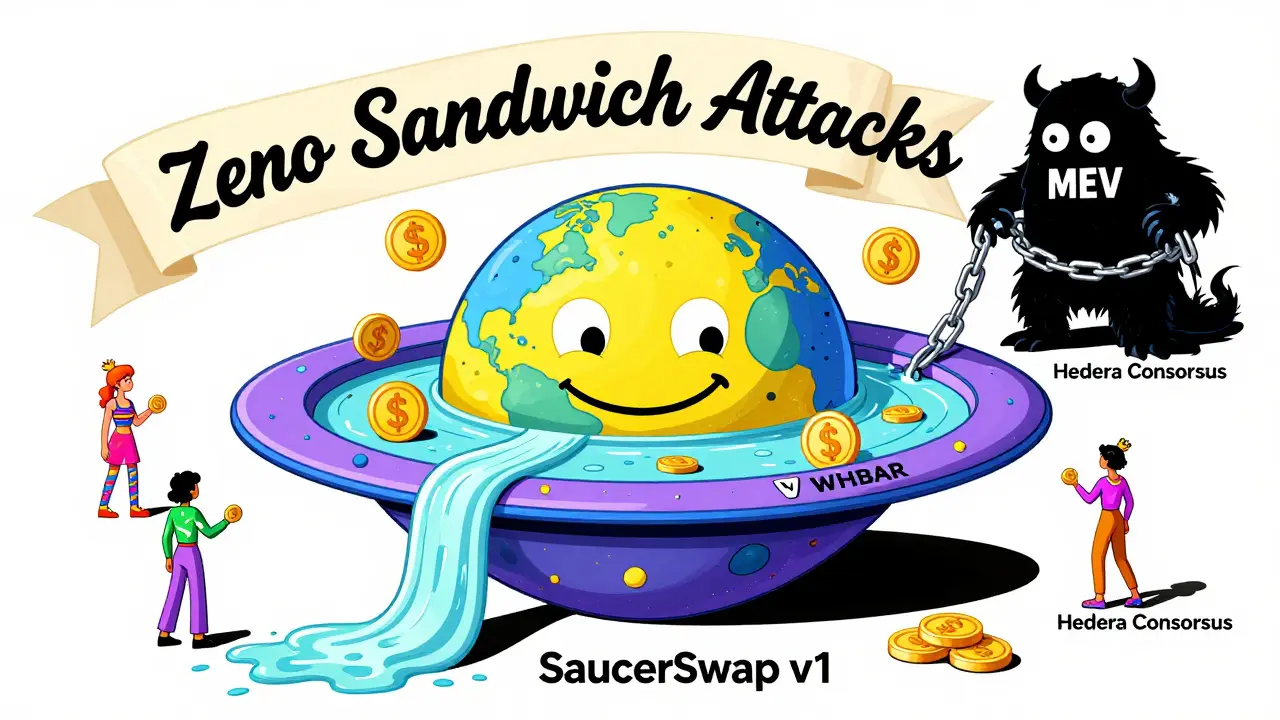
Because Hedera doesn’t use miners, there’s no MEV. No bots sniping your trades before they go through. No sandwich attacks. According to data from Q2 2025, there were zero MEV exploits on SaucerSwap v1. Meanwhile, Ethereum-based DEXs saw over 140 attacks in the same period. That’s a huge win for everyday users.
Performance Numbers That Matter
Let’s get real about the numbers. As of December 2025:- Transaction speed: 2.8 seconds average confirmation time
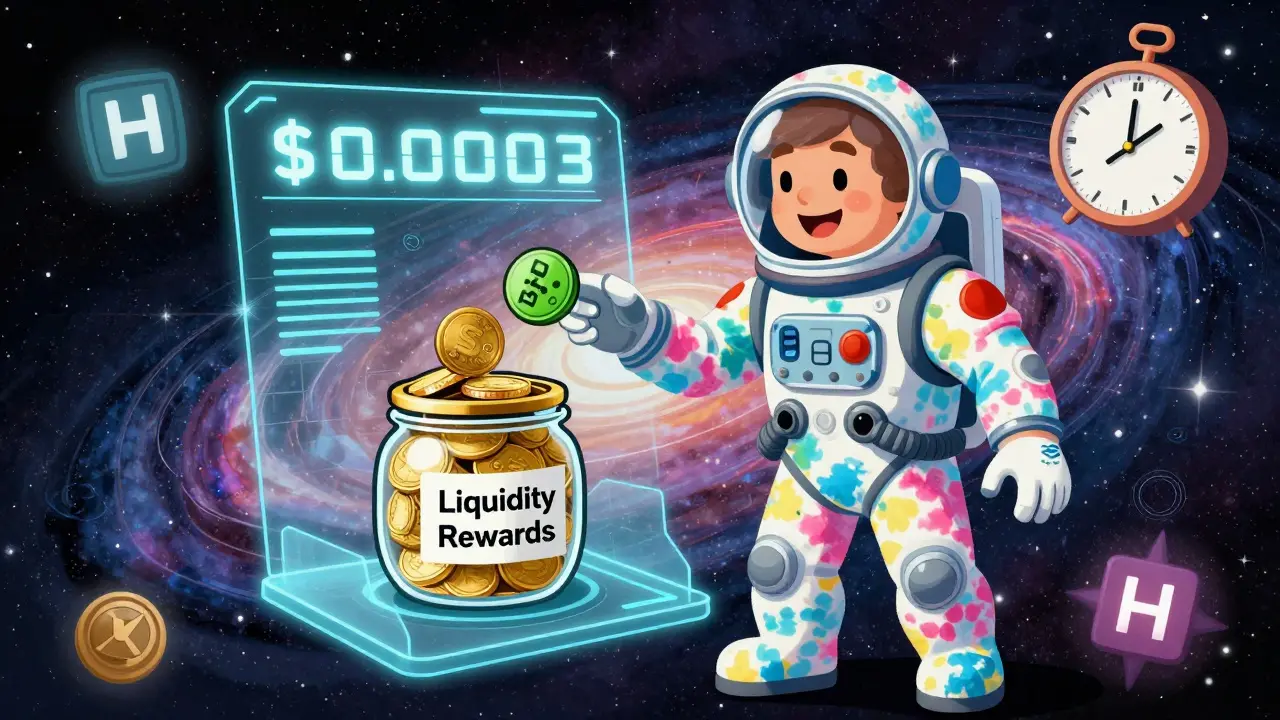
- Cost per swap: $0.0003-$0.001
- Trading volume (24h): $1.47 million across all pairs
- Most traded pair: USDC/WHBAR - $585,390 daily volume
- Average bid-ask spread: 0.636% - lower than most DEXs
- Total Value Locked (TVL): $69.8 million
- Market share on Hedera: 85%
That TVL represents 58% of all DeFi value locked on the entire Hedera network. That’s massive for a single DEX. And it’s not just hype - it’s real usage. FxVerify’s data shows 46,542 organic monthly visits to SaucerSwap v1. That’s not TikTok-level traffic, but for a niche DEX on a lesser-known chain, it’s impressive. Paid traffic? Just 447 visits. People aren’t being pushed here - they’re choosing it.
Who Is This For? (And Who Should Skip It)
SaucerSwap v1 isn’t for everyone. It’s laser-focused.Best for:
- Traders who use Hedera-native tokens (WHBAR, USDC, SAUCE, etc.)
- Users who hate Ethereum gas fees and slow confirmations
- Liquidity providers looking for stable, high APYs (14-28%) without the volatility of Ethereum farms
- Anyone who values security and zero MEV
Not for:
- People who want to trade Solana, Ethereum, or BSC tokens - SaucerSwap v1 has no cross-chain bridging
- Those looking for 1,000+ token pairs - you’ll find only 93
- Beginners who want a polished UI - the interface is functional, not beautiful
One Reddit user summed it up perfectly: “Swapped 500 WHBAR to USDC with $0.0003 in fees and confirmed in 2.8 seconds - this is the future of DeFi.” That’s the experience. Fast. Cheap. Reliable.
The Downsides: What’s Missing
No system is perfect. SaucerSwap v1 has real weaknesses.1. Limited Token Selection
Only 38 coins. If you’re into meme coins, altcoins, or tokens from other chains, you’re out of luck. The entire ecosystem revolves around Hedera. That’s a bottleneck.
2. UI and User Experience
Trustpilot reviews and user reports show that 63% of negative feedback is about the interface. Adding liquidity, connecting wallets, or navigating settings can be clunky. One user spent 20 minutes stuck in a loop trying to stake LP tokens. Documentation is solid technically, but lacks beginner-friendly video guides.
3. Single Ecosystem Risk
98% of SaucerSwap’s TVL is tied to HBAR’s price. If Hedera loses momentum, SaucerSwap v1 collapses with it. Experts warn this is a single point of failure. The protocol’s future depends entirely on Hedera’s adoption - and right now, Hedera is still mostly used by enterprises, not retail users.
4. No Cross-Chain Support
Unlike v2 (which added limited bridging), v1 is locked to Hedera. If you have ETH, SOL, or even USDT on BSC, you can’t bring it over. You need to buy HBAR first, then swap it. That’s a barrier.
Security and Trust
SaucerSwap v1’s smart contracts were audited by Hacken in August 2022. No critical vulnerabilities were found. They gave it a 7.8/10 - decent, not perfect. The audit praised the clean implementation of the constant product formula but noted weak reentrancy protections compared to newer standards.But here’s the real win: zero MEV exploits. On Ethereum, bots constantly exploit front-running and sandwich attacks. On SaucerSwap v1? Nothing. That’s because Hedera’s consensus doesn’t allow block reordering. No miners. No validators gaming the system. It’s baked into the network.
Wallet compatibility is straightforward: HashPack (recommended), Freewallet, or Ledger. No MetaMask. No WalletConnect. You need a Hedera-native wallet. That’s another barrier for Ethereum users.
Community and Support
The community is small but active. Reddit’s r/hedera has hundreds of SaucerSwap-related posts. The official Hedera Discord server - with over 86,000 members - has a dedicated SaucerSwap channel. Response times? Around 22 minutes from moderators. That’s fast for crypto.Trustpilot has 37 verified reviews with a 4.1/5 average. Positive reviews almost always mention speed and low fees. Negative ones? UI issues and lack of tokens. One user wrote: “Great protocol but the UI needs serious work.” That’s the recurring theme.
Documentation scores 4.3/5 for technical accuracy - but only 3.1/5 for ease of use. New users report needing 45-60 minutes to complete their first swap. That’s steep. Most people aren’t ready for that kind of learning curve.
What’s Next for SaucerSwap v1?
Here’s the kicker: SaucerSwap v1 is being phased out.On November 30, 2025, the team announced they’re stopping all feature development for v1. They’ll keep it running and push security updates through Q2 2026, then archive the docs. The future is SaucerSwap v2 - which uses Uniswap V3’s concentrated liquidity model, supports cross-chain assets, and has a better UI.
That means v1 is now in maintenance mode. It’s not dead - but it’s not evolving. If you’re new, you should probably start with v2. But if you’re already using v1? It’s still rock-solid. The liquidity pools are active. The fees are still dirt cheap. The trades still confirm in seconds.
Final Verdict: Should You Use It?
If you’re trading Hedera-native tokens - especially WHBAR, USDC, or SAUCE - SaucerSwap v1 is one of the best DEXs you can use. It’s faster, cheaper, and more secure than almost anything on Ethereum. The 0.636% average spread is among the tightest in DeFi. The APY for liquidity providers is consistently high. And the lack of MEV? A game-changer.But if you want to trade anything outside Hedera, or if you’re new to crypto and want a smooth experience? Look elsewhere. The UI is rough, the token list is tiny, and you’ll need to learn how Hedera wallets work.
SaucerSwap v1 isn’t the future of DeFi - it’s the present of a niche, high-performance corner of it. And for those who fit its mold? It’s unbeatable.
Is SaucerSwap v1 still active in 2026?
Yes, SaucerSwap v1 is still fully operational in early 2026. The development team stopped adding new features after November 2025, but they continue to issue security updates through Q2 2026. All existing liquidity pools, trading pairs, and wallet integrations remain functional. Users can still swap, provide liquidity, and earn rewards without interruption.
Can I use MetaMask with SaucerSwap v1?
No, you cannot use MetaMask with SaucerSwap v1. The protocol only works with Hedera-native wallets: HashPack (recommended), Freewallet, or Ledger. MetaMask is designed for Ethereum and EVM-compatible chains. Since SaucerSwap v1 runs on Hedera’s non-EVM network, MetaMask doesn’t recognize its contracts. You must use a wallet built for Hedera to interact with the DEX.
What’s the difference between SaucerSwap v1 and v2?
SaucerSwap v1 uses the Uniswap V2 model with constant product pools and no concentrated liquidity. It’s limited to Hedera-native assets and has no cross-chain bridging. SaucerSwap v2, launched in late 2025, adopts Uniswap V3’s concentrated liquidity model, allowing providers to set custom price ranges for higher capital efficiency. v2 also adds limited cross-chain support via Wormhole Bridge, expanding access to tokens from Ethereum, Solana, and BSC. The v2 UI is also significantly improved.
How much does a swap cost on SaucerSwap v1?
Every swap on SaucerSwap v1 costs 0.30% of the trade value. But because Hedera’s network fees are near-zero, the actual transaction cost to the user is less than $0.001 - often as low as $0.0003. This is roughly 1,200 times cheaper than a typical Uniswap swap on Ethereum, which averages $1.20 per transaction during normal conditions.
Is SaucerSwap v1 safe to use?
Yes, SaucerSwap v1 is considered safe. Its smart contracts were audited by Hacken in August 2022 with no critical vulnerabilities found. It’s also immune to MEV attacks due to Hedera’s consensus mechanism, which prevents front-running and sandwiching. However, users should always use trusted wallets (HashPack or Ledger), never share private keys, and be cautious of phishing sites - as with any DeFi platform.
What’s the best token pair to trade on SaucerSwap v1?
The most liquid and stable pair is USDC/WHBAR. It accounts for over 40% of total trading volume and has an average slippage of just 0.12% during November 2025. This makes it ideal for both trading and liquidity provision. Other popular pairs include SAUCE/WHBAR and HUSD/WHBAR, but USDC/WHBAR offers the tightest spreads and lowest price impact.
Robert Kunze
March 16, 2026 AT 16:30Sarah Zakareckis
March 18, 2026 AT 02:13Heather James
March 19, 2026 AT 04:29Dionne van Diepenbeek
March 20, 2026 AT 13:10Sarah Hammon
March 20, 2026 AT 21:58Katrina Smith
March 22, 2026 AT 03:27Graham Smith
March 23, 2026 AT 11:40Jerry Panson
March 25, 2026 AT 06:51Shreya Baid
March 27, 2026 AT 01:23Ann Liu
March 28, 2026 AT 01:05