
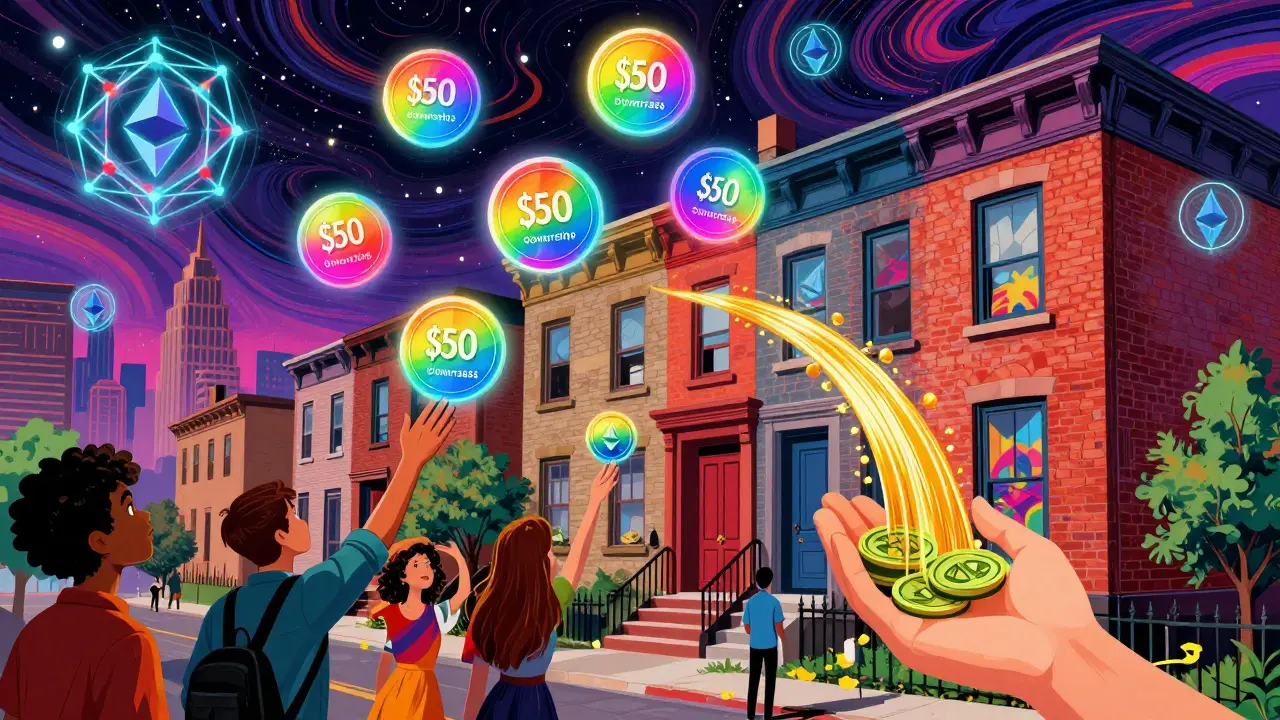
Imagine buying a piece of a rental house in Detroit for $50. Not the whole house. Just a slice of it. You get rent payments, you own part of the asset, and you can sell your share anytime - no realtor, no closing costs, no 60-day wait. This isn’t science fiction. It’s happening right now through real estate token trading.
Tokenized real estate is turning bricks and mortar into digital assets. Instead of needing $300,000 to buy a house, you can now invest $50, $500, or $5,000 and own a fraction of a property. These fractions are called tokens - digital units on a blockchain that represent ownership. And platforms have sprung up to let people buy, sell, and trade them like stocks.
How Real Estate Tokenization Works
Tokenization means turning a physical asset - like a building - into digital tokens. Each token represents a share of ownership. When a property is tokenized, a smart contract is created on a blockchain (usually Ethereum or Polygon) that defines who owns what, how rent is distributed, and how tokens can be traded.
Here’s how it works step by step:
- A real estate company or investor buys a property - say, a 10-unit apartment building in Atlanta.
- They work with a tokenization platform to split ownership into 100,000 tokens, each worth $10.
- Investors buy tokens through a marketplace, complete KYC (identity verification), and pay with crypto or fiat.
- Rent from tenants is collected automatically and distributed to token holders via smart contracts - usually within 24 hours.
- Token holders can sell their tokens on a secondary marketplace, often within minutes.
This cuts out banks, title companies, and lawyers from most of the process. Transactions that used to take months now happen in hours. And because it’s on the blockchain, ownership records can’t be altered or lost.
Major Platforms and How They Compare
Not all platforms are the same. Some target everyday investors. Others are built for hedge funds and family offices. Here’s how the top players stack up as of 2026:
| Platform | Minimum Investment | Property Types | Secondary Market | Key Strength | Limitation |
|---|---|---|---|---|---|
| RealT | $50 | Residential only | Yes | Low entry, high liquidity | No commercial assets |
| Propy | $5,000 | Residential & commercial | Yes | Cross-border transactions | Complex compliance |
| Harbor | $25,000+ | Commercial & luxury | No | Regulatory compliance | No trading - only buy and hold |
| SolidBlock | $10,000 | Commercial only | Yes | Liquidity pools for institutions | Not for beginners |
| Tokeny Solutions | N/A | Infrastructure | No | White-label for banks | Not for individual investors |
RealT leads in retail access. Over 15,000 users have invested, and 88% of them put in less than $5,000. The platform has over 970 tokenized properties - mostly single-family homes in cities like Detroit, Cleveland, and Phoenix. Investors report consistent rent payouts, with one user in August 2024 earning $3.27 from a $50 token in Miami - paid out in just 48 hours.
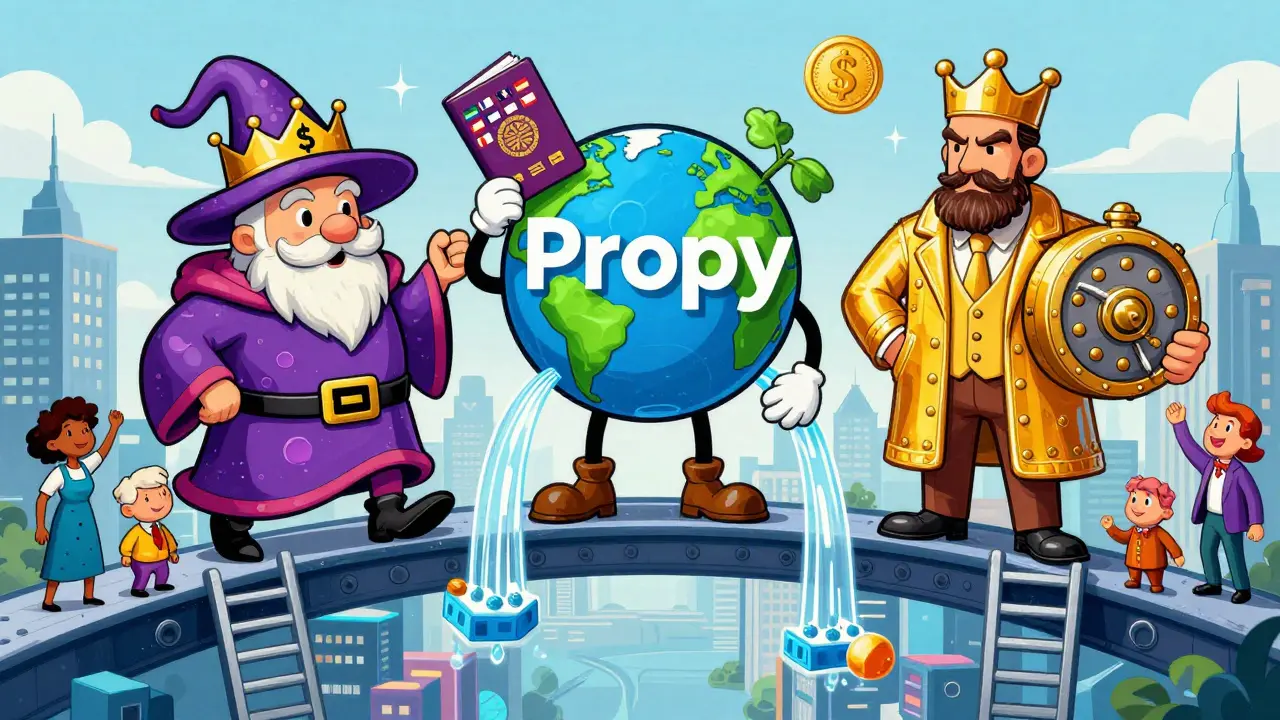
Propy stands out for international investors. It handles transactions in 17 different currencies and has processed deals from buyers in over 40 countries. But it’s not easy. You need to navigate tax rules and local laws - something 67% of users say is the hardest part.
Harbor is the go-to for institutions. It’s built to comply with SEC rules, so it restricts trading. You can’t sell your tokens freely - you’re locked in unless the platform finds a buyer. But if you’re a fund or family office, this is a feature, not a bug. It reduces volatility and keeps the asset class stable.
Why This Matters: The Real Benefits
Traditional real estate is broken for small investors. You need a down payment, a mortgage, inspections, insurance, property managers, and a lawyer. Tokenization strips that away.
Here’s what changes:
- Lower barriers: You don’t need $200,000 to invest in a high-value property. A $50 token gives you exposure to a $1 million building.
- Faster transactions: Buying a property traditionally takes 30-60 days. With tokens, it takes 10 minutes.
- Global access: Someone in Germany can buy a token in Texas without dealing with U.S. banking rules.
- Liquidity: Unlike a house you can’t sell quickly, tokens can be traded 24/7 on secondary markets. RealT alone sees $2.3 million in trades every month.
- Transparency: Every transaction is recorded on the blockchain. No hidden fees. No paper trails.
Deloitte predicts tokenized real estate will generate $1.4 trillion in new liquidity by 2030. That’s not speculation - it’s math. Right now, $613 trillion sits in global real estate. If even 1% of that becomes tokenized, it’s a $6 trillion market.
The Problems You Can’t Ignore
It’s not all smooth sailing. Here are the real hurdles:
- Regulation: The U.S. SEC still classifies most real estate tokens as securities. That means platforms must follow strict rules - and investors face complex tax reporting. 67% of users say filing taxes on tokenized property was harder than filing for a traditional rental.
- Geographic limits: 43% of potential investors are blocked because of where they live. EU residents can’t invest in many U.S. platforms due to MiCA regulations. Some countries ban crypto entirely.
- Limited trading: Only 18% of tokenized properties have active secondary markets. Most tokens sit idle. You might own a piece of a building, but if no one wants to buy your token, you’re stuck.
- Fiat on-ramps: Only 31% of platforms let you deposit money directly from your bank. Most require crypto first - meaning you need to buy Bitcoin or Ethereum elsewhere, then transfer it.
- KYC delays: Identity checks can take up to 72 hours. Some users report waiting over a week just to get started.
And then there’s the risk of code. Smart contracts are supposed to be foolproof. But if there’s a bug? A glitch in the rent-distribution code? No human can stop it. Pillsbury Law warns that without legal frameworks to handle these cases, investors could lose money without recourse.
Who’s Actually Doing This?
It’s not just tech bros with crypto wallets. The data shows real adoption:
- 63% of RealT users are between 25 and 44 - millennials and Gen Z investors looking for passive income.
- 41% of institutional tokenization comes from REITs (Real Estate Investment Trusts) trying to digitize their portfolios.
- Private equity firms and family offices are using Harbor to pool capital across borders without legal red tape.
- Commercial real estate accounts for 63% of the total value of tokenized assets, even though residential properties make up 78% of the listings.
Why? Because commercial buildings - warehouses, office parks, retail centers - generate steady, high-yield cash flow. They’re perfect for tokenization. A single office tower in Chicago might generate $1.2 million in annual rent. Split into 100,000 tokens? Each one pays $12 in rent per year. That’s a 12% yield on a $100 token.
What You Need to Get Started
If you’re thinking about jumping in, here’s what you need:
- A crypto wallet - preferably MetaMask (used by 73% of investors).
- A verified identity - expect 24 to 72 hours for KYC.
- Understanding of taxes - you’ll owe capital gains on profits and income tax on rent. Some users hire accountants who charge $250/hour just for this.
- A platform - start with RealT if you’re new. It’s the easiest, most transparent, and has the most active secondary market.
- Patience - the ecosystem is still young. Don’t expect to get rich quick. Think long-term, like you would with any real estate investment.
There are no guarantees. Property values can drop. Vacancies can rise. But unlike flipping a house, you’re not stuck. You can sell your token anytime. And if the market grows as predicted, the upside is massive.
The Road Ahead
The future of real estate tokenization hinges on two things: regulation and liquidity.
Right now, 29 U.S. states have passed laws supporting tokenized property. Dubai and Singapore have frameworks. But globally, 83% of platforms still need custom legal structures for each country they operate in. That’s expensive and slow.
The big game-changer could come from the SEC. If they approve real estate tokens as Alternative Trading Systems (ATS), it could unlock $3.7 billion in new trading volume. That would turn these platforms from niche tools into mainstream investment channels.
By 2027, ScienceSoft predicts that 45% of commercial real estate deals under $50 million will use tokenization. That’s not a guess - it’s based on institutional adoption trends.
For everyday investors, the door is open. You don’t need to be rich. You don’t need to be a lawyer. You just need to understand that this isn’t a get-rich-quick scheme. It’s a new way to own real estate - one that’s faster, fairer, and more open than anything that came before.
Can I really buy a piece of a house for $50?
Yes. Platforms like RealT allow you to buy fractional ownership of rental properties starting at $50. Each token represents a small share of the property’s value and entitles you to a portion of the rent. For example, if a house generates $1,000 in monthly rent and is split into 100,000 tokens, each token earns $0.10 per month. You can buy multiple tokens to increase your exposure.
Are real estate tokens legal?
In the U.S., most real estate tokens are classified as securities by the SEC, meaning they must comply with federal regulations. Platforms must register, verify investors, and report transactions. In the EU, the MiCA regulation creates barriers for non-compliant platforms, and some countries ban them entirely. Always check if the platform operates legally in your country.
Do I get a deed or title to the property?
No. You don’t get a physical deed. Your ownership is recorded on the blockchain as a digital token. This is legally recognized by many U.S. states that have passed tokenization laws, but it’s not the same as traditional property title. You own a share of the asset, not the physical building.
Can I sell my tokens anytime?
It depends on the platform. RealT and Propy have active secondary markets where you can sell anytime. Harbor and some others restrict trading - you can only sell if the platform finds a buyer. Liquidity varies widely, so check the platform’s rules before investing.
How are taxes handled with tokenized real estate?
Rental income from tokens is taxed as ordinary income. Profits from selling tokens are taxed as capital gains. Many investors use specialized accountants because tax software doesn’t yet support blockchain property records. The IRS treats these like stocks or mutual funds - but tracking cost basis across multiple purchases can be complex.
What happens if the platform shuts down?
Your tokens remain on the blockchain - they’re not tied to the platform’s servers. If RealT or Propy goes offline, you can still access your tokens using your wallet. However, you’d lose access to their marketplace, rent collection, and support. The underlying property still exists, but trading and management become harder without the platform.
Is this safer than buying a house?
It’s different, not necessarily safer. You avoid some risks (like property damage or tenant lawsuits) because you’re not the landlord. But you gain new ones: smart contract bugs, regulatory crackdowns, and illiquidity. The property itself is still subject to market swings, vacancies, and local economic conditions. It’s real estate - just digitized.
Do I need crypto experience to start?
Basic knowledge helps. You’ll need a wallet (like MetaMask), understand how to send crypto, and know what gas fees are. Most platforms guide you through it, and 73% of users start with no prior experience. But if you’ve never used crypto before, expect a 2-week learning curve.
perry jody
February 8, 2026 AT 11:54Brendan Conway
February 8, 2026 AT 14:45Katie Haywood
February 9, 2026 AT 01:16Let me get this straight - you’re telling me I can invest in a Detroit house with $50, but I have to hire an accountant who charges $250/hour just to file taxes? That’s not democratizing real estate. That’s just outsourcing the headache to someone else.
Also, if the platform shuts down, my tokens are ‘still on the blockchain’... cool. So now I’m a blockchain hoarder. Congrats, I guess.
Matt Smith
February 9, 2026 AT 11:09RealT? More like Real-Scam. You think you’re investing in a house? Nah. You’re investing in a smart contract written by some 19-year-old in a basement who got rich off Dogecoin and now thinks he’s Warren Buffett.
And don’t even get me started on ‘liquidity.’ You think you can sell your token? Try selling it when the market crashes and no one’s buying. You’re stuck with a digital brick. And the SEC? They’re gonna come for you when you owe $12k in capital gains on $500 of rent. This isn’t innovation - it’s a Ponzi with a property tag.
orville matibag
February 9, 2026 AT 23:46My cousin in Manila bought three tokens in a Phoenix rental last year. He gets $1.10/month. Doesn’t sound like much, but he’s never had any asset that made money without him lifting a finger. He’s now saving up to buy five more.
Yeah, the tax stuff is messy. Yeah, the platforms aren’t perfect. But this is the first time regular people - not just the rich or the connected - have had a real shot at owning part of something that actually produces cash. That’s huge.
sachin bunny
February 10, 2026 AT 13:45