

Imagine walking into a bank where everyone sees exactly what you bought, how much you paid, and who you sent money to. That sounds like a nightmare, right? Yet, that is exactly what happens on many public blockchains today. We are standing at a crossroads where the technology promised total openness to build trust, but in doing so, it accidentally stripped away the anonymity we expected. As we move through 2026, the fight between privacy and transparency isn’t just a technical glitch; it’s the biggest hurdle keeping normal people from using digital money.
The core problem is simple. A BlockchainA decentralized digital ledger that records transactions across many computers so that the record cannot be altered retroactively was built to be open. You want to know that your money didn’t vanish, so you check the ledger. You want to prove you aren’t cheating, so you show your account history. But once those details are there, they stay there forever. This immutability creates a massive conflict with laws like the General Data Protection Regulation, which basically says you have the right to be forgotten.
The Transparency Trap
When BitcoinThe first decentralized cryptocurrency that operates on a public blockchain launched over a decade ago, the idea was that no one would need to trust a middleman because the math was open for anyone to verify. That worked great for security, but terrible for secrecy. Even though you don’t give your real name to get a wallet address, that address acts like a unique ID card. If you ever link that address to your identity-maybe by buying goods online with a shipping address or depositing cash at a regulated exchange-you’ve just connected the dots.
Companies have gotten very good at connecting those dots. There are entire firms dedicated to blockchain forensics. They track the flow of funds like detectives following a trail of breadcrumbs. If you paid for a subscription service, their records might link your credit card to your crypto wallet. Suddenly, your private purchase history is available to anyone with a decent analytics tool. The Mt. GoxA former Bitcoin exchange that suffered a massive hack and bankruptcy in 2014 hack highlighted this vulnerability years ago, proving that even secure systems leak data when exchanges compromise.
The Need for Total Secrecy
On the other side of the spectrum, you have privacy coins and private chains. These try to fix the tracking problem by hiding everything. In these systems, transaction amounts, sender addresses, and receiver addresses are encrypted. Sounds perfect, right? Well, it brings its own set of headaches. Regulators hate it. If a government agency like the IRSThe Internal Revenue Service, responsible for tax collection in the United States can’t see the money moving, they assume it’s for illegal activity. Money laundering and illicit trades thrive in environments with zero oversight. Because of this, many countries are banning or severely restricting these privacy-focused assets.
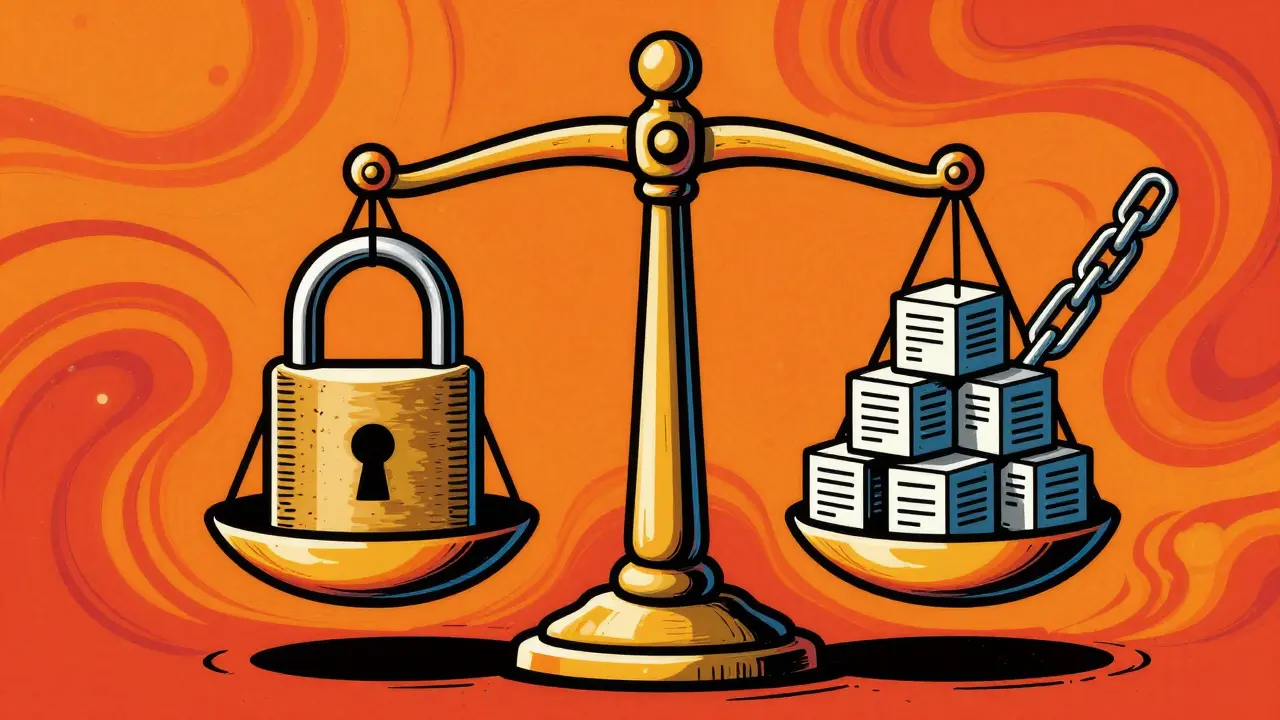
So, you can’t have total transparency because it invades your life, and you can’t have total secrecy because it invites regulation and banishment. Where do we stand in 2026? We are moving toward the middle ground. Researchers call it “selective transparency.” This approach lets you prove you are a legitimate actor without broadcasting your personal business to the world.
Zero-Knowledge Proofs: The Game Changer
This brings us to the most promising solution: Zero-Knowledge ProofsA cryptographic method that allows one party to prove knowledge to another without revealing the information. Think of it like a bouncer at a club who checks your ID to verify you are of legal age. Once verified, they stamp your hand. They don’t keep your birth certificate, your name, or your parents’ names on file. They just know you met the criteria.
In blockchain terms, ZKPs allow you to prove you have enough balance to pay a bill without telling the network your total balance or revealing your identity. Zk-SNARKsZero-Knowledge Succinct Non-Interactive Argument of Knowledge, a type of ZKP used in crypto and Zk-STARKsA newer generation of zero-knowledge proofs that are quantum-resistant are the technologies making this possible. Major networks like EthereumA decentralized platform that runs smart contracts and applications are integrating these tools directly into their architecture.
This solves the privacy problem without breaking the trust model. Auditors can verify the transaction is valid because the cryptography confirms the math works, but they cannot peek at the hidden values. It’s a massive shift from the early days of crypto, where either you saw everything or nothing. Now, businesses can share supply chain data on a ledger, confirming goods were sourced ethically without leaking supplier pricing secrets.
The Legal Battlefield
Tech is easy; law is hard. The biggest friction point remains the GDPRThe General Data Protection Regulation, a European law on data protection. The EU gives citizens the right to have personal data erased. A public blockchain is designed specifically so that data *cannot* be erased. When you write something onto a block, it becomes permanent history.
Lately, companies have found workarounds. They store sensitive data off-chain in encrypted storage and only place a hash-a digital fingerprint-on the blockchain. If a user requests deletion, the company deletes the encryption key to the off-chain data. The fingerprint stays, but without the key, it’s useless gibberish. It’s messy, but it’s better than nothing. Enterprise clients prefer this hybrid model because it satisfies the regulators while maintaining some level of audit capability.
User Control and Selective Sharing
By 2026, we expect to see "Data Protection Blockchains" become the norm rather than the exception. The user experience is changing. Instead of just sending a transaction, users will present credentials. Imagine applying for a loan. Previously, the lender checked your credit score and saw your exact income. With a privacy-preserving system, you could generate a proof that says "My income is greater than $50,000" without actually revealing what your salary is.
| Feature | Public Chain (Legacy) | Private Chain (Enterprise) | Data Protection Chain (Future) |
|---|---|---|---|
| Privacy Level | Low (Pseudonymous) | High (Permissioned) | Moderate (Selectable) |
| Transparency | Total | None (Internal only) | Verified but Hidden |
| Regulatory Risk | Medium (Tracking) | Low (Controlled) | Low (Compliant ZKP) |
| Decentralization | High | Low | High |
Look closely at the differences. The legacy model offers high decentralization but fails on privacy. The private model is safe for companies but feels like a traditional database wrapped in crypto magic. The emerging "Data Protection Chain" category tries to give us the best of both worlds: a public audit trail where the content is encrypted by default but verifiable on demand.

Practical Implementation Challenges
Even with the tech available, adoption takes time. Implementing Zero-Knowledge Proofs is not trivial. It requires heavy computation power. Validating a ZK-proof takes more energy and CPU cycles than a standard signature. For mobile apps or low-end devices, this can cause battery drain or slow loading times. Developers are working on lighter versions of these protocols, but until 2027 or beyond, you will likely find privacy features reserved for larger transactions or enterprise-grade setups.
Furthermore, the user interface needs to change. Currently, most wallets just show "Send" and "Receive." To support selective transparency, wallets need to include permission management tools. Users need to decide which data points to reveal to which recipients. That’s a lot of cognitive load for the average person. Until privacy tools become invisible and automatic, most users will still default to basic transactions that expose too much metadata.
What Comes Next?
We are seeing the industry stabilize around a few key players and standards. Layer 2 solutions, which sit on top of main chains to speed up transactions, are heavily investing in privacy layers. If you buy an NFT or trade a token, the transaction might happen privately on Layer 2, with only a final settlement visible on the main Layer 1. This reduces the cost of privacy and spreads the load.
As we look ahead, the dichotomy of "privacy versus transparency" will eventually dissolve. They won’t be opposites anymore. Instead, they will coexist through cryptography. You will retain ownership of your data’s visibility, granting access only when necessary. It is a significant leap from where we started, moving from a glass house to one with curtains that can be drawn instantly.
Is blockchain truly anonymous?
No, most public blockchains are pseudonymous, not anonymous. Your wallet address is visible to everyone, and if that address gets linked to your identity (like via an exchange KYC), your past and future transactions can be traced back to you.
How does Zero-Knowledge Proof help?
Zero-Knowledge Proofs allow you to verify a statement is true without revealing the underlying data. For example, you can prove you have sufficient funds to make a payment without revealing your total balance or wallet address.
Why is GDPR a problem for blockchain?
GDPR grants the "right to be forgotten," allowing users to request data deletion. However, blockchains are immutable, meaning data once written cannot be changed or deleted, creating a direct legal conflict.
Can banks use blockchain securely?
Yes, many banks use permissioned private blockchains or enterprise networks where access is restricted to verified participants, ensuring that only authorized parties can view sensitive financial data.
Are privacy coins banned?
Several jurisdictions are imposing strict regulations or bans on privacy coins due to concerns over money laundering. Many centralized exchanges have delisted coins like Monero to comply with anti-money laundering laws.
Arlen Medina
April 3, 2026 AT 00:56People really dont understand how the ledger works when we talk about total transparency
Most of you think encryption fixes everything but it just adds layers that slow things down
The real issue is who controls the validation nodes during these zero knowledge proofs
If the math relies on central servers then we have lost the point of decentralization entirely
We need sovereign control over our financial data and that starts with strong domestic regulation
European laws are killing off progress while we build better infrastructure right here in America
You cannot compare public chains to private ledgers because they serve completely different markets
Public chains require proof of work or stake to maintain security without revealing identity details
Forensic tracking tools are actually good because they stop bad actors from washing money
Privacy coins are banned for a reason and the market knows exactly why regulators hate them
Zero knowledge proofs sound cool in theory but they burn through hardware resources constantly
Mobile devices will never support heavy cryptographic proving without draining batteries instantly
Enterprise clients prefer hybrid models because compliance keeps them out of jail cells easily
Innovation happens where the legal framework supports the technology development process fully
We should focus on making standard transactions faster instead of hiding behind complex math tricks
Trust me the future of finance depends on openness rather than obscurity
Emily 2231
April 4, 2026 AT 18:52the government already owns the data and pretending otherwise is just childish denial
June Coleman
April 4, 2026 AT 19:41oh yeah because the secret service is definitely queuing up to audit my bitbuy receipts just to keep the peace
that logic holds water only if you ignore how much surveillance is already happening silently
shubhu patel
April 6, 2026 AT 06:52I appreciate the perspective on regulation but we must remember that user experience remains paramount throughout this transition phase
Many developers struggle with implementing zkp correctly without losing performance gains
It is important to consider that privacy features might feel invisible to regular users
We need to balance security protocols with ease of usage for the general population
The article mentions gdpr issues which are valid concerns for enterprise adoption globally
Suzanne Robitaille
April 6, 2026 AT 20:05This discussion touches upon the very soul of digital trust and human autonomy online
We must question whether true freedom exists without the ability to remain unseen at times
Transparency is valuable yet it comes with heavy costs regarding personal safety and dignity
sekhar reddy
April 8, 2026 AT 16:46this is absolutely insane and nobody is talking about the energy costs for this stuff!!!
imagine having to wait minutes just to prove your age without showing your birth cert
the tech is cool but the execution feels way too clunky for daily use
we need something smoother before people even care about this privacy stuff