
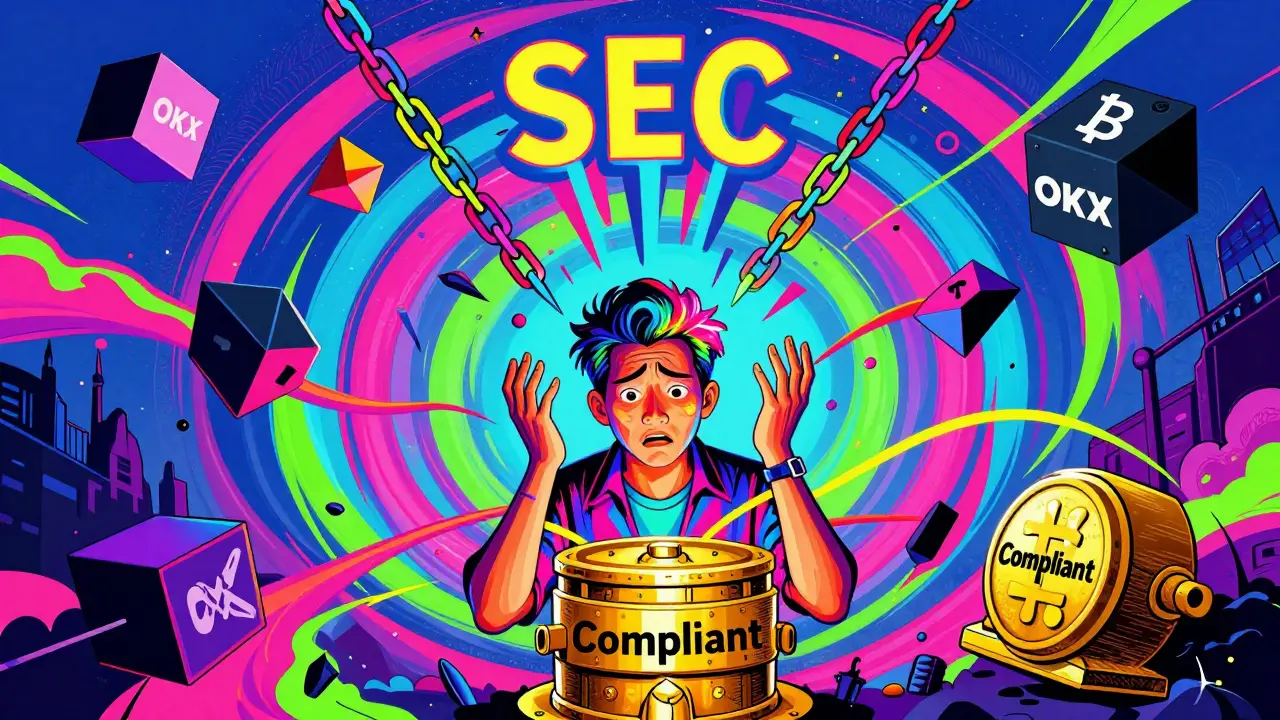
If you are a cryptocurrency trader in the Philippines, your access to popular global platforms like OKX, Bybit, and KuCoin might have suddenly vanished. This is not a glitch or a temporary server outage. It is the result of a massive regulatory crackdown by the Securities and Exchange Commission (SEC) of the Philippines. Starting in mid-2025, the Philippine government moved aggressively to block unlicensed crypto exchanges, forcing millions of users to either migrate to compliant local platforms or find technical workarounds. Understanding this shift is critical for anyone holding digital assets in the region.
The New Rules: What Changed in 2025?
The root cause of this disruption lies in two major documents issued by the SEC in May 2025: Memorandum Circular No. 4 and Memorandum Circular No. 5. These circulars established the country’s first comprehensive framework for Crypto Asset Service Providers (CASP). Before these rules, the regulatory landscape was fragmented, allowing many international exchanges to operate with minimal oversight. The new CASP framework changes that entirely.
Under the new regulations, any entity offering crypto services to Filipino citizens must register as a domestic corporation. This is not a simple paperwork exercise. Companies must meet a strict minimum capital requirement of 100 million pesos (approximately $1.8 million USD). They are also required to maintain physical offices within the Philippines and submit detailed monthly financial reports to the SEC. A crucial component of these rules is the mandatory separation of customer funds from company assets. This safeguard is designed to prevent the type of catastrophic losses seen in previous global exchange collapses, ensuring that user deposits remain protected even if the exchange faces financial trouble.
The Blacklist: Who Got Banned?
The enforcement of these rules began swiftly. On August 1, 2025, the SEC issued a public advisory targeting ten major global cryptocurrency platforms for operating without proper licenses. The initial list included industry giants such as:
- OKX
- Bybit
- KuCoin
- Kraken
- MEXC
- Bitget
- CoinEx
- Phemex
- BitMart
- Poloniex
By late August, the net widened further. On August 25, 2025, the SEC added five more platforms to the blacklist: Blofin, CoinW, DigiFinex, LBank, and Pionex. This brought the total number of flagged exchanges to fifteen. Notably, the inclusion of Kraken, one of the oldest and most respected exchanges globally, signaled that the SEC would not make exceptions based on international reputation or size. The message was clear: compliance is mandatory for all.
| Requirement | Pre-2025 Status | Post-July 2025 CASP Rules |
|---|---|---|
| Corporate Structure | Foreign entities could operate remotely | Must register as domestic corporations |
| Capital Requirement | No specific minimum | Minimum 100 million pesos (~$1.8M USD) |
| Physical Presence | Optional | Mandatory physical office in the Philippines |
| Fund Segregation | Not strictly enforced | Strict separation of customer and company funds |
| Reporting | Minimal | Detailed monthly financial reports to SEC |

How the Ban Works: ISP Blocking and Penalties
A blacklist on paper means little without enforcement. The Philippines took a decisive step by coordinating with major Internet Service Providers (ISPs). Starting August 7, 2025, telecom giants PLDT and Globe Telecom began blocking access to non-compliant exchanges. When users try to visit these sites, they encounter notification pages indicating regulatory violations rather than the trading interface.
This infrastructure-level blocking forces users to take active steps to bypass restrictions, such as using Virtual Private Networks (VPNs). However, the SEC has warned that circumventing these blocks does not absolve users or platforms of liability. The penalties for violating these rules are severe. Fines range from 50,000 to 10 million pesos per violation, with an additional daily penalty of 10,000 pesos for ongoing non-compliance. For smaller exchanges, these fines can be existential threats.
Regional Context: Is the Philippines Alone?
The Philippines’ aggressive stance is part of a broader trend across Southeast Asia. Neighboring countries are tightening their grip on the crypto sector to combat money laundering and protect investors. In May 2025, Thailand’s SEC ordered the blocking of five crypto exchanges, including Bybit and OKX, citing anti-money laundering concerns. Indonesia simultaneously revised its tax policy, increasing income tax on domestic exchange transactions from 0.1% to 0.21%, while imposing a fivefold increase on offshore platform trades, raising them from 0.2% to 1%.
This coordinated regional approach suggests that the era of wild-west crypto trading in Southeast Asia is over. Regulators are asserting control, demanding transparency, and prioritizing investor protection over unrestricted market access. For traders, this means that cross-border arbitrage opportunities may shrink as compliance costs rise and access becomes restricted.

Impact on Traders and the Industry
The immediate impact on Filipino traders has been mixed. Some users express frustration over reduced platform choices and the inconvenience of setting up VPNs. Others welcome the increased oversight, pointing to the historical risks associated with unregulated international platforms. The high-profile collapse of several global exchanges in recent years has made many investors wary of where their funds are held. The new requirement for fund segregation offers a layer of security that was previously absent.
For the industry, the 100 million peso capital requirement creates a significant barrier to entry. Smaller exchanges are effectively locked out of the Philippine market, while larger platforms must weigh the cost of establishing local operations against the potential revenue. Monthly reporting adds ongoing administrative burdens. However, the SEC has clarified that there is no ban on cryptocurrency trading itself. The goal is to create a "free, competitive market" that is "responsibly regulated." Compliant exchanges that secure the necessary licenses can continue to operate, potentially gaining market share from those blocked.
What Should You Do Now?
If you are currently using a blacklisted exchange, you need to act quickly. First, check if your platform is on the SEC’s updated list. If it is, consider migrating your assets to a compliant local exchange or a self-custody wallet. Using a VPN to access blocked platforms carries legal and security risks. While it may restore access, it does not change the fact that the platform is operating illegally in the Philippines. Furthermore, relying on third-party VPN services introduces additional privacy vulnerabilities.
For long-term safety, prioritize exchanges that are registered with the Philippine SEC. Look for platforms that clearly state their compliance status and offer transparent information about fund segregation. Stay informed about updates from the SEC, as the list of blacklisted entities may expand. The regulator has explicitly stated that "other platforms with similar features designed to onboard Philippine users without registration shall likewise be considered in violation."
Is cryptocurrency trading illegal in the Philippines?
No, cryptocurrency trading itself is not illegal. The SEC has clarified that the ban applies only to unlicensed service providers. You can trade crypto legally if you use exchanges that are registered and compliant with the CASP framework.
Which crypto exchanges are currently banned in the Philippines?
As of late August 2025, fifteen exchanges are on the blacklist, including OKX, Bybit, KuCoin, Kraken, MEXC, Bitget, CoinEx, Phemex, BitMart, Poloniex, Blofin, CoinW, DigiFinex, LBank, and Pionex.
Can I use a VPN to access blocked exchanges?
Technically, yes, but it is risky. The SEC has warned that accessing unregistered platforms violates securities laws. Additionally, using VPNs can expose you to security threats and does not protect you from potential legal repercussions or loss of funds if the exchange fails.
Why did the SEC ban Kraken and other reputable exchanges?
The SEC applied the rules uniformly regardless of an exchange's international reputation. Even well-established platforms like Kraken were banned because they had not registered as domestic corporations or met the new CASP requirements by the deadline.
What are the penalties for non-compliant exchanges?
Penalties range from 50,000 to 10 million pesos per violation. There is also a daily fine of 10,000 pesos for ongoing violations. ISPs are also mandated to block access to these platforms.
Lisa Chong
July 17, 2026 AT 02:23Heather Austin
July 18, 2026 AT 16:17Ran Tao
July 19, 2026 AT 03:43Drew M
July 19, 2026 AT 04:42Deep Rahman
July 20, 2026 AT 02:02Melissa Beckwith
July 20, 2026 AT 21:58Josephine Finlayson
July 22, 2026 AT 04:25Tuan Nguyen
July 23, 2026 AT 01:05Hazel Fruitman
July 23, 2026 AT 18:35Autumn Story
July 25, 2026 AT 13:25