
Singapore Crypto Compliance Cost Calculator
Calculate your annual compliance costs under Singapore's DTSP licensing framework (effective June 30, 2025). Input your transaction volume and user base to see estimated costs for:
- Travel Rule implementation
- Compliance officer salary
- Annual audits
- Cybersecurity requirements
Travel Rule Implementation: SGD
Compliance Officer Salary: SGD
Annual Audits: SGD
Cybersecurity Requirements: SGD
Total Annual Cost: SGD
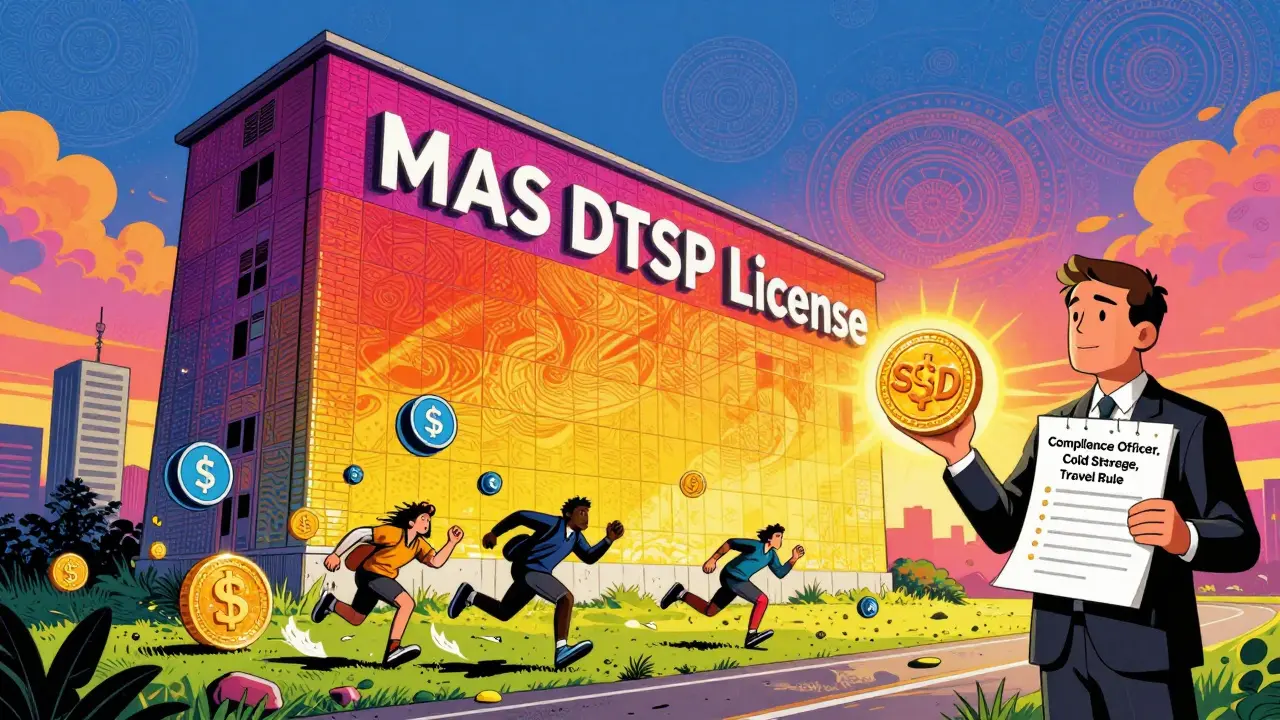
When the Monetary Authority of Singapore (MAS) announced in June 2025 that it would issue crypto licenses only in extremely limited circumstances, the global crypto industry took notice. This wasn’t a tweak to existing rules-it was a full-scale retreat from Singapore’s earlier reputation as a crypto-friendly hub. By June 30, 2025, any company operating a digital token service from Singapore had to comply with a new, ironclad regulatory framework. And if they didn’t? They were shut down-no warnings, no extensions, no exceptions.
Why MAS Changed Course
For years, Singapore attracted crypto firms with its stable government, strong legal system, and clear rules. But MAS saw a problem: too many companies were using Singapore’s reputation as a badge of trust while running operations from offshore servers, serving clients in countries with little to no oversight. These firms weren’t building anything in Singapore-they were just registering here to look legitimate. MAS called it regulatory arbitrage, and they weren’t going to let it continue. The Financial Services and Markets Act 2022 (FSMA) gave MAS the power to act. Section 137 of the law made it clear: if you’re based in Singapore, you’re under MAS’s control-even if your users are in Nigeria, your servers are in Germany, and your wallet addresses are on a blockchain in another country. This extraterritorial reach was unprecedented. No other major financial center had gone this far.What the DTSP License Actually Requires
To legally operate, firms now need a Digital Token Service Provider (DTSP) license. But getting one isn’t about filling out forms-it’s about proving you can meet standards most crypto companies can’t afford.- Minimum capital: Firms must hold at least SGD 1 million in liquid assets, not just on paper, but ready to cover losses or regulatory fines.
- Singapore-based compliance officer: This isn’t a remote role. The officer must live in Singapore, be employed full-time, and answer directly to MAS. Salaries for qualified candidates now range from SGD 150,000 to SGD 250,000 per year.
- Annual independent audits: Every year, an external auditor approved by MAS must review the firm’s AML/CFT systems, transaction records, and cybersecurity controls.
- Travel Rule compliance: For any transaction over SGD 1,500 (about USD 1,100), the platform must collect and share the sender’s and receiver’s full name, ID number, and account details. This requires expensive software integration-costing between SGD 50,000 and SGD 200,000 depending on volume.
- Cybersecurity standards: Platforms must use encryption, multi-factor authentication, cold storage for 95% of assets, and undergo penetration testing every six months.
Consumer Protection Rules That Changed Everything
In September 2024, MAS rolled out new consumer rules that hit retail traders hard. You can no longer buy crypto with a credit card in Singapore. Period. That rule alone cut off a major funding stream for many platforms. Platforms now must also:- Assess whether each customer understands the risks of crypto trading
- Warn customers clearly that crypto isn’t backed by any government or bank
- Block accounts if they detect signs of compulsive trading or financial distress
Stablecoins Are Treated Like Cash
MAS didn’t ignore stablecoins. In November 2023, they released a framework that treats them like bank deposits-not speculative tokens. Any stablecoin issued or traded in Singapore must be fully backed by reserves held in Singapore banks. The reserves must be audited monthly and kept separate from the issuer’s other assets. If a stablecoin loses its peg, the issuer must immediately redeem all tokens at face value. This killed most algorithmic stablecoins. Only those backed 1:1 by SGD or USD cash equivalents are allowed. Even then, they need MAS approval before launch.Who’s Still in the Game?
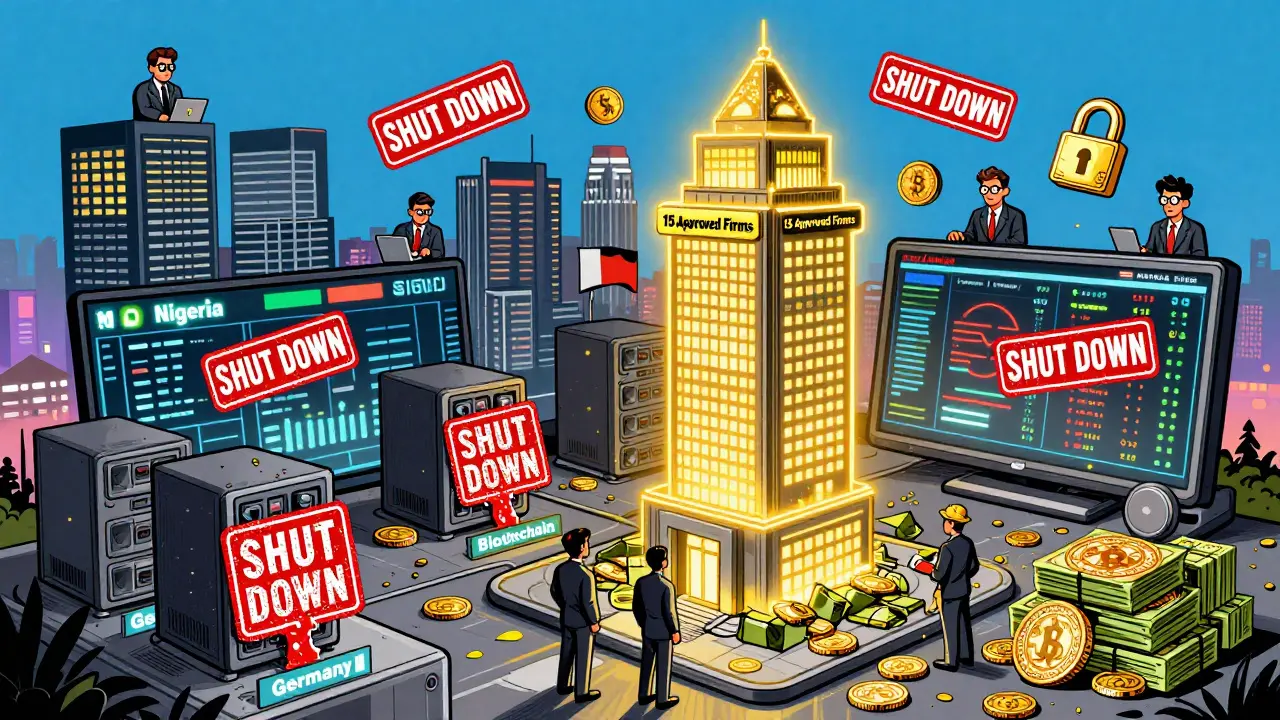
By the June 30, 2025 deadline, around 200 firms had applied for or held provisional licenses. Now, only 15 to 20 are confirmed to be fully compliant. Most of them are not startups. They’re well-funded institutions with global operations-think banks, hedge funds, or large fintechs with deep compliance teams. Smaller players? They either left Singapore or shut down. Some moved to Dubai, Switzerland, or Gibraltar-places that still offer active licensing. Others folded entirely. LinkedIn data shows crypto job postings in Singapore dropped 37% in Q1 2025 compared to the previous quarter.Why This Matters Outside Singapore
Singapore’s move isn’t just about local rules. It’s a signal to the world. If a country with Singapore’s financial infrastructure and global reach can say, “We’re done with this,” then others may follow. The U.S. and EU are watching closely. So are regulators in Japan, South Korea, and Australia. MAS’s model-strict licensing, extraterritorial reach, mandatory Travel Rule, and zero tolerance for risk-is becoming a blueprint. It’s not about stifling innovation. It’s about protecting the integrity of the global financial system.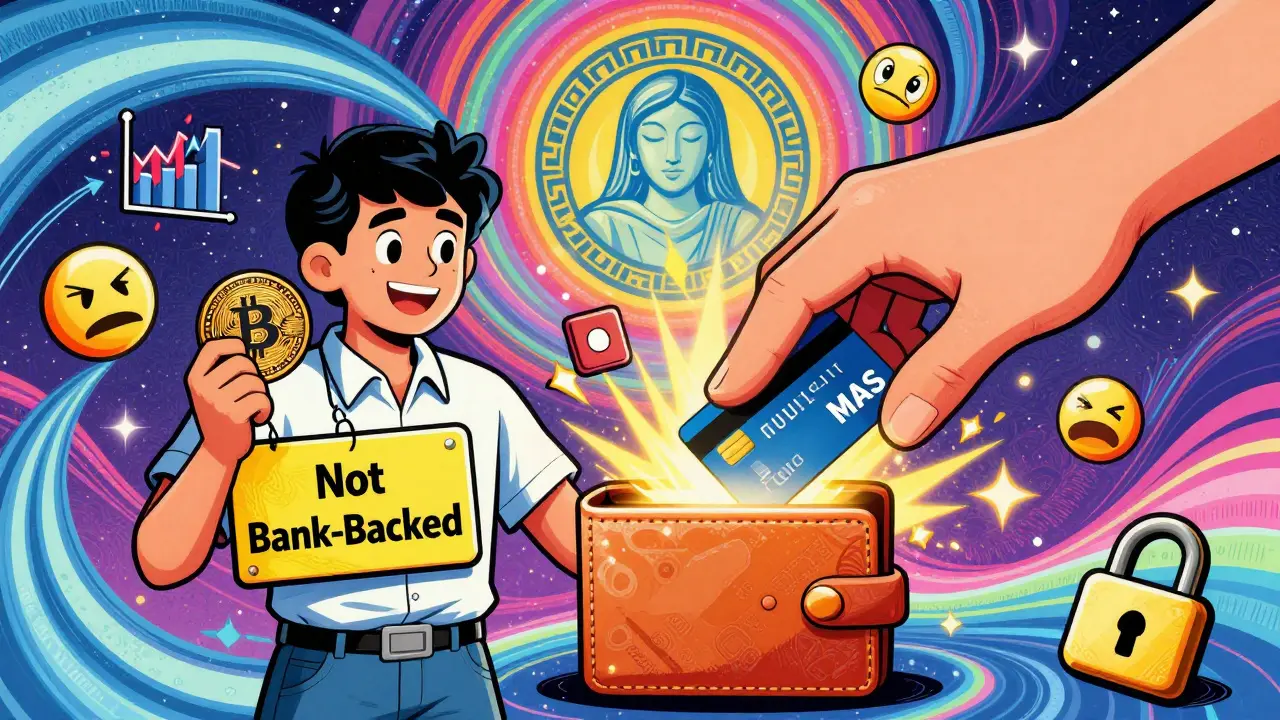
What Happens Now?
MAS says it’s not done. In late 2025, they plan to release guidance on DeFi protocols and decentralized exchanges. That’s the next frontier. Can you regulate a protocol with no company behind it? MAS hasn’t said yet. But they’ve made it clear: if it touches Singapore, it’s under their watch. For now, the message is simple: if you want to operate in Singapore’s crypto space, you need deep pockets, top-tier compliance, and a willingness to sacrifice growth for control. The era of quick registrations and offshore operations is over.Is There Any Flexibility Left?
No. MAS made it clear there are no transitional periods, no grace periods, and no exceptions. Even firms that had been operating for years under provisional licenses were given no leniency. The June 30 deadline was absolute. Some industry voices criticized the timing-only four weeks’ notice before enforcement. But MAS didn’t care. Their priority wasn’t convenience. It was certainty.What This Means for You
If you’re a trader in Singapore: you’re still allowed to hold crypto. But you can’t use credit cards to buy it, and your platform must warn you about the risks. You’re not banned-you’re just better informed. If you’re a crypto business: if you’re not based in Singapore, you’re probably safe. But if you have any team, office, or server in Singapore, you’re now under MAS’s microscope. Don’t assume you’re invisible because your users are overseas. You’re not. If you’re an investor: Singapore’s crypto scene is now smaller, but far more trustworthy. The firms that remain are the ones with real compliance, real capital, and real accountability. That’s not a bad thing.Can I still buy crypto in Singapore?
Yes, you can still buy and hold crypto in Singapore. But you can’t use credit cards to purchase it. Platforms must verify your financial situation and warn you about the risks before allowing trades. The rules are designed to protect you-not stop you.
Do I need a DTSP license if I’m just trading crypto for myself?
No. Individual traders don’t need a license. The DTSP license applies only to businesses that provide crypto services-like exchanges, wallet providers, or trading platforms. If you’re buying crypto to hold or trade on your own, you’re not regulated under this framework.
What happens if a crypto platform in Singapore doesn’t comply?
They’re shut down immediately. MAS can issue fines up to SGD 200,000, pursue criminal charges against executives, and order the freezing of assets. There’s no warning period. The June 30, 2025 deadline was final-and enforcement began the next day.
Why is the compliance officer required to be based in Singapore?
MAS wants direct accountability. If a firm breaks the rules, MAS needs to be able to speak to someone on the ground who can respond immediately. A remote compliance officer can’t be summoned for an emergency meeting or subpoenaed in a local court. This rule ensures real oversight, not just paperwork.
Is Singapore still a good place for crypto innovation?
Not for startups or speculative ventures. But for institutions that prioritize security, compliance, and long-term stability, Singapore remains one of the most respected financial hubs in the world. The crypto industry here is smaller now-but it’s also cleaner, more transparent, and less prone to fraud.
Joe West
December 5, 2025 AT 19:22Man, this is actually one of the cleanest crypto regulatory frameworks I’ve seen. Most places just throw out vague guidelines and hope for the best. MAS didn’t mess around-minimum capital, on-ground compliance officers, Travel Rule enforcement, cold storage requirements? That’s not bureaucracy, that’s responsibility.
And the stablecoin rules? Genius. If your token claims to be worth $1, it better have $1 in a Singapore bank account, not some shady offshore shell company. No more ‘algorithmic magic’ pretending to be money.
Yeah, it killed a lot of fly-by-night ops, but honestly? That’s a win for everyone who actually wants to use crypto without getting scammed. The firms that survived? They’re the ones built to last.
Mariam Almatrook
December 6, 2025 AT 09:57One cannot help but observe, with a mixture of clinical detachment and profound existential dismay, that the Monetary Authority of Singapore has, in a single stroke, transformed what was once a vibrant, if chaotic, frontier of financial experimentation into a sterile, compliance-driven mausoleum of institutional inertia.
Their draconian mandates-SGD 1 million in liquid assets, a full-time compliance officer paid like a hedge fund partner, mandatory penetration testing every six months-do not foster innovation; they entomb it. One might reasonably argue that the spirit of decentralization has been strangled by the very arms of the state that once claimed to embrace it.
And yet, one must concede, with a sigh and a sip of Earl Grey, that their logic is irrefutable. The specter of regulatory arbitrage, that ghost in the machine of global finance, has been exorcised-not with grace, but with a guillotine.
Thus, we stand at the precipice: a world where crypto is no longer a revolution, but a regulated utility. A monument to order. A tombstone for dreams.
Chris Mitchell
December 7, 2025 AT 09:52Regulation isn’t the enemy of innovation. Bad regulation is.
MAS didn’t ban crypto. They banned fraud.
Stop crying about ‘freedom’ when your ‘freedom’ was just hiding behind a shell company in Singapore while scamming people in Nigeria.
Real builders don’t need loopholes. They build inside the rules.
This is the future. Get used to it.
nicholas forbes
December 8, 2025 AT 17:58I get why MAS did this. Honestly, I do. But I also know how many small teams got wiped out overnight-people who weren’t trying to scam anyone, just trying to build something cool.
It’s not fair to lump them all together. The rules are clear, the enforcement is brutal, and now the ecosystem is… hollowed out.
I’m not defending bad actors. But I’m sad for the ones who didn’t deserve to die with them.
miriam gionfriddo
December 10, 2025 AT 11:43OMG I CANT BELIEVE THIS IS HAPPENING 😭😭😭
SO MANY FRIENDS LOST THEIR JOBS 😭
AND NOW THE ONLY ONES LEFT ARE BIG BANKS?? WHAT EVEN IS CRYPTO ANYMORE??
THEY TOOK OUR DREAMS AND TURNED IT INTO A BORING BANKING REGULATION MANUAL 😭
WHY DIDNT THEY JUST LET US HAVE FUN???
also i think the compliance officer salary is 150k?? that’s like 10x what my cousin makes as a software dev in dubai 😭
someone please tell me this is a joke
Kenneth Ljungström
December 12, 2025 AT 00:14Honestly? I’m kinda proud of Singapore for this. 🙌
Yeah, it’s strict. Yeah, it killed a bunch of sketchy startups. But look-now if you’re trading on a platform there, you know it’s legit. No shady tokens. No rug pulls. No ‘we’re based in Singapore’ while operating out of a garage in Manila.
And the credit card ban? YES. People were blowing rent money on DOGE like it was a lottery ticket. This isn’t censorship-it’s harm reduction.
It’s not about stopping crypto. It’s about making sure it doesn’t destroy people.
Also, if you’re a dev or compliance pro? There’s a *huge* demand for good people now. The bar’s high, but so are the paychecks. 💪
Let’s not mourn the chaos. Let’s build the future-safely. 🚀