

Most people think of stablecoins as just another way to hold dollars in crypto. You buy USDT or USDC, and you’re good. But what if your local currency is the one that matters most to your daily life? What if you need to pay rent in pesos, send remittances in naira, or save in baht without relying on a centralized bank?
This is where Mento Protocol is a decentralized infrastructure ecosystem designed for on-chain foreign exchange operations, enabling the creation and exchange of stablecoins pegged to local currencies rather than solely USD comes into play. It’s not a typical exchange where you trade Bitcoin for Ethereum. Instead, it’s a specialized platform built on the Celo blockchain that lets communities create their own stablecoins pegged to local fiat currencies.
If you are looking for a high-frequency trading bot or a place to gamble on meme coins, Mento isn’t it. But if you are interested in financial inclusion, decentralized finance (DeFi), or protecting yourself against local currency volatility, this protocol offers a fascinating, albeit niche, solution. Let’s break down how it works, whether it’s safe, and who should actually use it.
What Is Mento Protocol Really Doing?
To understand Mento, you have to forget the traditional model of stablecoins. Tether (USDT) and Circle (USDC) are centralized. They promise that for every token in circulation, they hold a dollar in a bank account. You trust them because they say so. Mento flips this script. It is community-governed and transparent. Every asset in its reserve is visible on-chain.
The core innovation here is the focus on local currencies. While the global market is dominated by USD-pegged tokens, Mento allows for the issuance of stablecoins tied to specific regional currencies. This is huge for emerging markets. Imagine a merchant in Argentina accepting a stablecoin that holds its value relative to the Argentine Peso, settled instantly on a blockchain with low fees, rather than dealing with slow bank transfers or volatile crypto assets.
Built on Celo, an Ethereum Virtual Machine (EVM)-compatible network known for being mobile-first, Mento leverages low transaction costs. This makes micro-transactions and small-scale remittances viable, which is often impossible on more expensive networks like Ethereum Mainnet. The protocol doesn't just issue tokens; it provides the entire infrastructure for minting, burning, and exchanging these assets through a virtual Automated Market Maker (AMM).
How the Technology Works Under the Hood
You don’t need to be a coder to use Mento, but understanding the mechanics helps explain why it’s different. The protocol relies on a few key components that work together to maintain stability.
- Stablecoin Factory: This is the engine room. It allows anyone to propose and create new stablecoins pegged to local currencies. It’s permissionless, meaning no central authority needs to approve a new currency pair.
- Virtual AMM: Unlike traditional exchanges that match buyers and sellers directly, Mento uses a virtual pool system. This ensures liquidity is always available for swapping between different stablecoins or redeeming them for underlying assets.
- FiatConnect API: This bridges the gap between traditional finance and DeFi. It allows users to deposit fiat currency from their bank accounts and receive the corresponding Mento stablecoin on-chain, and vice versa.
- Overcollateralization: To keep prices stable, the protocol requires more value in reserves than the value of the stablecoins issued. If the market gets shaky, the protocol has a buffer to absorb shocks.
The security architecture is particularly robust. Mento Labs employs an automated on-chain circuit breaker. Think of this as an emergency stop button. If the system detects unusual market conditions-like a sudden crash in collateral value-it can automatically suspend trading to prevent losses. This feature was highlighted in technical analyses from early 2025 as a critical safeguard against the kind of flash crashes that have plagued other DeFi protocols.
Security and Trust: Is Your Money Safe?
In crypto, "not your keys, not your coins" is the mantra, but smart contract risk is real. Mento takes this seriously. The team describes their development approach as "paranoid." They don’t just run standard tests. They use formal verification, fuzz testing, and automated fork tests to simulate thousands of potential attack vectors before code ever hits the mainnet.
Independent audits are also part of the picture. Firms like Hats.finance, Sherlock, and 0xmacro have reviewed the code. However, audits are snapshots in time. As noted by security analysts at Vault12, a significant portion of crypto thefts still occur in DeFi due to unforeseen vulnerabilities. Mento mitigates this by diversifying its reserves and using Multi-Party Computation (MPC) wallets for certain operational functions.
One major risk factor remains oracle dependency. Oracles provide price data to the smart contracts. If an oracle is manipulated or fails during extreme volatility, the protocol could make incorrect decisions about collateral ratios. Mento addresses this by using multiple data feeds and unique identifiers for each exchange rate report, reducing the chance of a single point of failure.
| Feature | Mento Protocol | USDT / USDC |
|---|---|---|
| Governance | Community-driven (Decentralized) | Centralized Companies |
| Currency Peg | Local Fiat Currencies + USD | Primarily USD |
| Transparency | Full On-Chain Reserve Visibility | Periodic Attestations |
| Underlying Network | Celo (Low Fee, Mobile-First) | Ethereum, Solana, etc. |
| Primary Use Case | Local Payments, Remittances, Forex | Global Trading, Savings |
User Experience and Practical Implementation
So, how do you actually use Mento? It’s not as simple as downloading an app and clicking "Buy." The learning curve is moderate to steep. You need a wallet compatible with the Celo network, such as Valora or WalletConnect. Once connected, you interact with the protocol’s smart contracts directly or through integrated dApps.
For everyday users, the process involves:
- Connecting your wallet to the Mento interface.
- Selecting a stablecoin pegged to your desired currency.
- Minting or Swapping using existing crypto assets or bridging fiat via FiatConnect partners.
- Participating in Governance by holding MENTO tokens, which allow you to vote on protocol changes, reserve management, and new currency proposals.
Support is primarily community-driven. There are active discussions on the Celo Forum and Reddit, where developers and power users help newcomers navigate the interface. However, don’t expect a 24/7 customer support chat line like you’d find on Coinbase. You are entering the world of self-custody DeFi, where personal responsibility is key.
Market Position and Future Outlook
As of late 2025, the total value locked (TVL) in Mento is around $287 million. Compared to the hundreds of billions in USDT, this seems small. But context matters. Mento operates in a niche segment: non-USD stablecoins. Analysts at Messari predict over 20% annual growth for this sector through 2027, driven by demand in emerging markets where inflation erodes local purchasing power.
The regulatory landscape is shifting. With frameworks like the EU’s MiCA coming into full effect, clarity around stablecoins is increasing. Mento’s transparent, compliant-by-design structure positions it well to adapt to these rules. Its roadmap includes cross-chain expansion beyond Celo, which would significantly broaden its accessibility.
However, challenges remain. Adoption hurdles are significant. Convincing merchants and everyday users to switch from familiar banks or dominant players like PayPal requires education and incentives. Additionally, competition is fierce. Other protocols are exploring similar local currency models. Mento’s advantage lies in its first-mover status within the Celo ecosystem and its mature governance model.
Who Should Use Mento Protocol?
Mento isn’t for everyone. Here is who benefits most:
- Residents of Emerging Markets: People living in countries with volatile currencies can use Mento to preserve wealth in a stable, locally-relevant digital asset.
- DeFi Developers: Builders creating payment apps, lending platforms, or remittance services can integrate Mento’s APIs to offer local currency options without building infrastructure from scratch.
- Forex Traders: Those interested in decentralized foreign exchange can trade local currency pairs with greater transparency than traditional OTC markets.
- Crypto Natives: Users who prioritize decentralization and want to avoid counterparty risk associated with centralized issuers like Tether.
If you are a casual investor looking to park funds in a stable asset for long-term savings, USDC might still be simpler. But if you need functional utility in a specific region or believe in the future of decentralized monetary policy, Mento is worth exploring.
Is Mento Protocol safe to use?
Mento employs rigorous security measures including formal verification, multiple independent audits, and an automated circuit breaker system to halt trading during anomalies. However, as with all DeFi protocols, risks remain, particularly regarding smart contract vulnerabilities and oracle manipulation. Always do your own research and start with small amounts.
How does Mento differ from USDT or USDC?
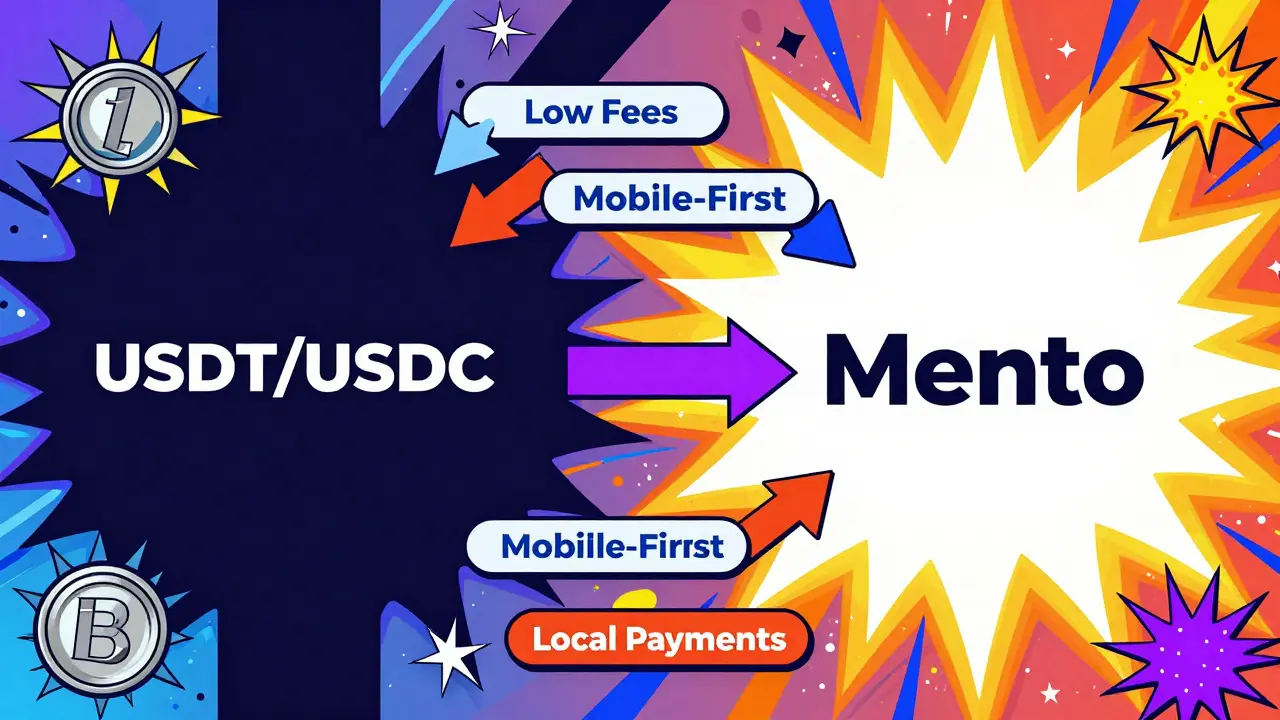
Unlike USDT and USDC, which are centrally issued and pegged primarily to the US Dollar, Mento is decentralized and allows for the creation of stablecoins pegged to various local fiat currencies. It operates on the Celo blockchain, offering lower fees and greater transparency through on-chain reserve visibility.
Can I use Mento for international remittances?
Yes, Mento is specifically designed to facilitate cross-border remittances. By converting fiat to a local currency-pegged stablecoin, sending it on-chain, and having the recipient redeem it back to fiat, users can bypass traditional banking fees and delays. The FiatConnect API simplifies the entry and exit points for fiat currency.
What is the role of the MENTO token?
The MENTO token is used for governance. Holders can vote on protocol upgrades, new stablecoin proposals, and reserve management strategies. It empowers the community to steer the direction of the platform, ensuring it remains aligned with user needs rather than corporate interests.
Do I need a lot of technical knowledge to use Mento?
Basic familiarity with DeFi concepts is helpful. You will need to manage a crypto wallet (like Valora) and understand gas fees. While the interface is user-friendly, interacting with smart contracts carries inherent risks. New users should utilize community resources and tutorials before committing significant funds.
Heather Austin
July 22, 2026 AT 01:14honestly the cello integration is what sold me on this concept initially. most people just stare at ethereum gas fees and cry but if you actually look at the mobile first architecture it makes sense for remittances in places like latin america or africa where smartphones are more common than bank accounts. i used to send money back home via western union and the fees were absolutely criminal so seeing a protocol that tries to solve that with local currency pegs feels like actual progress rather than just another meme coin casino. the virtual amm model is tricky though because liquidity fragmentation can be a nightmare if not managed correctly but the overcollateralization buffer seems solid enough for now. just make sure you understand the oracle risks before dumping your life savings into it
Lisa Chong
July 23, 2026 AT 20:01They say it's decentralized but who really controls the reserves?? The 'community governance' is just a facade for the elites to wash their dirty money while the little guy gets rug pulled. It is all part of the great reset agenda to replace our hard earned cash with digital tokens that they can freeze with one click. I have been watching these crypto scams since 2013 and they always start with promises of financial inclusion but end with total surveillance capitalism. You think you own your keys but when the government decides to ban the stablecoin your assets will vanish into thin air. Do not trust anything that is not physical gold in your hand right now.
Ran Tao
July 24, 2026 AT 00:05Oh wow, another 'revolutionary' protocol that reinvents the wheel but calls it a square 🙄. Everyone here acting like Mento is some kind of savior for emerging markets but let's be real, most of these users don't even know how to secure their seed phrases properly. It's adorable how naive you all are thinking that a few smart contracts will fix hyperinflation caused by decades of poor fiscal policy. I've seen better tech in my toaster 🍞. The only thing decentralized about this is the blame when things inevitably crash. Keep dreaming though, maybe next time you'll invent cold fusion 🔥.
Hazel Fruitman
July 25, 2026 AT 10:34i feel like we are forgetting the basic human element here. technology is cool but does it actually help the single mother trying to pay rent in naira without getting eaten alive by exchange rates? probably not if the interface is as clunky as half the defi apps out there. it feels very cold and impersonal to talk about 'virtual amms' when real people are losing their savings every day. we need empathy not just code.
Autumn Story
July 25, 2026 AT 18:36I think it is wonderful that there is an effort to bring stability to regions with volatile currencies!!! It gives me hope that technology can be used for good instead of just speculation... However, please remember that risk is still involved and no one should invest more than they can afford to lose... It is important to stay informed and cautious... The community support aspect sounds nice but I worry about the learning curve for older generations... Let us keep the conversation respectful and helpful for everyone...
Mark Tuason
July 27, 2026 AT 02:43While the technical merits of the Celo ecosystem are undeniable, one must consider the regulatory implications carefully. The EU's MiCA framework suggests that compliance will become a significant barrier to entry for many decentralized protocols. Mento's transparent reserve structure may indeed position it favorably, but the reliance on oracles remains a critical vulnerability that requires continuous monitoring. It would be prudent for users to diversify their holdings and not rely solely on this infrastructure for long-term value preservation.