
Buying a house with an NFT sounds like science fiction, but it’s already happening. In 2021, a Miami penthouse sold for $654,000 using a blockchain-based deed. The buyer didn’t get a paper title. They got a digital token. But here’s the catch: owning that token doesn’t automatically mean you own the property under the law. That’s the core problem with real estate NFTs today. The technology moves fast. The law is still catching up.
What Exactly Is a Real Estate NFT?
A real estate NFT is a digital certificate stored on a blockchain-usually Ethereum or Polygon-that represents ownership or a claim to a physical property. It’s not the property itself. It’s a token that points to it. Think of it like a deed, but instead of being filed in a county office, it’s recorded on a public, tamper-proof ledger.
These tokens can represent full ownership, partial shares, or even usage rights-like a vacation home you can book for two weeks a year. The most common setup? A Special Purpose Vehicle (SPV), usually a Delaware LLC, holds the actual property. Then, ownership shares in that LLC are turned into NFTs. So when you buy the NFT, you’re really buying a stake in the company that owns the building.
But here’s where it gets messy. In most places, the law still requires a physical deed, signed, notarized, and recorded by a county clerk. A blockchain transaction alone? Not enough. In 2022, a property transfer in Wyoming failed because the recorder’s office refused to accept the NFT as proof of ownership. The system wasn’t built for it.
Why the Law Is Struggling to Keep Up
Property law was designed for paper records, not digital tokens. It’s territorial. If you own land in Texas, Texas law applies. But NFTs exist on global blockchains. No borders. No central authority. That’s a direct conflict.
The Law Commission of England and Wales made a big move in 2023, saying NFTs themselves can be treated as personal property under English law. That’s a start. But they were clear: recognizing the token doesn’t mean recognizing the underlying property. You can own the NFT, but if the deed isn’t updated in the official land registry, you don’t own the house.
This creates a legal fiction. One that’s dangerous. In 2023, a $1.1 million Miami property sale collapsed because the buyer had the NFT but no legal title. The seller never filed the deed. The buyer had proof of payment on the blockchain-but no court recognized it as ownership.
Where It’s Legal (and Where It’s Not)
The rules vary wildly by country-and even by state.
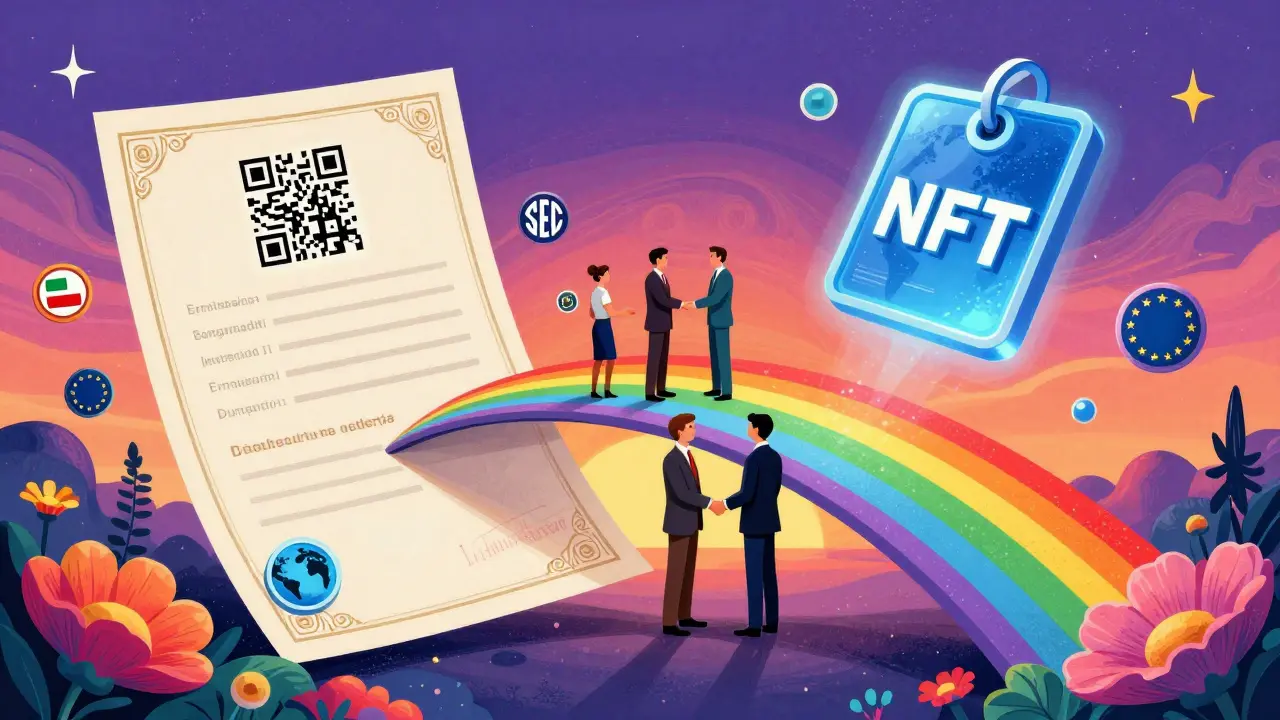
In the U.S., only three states have passed laws specifically recognizing blockchain-based property records: Wyoming, Vermont, and Ohio. Wyoming’s 2025 update requires every NFT deed to include a QR code linking to the county’s traditional records. It’s a bridge between old and new.
Other states? They’re stuck. As of early 2025, 27 states introduced bills to regulate real estate NFTs. None passed. That means investors face a patchwork. A property tokenized in New York might need full SEC registration. The same token in Florida might be treated as a simple digital asset. The Blockchain Association documented 42 cases where identical NFT deals required completely different legal documents just because of location.
Outside the U.S., the differences are even sharper. Switzerland treats real estate NFTs as securities if they promise rental income or price appreciation. That means they must be listed on regulated exchanges like SIX Digital Exchange. The UAE went further. In 2023, Dubai launched the world’s first fully regulated real estate NFT exchange. Over 127 properties have been tokenized there since.
Then there’s China. In 2022, the government banned NFTs tied to real-world assets. Zero legal transactions. Even though China leads in blockchain tech, real estate NFTs are off-limits.
Securities Law Is the Biggest Hurdle
The SEC doesn’t care if you call it an NFT. They care if it’s an investment contract.
In 2023, the SEC shut down the REcoin Foundation for selling NFTs that promised profits from property appreciation. The court ruled: if buyers expect to make money from someone else’s effort-like managing the building-it’s a security. That’s not about the tech. It’s about the promise.
That’s why 89% of U.S. real estate NFT projects use security token offerings (STOs), not pure NFTs. They comply with Regulation D (Rule 506(c)) or Regulation A+, which require investor accreditation, disclosures, and audits. Between 2021 and 2024, the SEC filed 17 enforcement actions against non-compliant tokenized property deals.
Even if you’re selling access rights-say, a token that lets you stay in a beach house for 10 days a year-you still need to be careful. If the platform markets it as a “high-return investment,” you’re in securities territory.
How Real Projects Actually Work (The Practical Side)
Successful tokenization isn’t just about coding a smart contract. It’s about legal infrastructure.
Take the $150 million tokenization of a Berlin office building by LAB10. Their secret? A “legal wrapper.” The SPV’s operating agreement says: the blockchain ledger is the official record of ownership. That’s what made it legally enforceable in a German court in February 2025.
Here’s what’s needed to make it work:
- A compliant SPV (usually a Delaware LLC for U.S. properties)
- Smart contracts that mirror legal agreements-not replace them
- KYC/AML checks to meet FATF Travel Rule standards
- Official property deeds linked to NFT metadata
- A smart contract audit from firms like Quantstamp or OpenZeppelin
- A tokenomics whitepaper meeting IOSCO standards
The average cost to tokenize a $1 million property? $47,300. That’s 18% more than traditional securitization. Most of that goes to lawyers, compliance, and audits.
And even then, problems happen. On Reddit’s r/RealEstateNFT community, 68% of users reported title companies refusing to recognize blockchain transfers. One investor in Colorado waited 147 days for a $450,000 deal to close because the county office didn’t know how to process the NFT documentation.
Metaverse Real Estate? Even Wilder
Virtual land in Decentraland or The Sandbox is a whole different beast. Who owns it? The platform? You? The government?
In March 2025, a $2.4 million lawsuit was filed in Florida over a virtual plot that overlapped with real-world coordinates. The buyer claimed ownership. The platform said it could delete the land anytime under its terms of service. The court had no precedent. No one knows who has jurisdiction.
68% of metaverse real estate disputes in 2024 involved this exact conflict: platform rules vs. national property law. There’s no global rulebook. Just a bunch of private contracts with no enforcement power.
What’s Changing in 2026?
The market is growing fast. Real estate tokenization hit $14.2 billion in 2024-up from $3.7 billion in 2023. BlackRock launched its Blockchain Real Estate Fund in January 2025. It only invests in assets with dual on-chain and off-chain title verification. That’s a sign institutions are waiting for clarity.
The European Commission’s MiCA II framework, expected to pass in Q3 2025, will be the first EU-wide standard for real-world asset tokenization. It requires blockchain records to link to official land registries. That’s a game-changer.
The U.S. CFTC and SEC are also moving. In December 2024, they proposed rules requiring all real estate NFT platforms to register as Alternative Trading Systems. That means more oversight, more compliance-but also more legitimacy.
Still, three gaps remain:
- Standardized integration between blockchain ledgers and county property offices
- Clear tax rules for NFT-based ownership transfers
- International dispute resolution for cross-border property NFTs
Without these, the World Economic Forum’s prediction that 10% of global real estate will be tokenized by 2030 won’t happen.
Is It Worth It?
For investors? It’s risky. But it’s also fast. One tokenized Manhattan apartment project using RealT distributed quarterly rental income in 7 days. Traditionally? 90 days.
For homeowners? It’s not ready. You can’t sell your house with an NFT and expect the county to update the deed. Not yet.
The future isn’t NFTs replacing deeds. It’s NFTs enhancing deeds. A QR code on a paper title that links to a blockchain record. A smart contract that triggers the filing of a deed once payment clears. Hybrid systems. Not replacements.
The law is waking up. But it’s moving slowly. If you’re thinking of buying, selling, or tokenizing real estate with NFTs, don’t assume the blockchain protects you. It doesn’t. Only the law does. And right now, the law is still writing the rules.
Kenneth Mclaren
January 1, 2026 AT 09:45They’re lying to you. The government and big banks control the land registries. The NFT is just a shiny distraction so they can quietly seize your property later under ‘national security’ laws. I’ve seen the backdoor code in the smart contracts-they’re all tied to a central server that can freeze or delete your NFT anytime. This isn’t innovation. It’s a trap. 🤫
Alexandra Wright
January 3, 2026 AT 08:45Oh sweet baby Jesus, another ‘blockchain will fix everything’ dreamer. Let me break it to you gently: if your lawyer hasn’t signed off on the deed AND the NFT metadata links to the county’s official system, you own a digital post-it note with a fancy logo. I’ve seen three deals collapse because someone thought ‘smart contract’ meant ‘magic spell.’ Stop buying NFTs like they’re crypto lottery tickets. You’re not a pioneer-you’re the sucker in the story.
Jack and Christine Smith
January 5, 2026 AT 05:33ok so i read this whole thing and honestly?? i’m confused but also kinda excited?? like… what if we just… combined the paper deed with the nft? like a qr code on the title that links to the blockchain? that way grandma can still understand it but we get the speed? also why is everyone so mad?? it’s just tech!! 🤷♀️
Jackson Storm
January 5, 2026 AT 11:46Hey, if you're thinking about getting into real estate NFTs, don't panic-but do your homework. Look for projects that use a Delaware LLC wrapper and have had their smart contracts audited by OpenZeppelin. Also, make sure the NFT metadata includes the official property ID from the county. That’s the only way it’ll hold up in court. And yeah, it’s expensive-like $50k for a $1M property-but cheaper than losing it all because you skipped the legal stuff. You got this.
Raja Oleholeh
January 6, 2026 AT 18:46USA and Europe think they own the future. India has real land laws. Blockchain is just western distraction. 🇮🇳
Prateek Chitransh
January 8, 2026 AT 18:37Wow, Raja, that’s… a perspective. But let’s not pretend the U.S. system is flawless either. India’s land records are a nightmare too-over 70% of disputes are still tied to paper deeds lost in dusty offices. Maybe the real question isn’t ‘whose system is better’ but ‘how do we fix both?’ NFTs aren’t the enemy. Laziness is.
Michelle Slayden
January 9, 2026 AT 04:57It is imperative to underscore that the legal architecture governing real property has evolved over centuries to ensure certainty, continuity, and enforceability. The introduction of blockchain-based instruments, while technologically sophisticated, does not, ipso facto, confer legal title absent statutory recognition and formal recordation in the public registry. To conflate cryptographic provenance with legal ownership is not merely an error-it is a jurisprudential peril. The law, in its essence, is not a protocol-it is a social contract.
christopher charles
January 9, 2026 AT 07:50Okay okay okay-so here’s the thing: I bought an NFT for a cabin in Colorado last year. The seller swore it was legit. Turned out the county had NO RECORD of it. I had to hire a lawyer, pay $12k in fees, and wait 5 months just to get the paper deed updated. The blockchain? It showed I paid. But the county? They didn’t even know what a wallet was. So yeah-NFTs are cool. But if your lawyer doesn’t sign off, you’re just holding a fancy JPEG of someone else’s house.
Vernon Hughes
January 9, 2026 AT 22:27The future is hybrid. Not replacement. Paper deeds with QR codes. Smart contracts that auto-file deeds when payment clears. That’s it. No drama. No hype. Just work.
Alison Hall
January 10, 2026 AT 21:07So if you’re thinking of investing-just start small. Find one project that’s already done it right (like that Berlin office building). Watch how they link the NFT to the deed. Learn the steps. You don’t need to be a coder. Just be careful. And celebrate the progress, even if it’s slow. We’re building the future, one legal doc at a time 💪