
Crypto Mining Energy Calculator
Legal Mining Requirements (2025)
Under Kosovo's 2025 regulations, crypto mining is only legal if powered by renewable energy. This calculator shows the solar/wind capacity needed to support mining operations without using the national grid.
Why This Matters
Kosovo's 2025 regulations require miners to:
- Use only renewable energy (solar, wind, biomass)
- Register all equipment with government
- Prove energy source through serial tracking
Renewable Energy Requirements
Total monthly energy needed: 0 kWh
Equivalent solar capacity needed: 0 kW
Comparison: This equals the output of 0 average households.
Enter your mining setup details to see renewable energy requirements.
Note: Kosovo requires 100% renewable energy for legal mining operations.
On January 4, 2022, Kosovo shut down its entire cryptocurrency mining industry overnight. No warning. No grace period. Just police raids, seized machines, and a total ban on mining using the national power grid. The reason? The country was running out of electricity.
Kosovo, a small Balkan nation with just 1.8 million people, was already struggling to keep the lights on. One of its two major coal plants had shut down. Imports were expensive and unreliable. Families were facing daily blackouts. And in the middle of it all, hundreds of crypto miners were running thousands of high-powered computers - all on free or heavily subsidized electricity.
One miner in northern Kosovo, known only as Dragan, was making up to 2,000 euros a month - five times the average salary. He wasn’t stealing power. He was using it legally, because the system didn’t charge him for it. But when the grid started failing, the government had to choose: keep the hospitals running, or let miners keep mining Bitcoin.
How Crypto Mining Drained Kosovo’s Power Grid
Crypto mining isn’t like browsing the web or streaming videos. It’s a constant, 24/7 energy hog. Machines called ASICs - specialized computers built only for mining - burn through electricity like a furnace. Each machine can pull as much power as a small home. In Kosovo, where the average household uses about 300 kWh per month, a single miner could be using 10 times that.
Before the ban, mining operations were everywhere - warehouses, garages, even basements in villages. Miners didn’t need permits. There were no rules. And because electricity was priced below cost, it was the perfect setup for profit. But when the government couldn’t pay for imported power, the math changed. Every kilowatt used by a miner was one less for a hospital, a school, or a heating system in winter.
By late 2021, the state was importing 40% of its electricity. Prices were soaring. The energy ministry warned the country could face total blackouts. The only way to stop the drain was to cut off the biggest user - crypto mining.
The Raid and the Aftermath
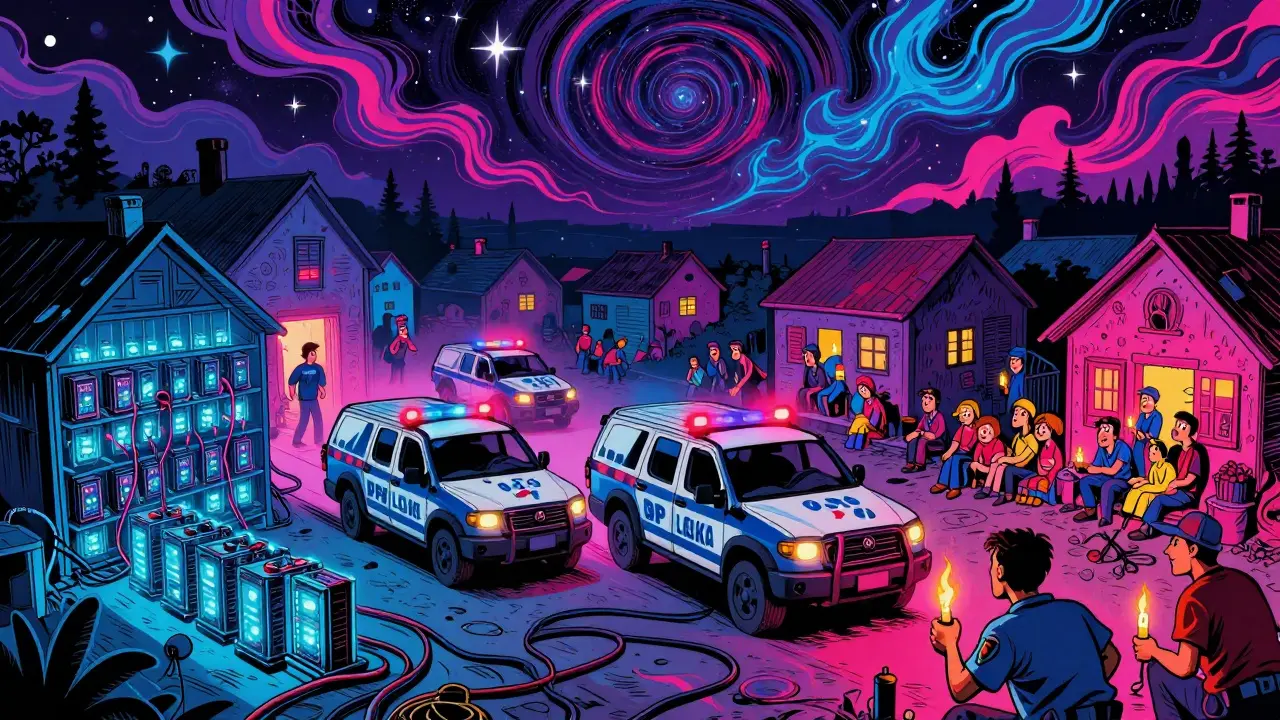
The ban didn’t come with a press release. It came with police in military trucks. Officers stormed mining farms, confiscated ASICs, and shut down operations on the spot. In some cases, they seized hundreds of machines at once. Each rig was worth between 20,000 and 30,000 euros. Thousands of machines vanished overnight.
Miners lost everything. Some had borrowed money to buy equipment. Others had quit their jobs to mine full-time. Now they had nothing but debt and a government that told them it was illegal to use electricity they thought was free.
But the ban didn’t just hurt miners. It hurt the economy. Kosovo’s informal tech scene, which had been growing quietly for years, took a major hit. Equipment suppliers, electricians who installed wiring, even local cafes that sold coffee to miners - all lost business. The ban was necessary, but it was brutal.
From Ban to Regulation: What’s Allowed Now in 2025
By 2023, Kosovo realized a total ban wasn’t sustainable. Miners didn’t disappear - they just went underground. Some started using solar panels or small diesel generators. Others moved to neighboring countries. But the government knew crypto mining wasn’t going away. The question became: How do you control it?
In 2025, the rules are clear: crypto mining is legal - but only if you don’t use the national power grid.
If you want to mine Bitcoin, Ethereum, or any other coin, you must power your rigs with your own renewable energy - solar, wind, or biomass. You can’t plug into the wall. You can’t rely on public electricity. You must generate your own. And you must register your equipment with the government.
This isn’t just about saving energy. It’s about accountability. The government now requires miners to prove where their power comes from. They track the serial numbers of mining rigs. They monitor transactions to prevent money laundering. And they’re working on a new law - 90% complete - that will finally bring crypto mining under formal regulation.
The European Commission pushed hard for this. They wanted Kosovo’s rules to match EU anti-money laundering standards. That’s why the law has taken so long. It’s not just about electricity. It’s about global compliance.
Why Kosovo’s Approach Matters Globally
Kosovo isn’t alone. In 2021, China banned crypto mining outright - and suddenly, half the world’s Bitcoin mining vanished. Other countries like Egypt, Algeria, and Morocco followed with similar bans. But Kosovo’s path is different.
Instead of killing the industry, Kosovo is trying to tame it. They’re saying: You can mine, but only if you don’t hurt the country. It’s a model other energy-strapped nations are watching closely.
Think about it: 61% of Bitcoin mining worldwide still runs on fossil fuels - coal, oil, gas. Only 39% uses renewables. That’s not sustainable. Kosovo’s rule forces miners to go green. If you want to profit from crypto, you have to pay for it with clean energy. That’s not a punishment. It’s a smart incentive.
Other countries could learn from this. Instead of banning mining because it uses too much power, why not make clean power the only option? Kosovo turned a crisis into a chance to build a cleaner, more responsible crypto economy.
The Human Cost and the Road Ahead
Still, the pain hasn’t faded. Many miners who lost their equipment in 2022 never recovered. Some left the country. Others switched to legal tech jobs. A few are still trying to mine - but now they’re installing solar panels on their roofs, hoping to generate enough power to run one or two machines.
The government estimates that less than 5% of pre-ban mining activity has returned - all under the new rules. That’s a small number, but it’s growing. And it’s legal.
The big question now is whether the new cryptocurrency law will pass. It’s been delayed for over two years, mostly because of EU pressure to tighten anti-money laundering rules. But if it passes, Kosovo could become the first country to successfully regulate crypto mining without killing it.
For now, miners who follow the rules are allowed to operate. Those who try to sneak back onto the grid risk fines, equipment seizure, and even jail time. The message is simple: Don’t use our power. Use your own. Or don’t mine at all.
What This Means for You
If you’re thinking about starting a crypto mining operation, Kosovo’s story is a warning - and a blueprint.
Don’t assume electricity will always be cheap. Don’t assume governments will let you use public resources for private profit. And don’t ignore the environmental cost. Crypto mining isn’t magic. It’s physics. It needs power. And power is finite.
The future of mining isn’t in cheap grids. It’s in solar farms, wind turbines, and off-grid systems. Kosovo didn’t ban crypto. It forced it to grow up.
John Sebastian
December 15, 2025 AT 12:22So let me get this straight - the government kicks out hundreds of people who were legally using subsidized power, and now we’re supposed to applaud them for making miners use solar? That’s not innovation. That’s just guilt-tripping the poor into becoming eco-warriors while the real culprits - big utilities and corrupt officials - walk away clean.
And don’t give me that ‘they had to choose hospitals over Bitcoin’ nonsense. If the grid was this broken, why wasn’t there any investment in infrastructure for years? This isn’t a moral victory. It’s a failure of governance dressed up as environmentalism.
Jessica Eacker
December 16, 2025 AT 14:57I know it sounds harsh, but Kosovo did the right thing. People were losing heat in winter because miners were running rigs in basements. Kids couldn’t do homework because the lights went out. This wasn’t about punishing crypto - it was about protecting human dignity.
Now, forcing miners to go off-grid? That’s genius. It turns a problem into a solution. Imagine if every country did this - crypto would finally have to grow up and stop being an energy parasite. No guilt. No drama. Just responsibility.
Andy Walton
December 17, 2025 AT 02:17bro like… what if the miners were just trying to survive in a broken system? 🥲
i mean, imagine being dragan - you’re not some rich wall street guy, you’re just some dude in a village with a garage full of rigs trying to make 2k a month because the economy collapsed and no one gave a shit.
now the government comes in like ‘nope, ur energy is stolen’ but wait… it was LEGAL?? 😭
so now they’re like ‘oh but you can mine if you get solar’ - sure, but how much does a solar setup cost? 10k? 20k? who’s gonna pay that? not the guy who lost everything.
we’re glorifying oppression as ‘sustainability’ and calling it progress. 🤡
also i think the earth is a living entity and crypto is just its immune system reacting to capitalism’s cancer… but idk man i’m just vibin’
🪐⚡️🌙
Candace Murangi
December 18, 2025 AT 20:54What’s interesting is how Kosovo didn’t just ban - they restructured. Most countries react with panic. They outlaw, they fear, they ignore the human cost.
Kosovo looked at a mess and said, ‘Okay, this isn’t going away. So let’s make it accountable.’ That’s leadership.
I’ve seen this in other post-conflict societies - when institutions are weak, people find loopholes. But when you give them a clear, fair path forward? They take it. The fact that 5% of mining came back legally? That’s not failure. That’s hope.
And honestly? If your mining operation can’t run on solar, maybe you shouldn’t be mining. The world’s changing. Adapt or get left behind.
Albert Chau
December 20, 2025 AT 18:19Let’s be real - this is just another case of a weak government using crypto as a scapegoat. If Kosovo had proper energy policy, they wouldn’t have let mining grow unchecked in the first place.
Now they’re pretending this is a ‘model’ for the world, but it’s really just a power grab wrapped in greenwashing. The real winners? The EU, who got to dictate terms, and the big energy conglomerates who now control the renewable supply chain.
Miners are the pawns. The ‘green’ solution? A new form of exploitation disguised as progress.
Eunice Chook
December 21, 2025 AT 07:26Jessica Petry
December 22, 2025 AT 15:10Oh please. ‘Kosovo turned a crisis into a chance’? That’s the kind of corporate PR nonsense that makes me gag.
They didn’t ‘tame’ crypto - they crushed a grassroots tech movement and replaced it with bureaucratic compliance. Now miners need permits, serial number tracking, and EU-approved anti-money laundering paperwork just to run a single ASIC powered by their rooftop solar.
This isn’t innovation. It’s control. And the fact that people are calling this ‘brilliant’ just proves how starved for virtue signaling we’ve become.
Real sustainability isn’t about who gets to mine - it’s about who gets to decide.