

Imagine paying less than five cents for the same amount of electricity that costs you over a dollar in your local grid. Now imagine using that power to mine Bitcoin, which normally requires massive energy inputs. This is not a hypothetical scenario; it is the daily reality in Iran. The country has become one of the world’s most profitable hubs for cryptocurrency mining, but this economic advantage comes at a steep social and infrastructural cost. While miners enjoy profit margins that dwarf global competitors, ordinary Iranians face rolling blackouts and soaring household prices.
The core issue lies in how the government structures its energy subsidy system. By artificially keeping industrial and residential rates low, the state creates an environment where mining becomes incredibly lucrative. However, this model strains a power grid that is already operating below capacity. As we look at the situation in mid-2026, the tension between generating foreign currency through crypto and maintaining basic electricity access for citizens has never been higher.
The Economics of Subsidized Mining
To understand why Iran is such a major player in the mining space, you have to look at the numbers. In many parts of the world, mining Bitcoin is a tight-margin business. You need cheap power, efficient hardware, and stable internet. In Iran, the first two are heavily manipulated by policy.
According to reports from early 2025, the cost to mine a single Bitcoin in Iran was estimated at around $1,300. Compare that to Italy, where the cost can skyrocket to over $300,000 due to high energy tariffs and carbon taxes. Even compared to other mining-friendly nations like Kazakhstan, where costs hover around $5,000 per coin, Iran’s edge is staggering. With global Bitcoin prices ranging between $30,000 and $40,000 in late 2024 and into 2025, Iranian miners were seeing profit margins of 20 to 30 times their production cost.
This profitability stems from the subsidized electricity rates. Licensed miners pay industrial tariffs that still feel like pocket change globally-roughly $0.04 to $0.07 per kilowatt-hour (kWh). Household rates are even lower, often dipping to $0.01 to $0.02 per kWh. These figures are a fraction of what miners in Europe or North America pay. The result? A flood of capital into the sector, with projections showing the industry generating $1.5 billion annually by 2025, growing at nearly 24% year-over-year.
| Region/Country | Est. Cost to Mine 1 BTC | Electricity Rate (per kWh) | Grid Stability |
|---|---|---|---|
| Iran | $1,300 | $0.01 - $0.08 | Poor (Frequent Outages) |
| Kazakhstan | $5,000 | $0.05 - $0.10 | Moderate |
| Italy | $306,000+ | $0.20 - $0.40+ | High |
| United States (Avg) | $15,000 - $25,000 | $0.05 - $0.15 | High |
The Hidden Cost: Grid Strain and Blackouts
If the economics are so good, why is there controversy? The answer is simple: physics. The Iranian power grid is old, underinvested, and struggling to meet basic demand even without crypto. Mining is energy-intensive. Producing one Bitcoin requires over 300 megawatt-hours of electricity. That is enough power to run roughly 35,000 average Iranian households for a day.
By mid-2025, official estimates suggested that legal and illegal mining operations combined consumed nearly 2,000 megawatts (MW) of power. While this might sound small compared to the total national output, it represents about 5% of Iran’s total electricity consumption. More critically, it accounts for 15-20% of the country’s electricity imbalance-the gap between supply and peak demand.
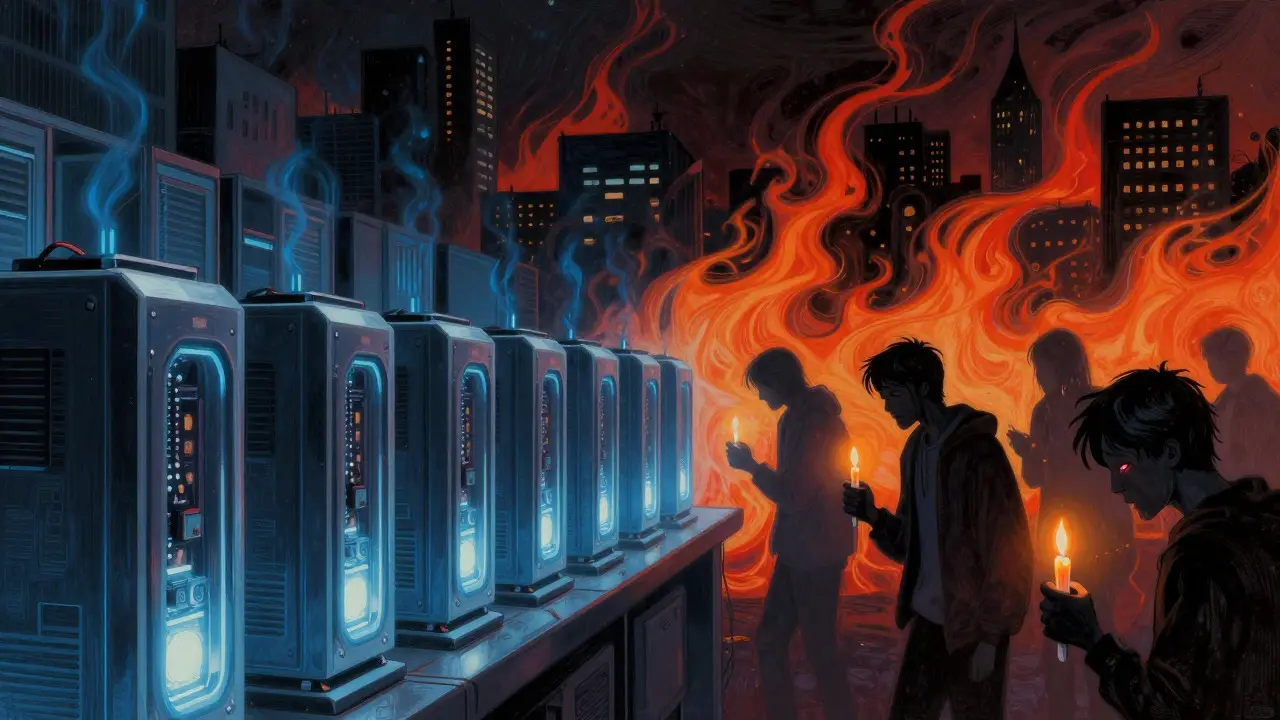
The impact on regular people is severe. During summer months, when air conditioning demand spikes by 30-40%, the grid buckles. We saw this clearly in July 2025. During a period of regional conflict that caused a nationwide internet outage, power consumption dropped by 2,400 MW almost instantly. Why? Because over 900,000 illegal mining devices went offline when the internet cut out. This sudden drop validated long-held suspicions about the scale of hidden mining farms draining the grid.
Citizens are feeling the pinch. Social media platforms like X (formerly Twitter) and Telegram channels dedicated to tracking electricity crises report blackouts lasting 8 to 12 hours a day during peak summer weeks. One resident in Tehran noted in August 2025, “These power cuts are endless. I can’t take it anymore. They only mine cryptocurrency, but we are deprived of electricity.” This sentiment is widespread, with surveys indicating that over 90% of users blame crypto mining for their daily disruptions.
Legal vs. Illegal Operations
The Iranian government walks a tightrope. On one hand, they want the foreign exchange generated by mining to help bypass international sanctions. On the other hand, they cannot afford to let the grid collapse entirely. This has led to a complex regulatory environment that splits miners into two camps: the licensed and the unlicensed.
Licensed Miners: To operate legally, you need approval from the Ministry of Industry, registration with the Iran Power Generation Company, and authorization from the Central Bank of Iran (CBI). The process takes 3 to 6 months, and fewer than 40% of applicants get approved. If you make it, you pay industrial rates ($0.04-$0.07/kWh) and must sell your mined coins to the state for trade settlement. You also face mandatory commissions of 15-20% to state-approved mining pools.
Illegal Miners: Because the barriers to entry are high and the profits are massive, a huge shadow economy has emerged. Estimates suggest that illegal miners consume up to two gigawatts of power daily-that’s equivalent to the entire electricity usage of Tehran, a city of 9 million people. These operators tap directly into household grids, using subsidized residential rates ($0.01-$0.02/kWh) to maximize profits. They avoid taxes, regulations, and state commissions.
The government’s response has been aggressive. In the first half of 2025 alone, Tavanir (the national power company) reported 8,432 citizen complaints leading to 2,157 shutdowns of illegal rigs. They even introduced a bounty program, offering 10% of recovered electricity costs to anyone who reports illegal mining. Yet, the problem persists because the incentive to cheat is simply too high.
The Role of the IRGC and State Control
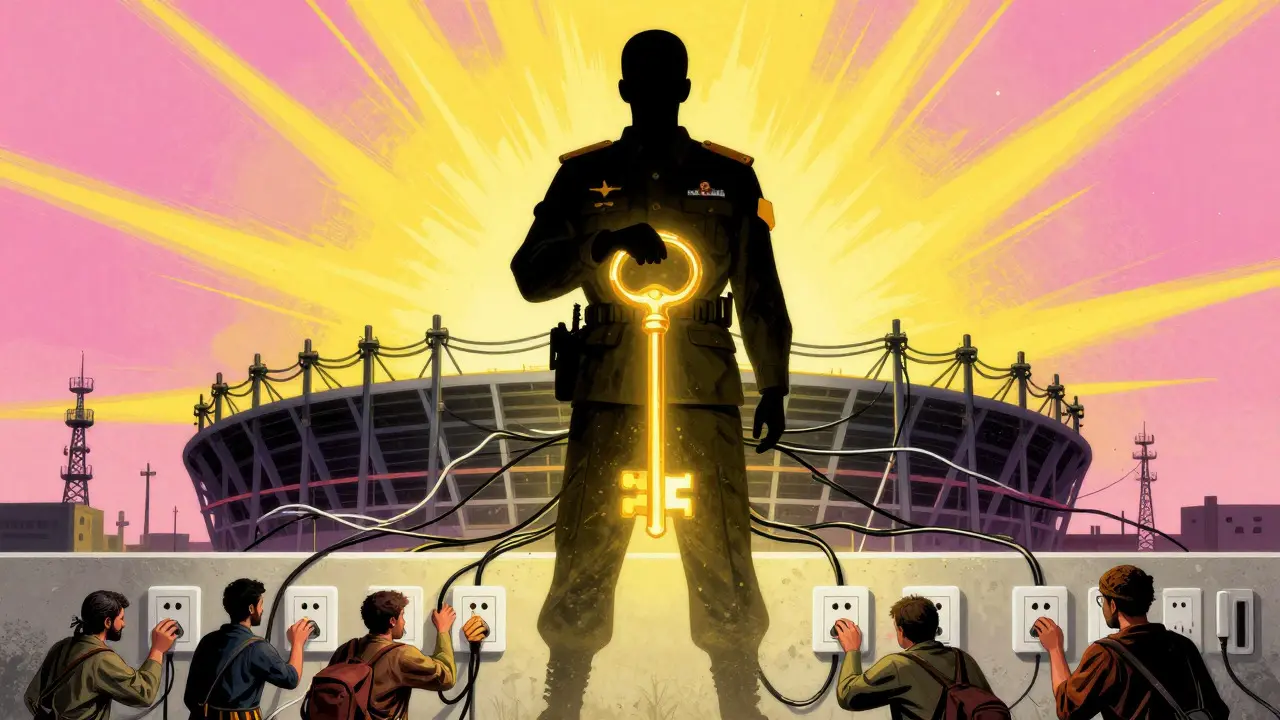
You cannot talk about Iranian crypto mining without mentioning the Islamic Revolutionary Guard Corps (IRGC). Analysis from early 2025 suggests the IRGC controls approximately 60% of all mining operations, both legal and illegal. They use front companies and leverage their control over infrastructure to secure prime locations for mining farms.
One infamous example is the discovery of a large-scale mining operation inside the tunnels of Ahvaz Stadium in April 2025. These facilities run 24/7, often while surrounding neighborhoods suffer blackouts. Critics argue this is "state-sanctioned theft" of public resources. Dr. Saeed Laylaz, an economic advisor, described it as a parallel economy where the military wing controls both the energy supply and the digital output, bypassing central bank oversight entirely.
This concentration of power creates political friction. Energy Minister Ali Akbar Mehrabian defends the practice, arguing that regulated mining generates $800 million annually in foreign exchange, which offsets the energy costs. But opponents point out that much of this revenue doesn't trickle down to fix the grid; instead, it bolsters specific state entities while the general infrastructure continues to degrade.
Regulatory Crackdowns and Future Outlook
As of 2026, the government is tightening its grip. New rules require all mining operations to be housed in industrial-scale facilities equipped with smart meters for real-time monitoring. The days of hiding ASIC miners in basements are ending, at least officially. Tariffs for licensed miners have also crept up slightly to $0.05-$0.08/kWh, attempting to reflect true costs without killing the industry.
However, the fundamental dilemma remains. The International Energy Agency predicts that without significant grid upgrades, power shortages could worsen by 25-30% by 2027. The Carnegie Endowment notes that Iran’s approach is a classic case of short-term economic gain versus long-term sustainability. The government will likely continue its cycle of periodic bans during summer peaks, allowing mining to resume in winter when demand is lower.
For the global crypto market, Iran remains a wild card. Its miners are highly efficient due to low costs, but their reliability is questionable. When the grid fails, thousands of hashes disappear from the network overnight. Investors and exchanges dealing with Iranian-sourced crypto must account for this volatility and the geopolitical risks associated with sanctions.
How much does it cost to mine Bitcoin in Iran compared to the US?
In Iran, the estimated cost to mine one Bitcoin is around $1,300, driven by heavily subsidized electricity rates of $0.01-$0.08 per kWh. In contrast, the average cost in the United States ranges from $15,000 to $25,000 per coin, with electricity rates typically between $0.05 and $0.15 per kWh. This makes Iranian mining significantly more profitable on paper, despite infrastructure risks.
Does the Iranian government allow cryptocurrency mining?
Yes, but with strict conditions. Mining was legalized in 2018, and the government issues licenses to select operators. However, domestic use of cryptocurrency for payments is prohibited. Licensed miners must sell their mined coins to the state for cross-border trade settlements to help circumvent international sanctions. Unlicensed mining is illegal and actively cracked down upon.
How does crypto mining affect electricity blackouts in Iran?
Crypto mining consumes a significant portion of Iran's limited power supply, accounting for 15-20% of the electricity imbalance during peak demand. During summer months, when air conditioning usage spikes, the strain from millions of mining devices contributes heavily to rolling blackouts. Data shows that when internet outages force mining rigs offline, national power consumption drops by thousands of megawatts, highlighting the direct link between mining activity and grid instability.
Who controls the majority of crypto mining in Iran?
Reports indicate that the Islamic Revolutionary Guard Corps (IRGC) controls approximately 60% of mining operations, either directly or through affiliated front companies. This includes both large-scale legal facilities and extensive networks of illegal miners tapping into residential grids. The IRGC uses these operations to generate foreign currency and consolidate economic power outside standard central bank oversight.
What are the penalties for illegal crypto mining in Iran?
Penalties include the confiscation of mining equipment, fines based on unpaid electricity costs, and potential arrest. The government has launched campaigns encouraging citizens to report illegal miners, offering bounties equal to 10% of the recovered electricity costs. In 2025 alone, thousands of illegal setups were shut down following citizen reports.