

Decentralized Storage Recommender
Input Your Requirements
Recommendation
Select your requirements to see the best solution
Imagine storing your life’s work-photos, videos, documents, even your NFTs-on a system that can’t be shut down, censored, or lost. No more worrying about a single company going bankrupt or changing its terms. That’s the promise of decentralized storage. But not all solutions are built the same. IPFS, Arweave, and Filecoin all promise to replace cloud giants like Amazon and Google, yet they work in wildly different ways. Choosing the wrong one could mean losing your data, overspending, or ending up with something that doesn’t last.
What Is IPFS, Really?
IPFS, or InterPlanetary File System, isn’t storage. It’s a way to find files. Think of it like a library catalog that tells you where a book is, but doesn’t own the book itself. When you upload something to IPFS, it gets a unique address based on its content-not its location. That means if ten people have the same file, IPFS only stores one copy. It’s efficient. It’s fast. And it’s useless if no one is keeping that file alive.
Here’s the catch: IPFS doesn’t keep your data by default. If you upload a photo and then shut down your computer, and no one else is "pinning" it (keeping a copy), that photo disappears. It’s like leaving a book on a park bench and hoping someone else picks it up. That’s why most people use IPFS with pinning services like Pinata. Pinata charges $0.50 per GB per month to keep your files alive. It’s not free. It’s not permanent. It’s just convenient.
Developers love IPFS because it’s easy to integrate. You can get basic functionality working in a few hours using JavaScript. But if you want true persistence, you need to layer something else on top. That’s where Filecoin comes in.
Filecoin: Pay to Keep Your Data Alive
Filecoin is IPFS with a wallet. Built by the same team behind IPFS, Filecoin adds a blockchain-based marketplace where people pay to store data and others get paid to host it. It turns storage into a job. Miners offer hard drive space. Clients pay for it. Contracts are enforced by code.
Filecoin uses two clever proofs: Proof of Replication (PoRep) and Proof of Spacetime (PoSt). These ensure miners aren’t cheating-like claiming they’re storing your data when they’re just holding a shortcut. As of mid-2025, the network holds 14 exbibytes of data across 3,500+ storage providers. That’s massive.
Cost-wise, you pay annually-$200 to $1,000 per terabyte, depending on how long you want to store it and how many copies you need. It’s flexible. You can cancel. You can upgrade. But you have to remember to pay. Miss a payment? Your data gets deleted. There are real stories of users losing hundreds of dollars’ worth of data because they forgot to renew.
Running a Filecoin miner isn’t for beginners. You need 128GB of RAM, 32TB of storage, and a powerful CPU. Most people don’t mine-they just rent space. But even renting requires managing deals, monitoring uptime, and dealing with network complexity. One Reddit user spent 30 hours a month just keeping their storage deals alive. They gave up and went back to AWS.
Filecoin’s big win? It’s the go-to for big projects. 67 Fortune 500 companies use it for temporary data storage. AI training datasets, video archives, backup systems-all of it lives on Filecoin because it’s scalable and affordable for short-term needs.
Arweave: Pay Once, Store Forever
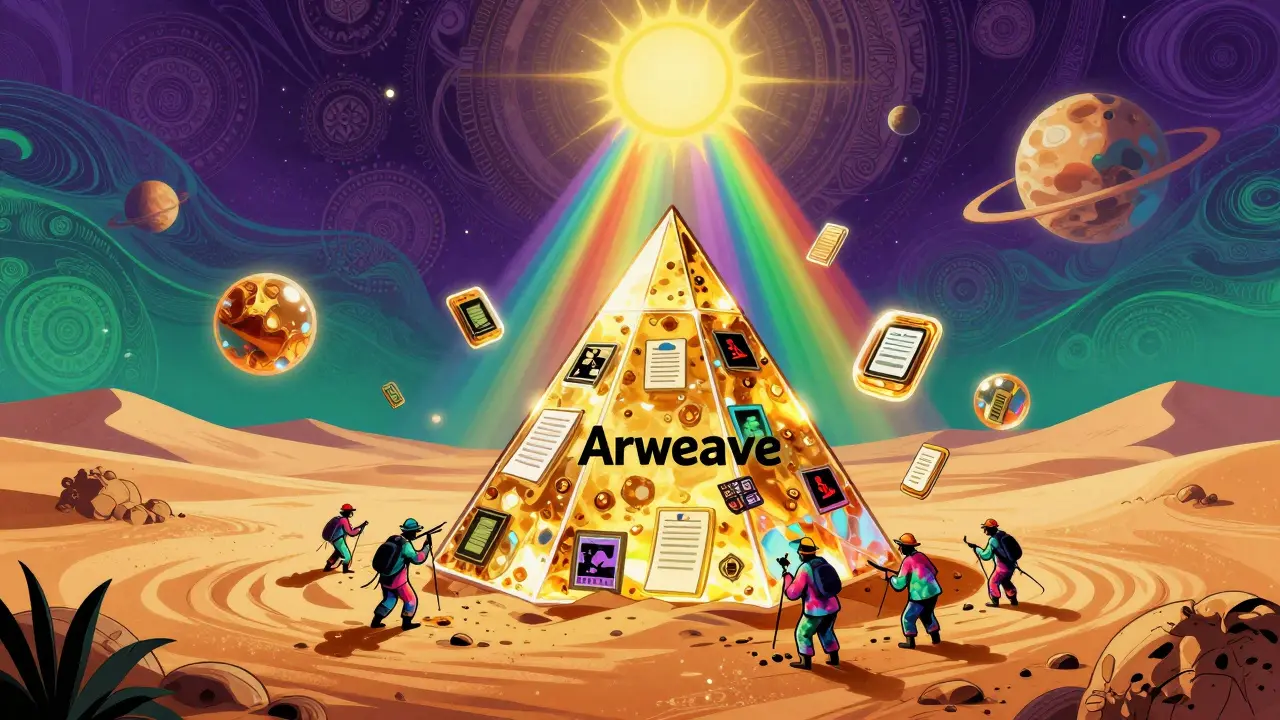
Arweave is the odd one out. It doesn’t ask for monthly payments. It doesn’t rely on ongoing contracts. You pay once-around $3,500 per terabyte in 2025-and your data is stored forever. Not for 10 years. Not for 100. Forever. That’s the promise.
How? Arweave uses something called the "endowment model." When you pay, part of your fee goes to the miner who stores your data now. The rest goes into a permanent fund that pays future miners to keep copying your data. The math is built into the protocol. As long as the network exists, your file survives.
It’s backed by a unique consensus mechanism called Proof-of-Access. Miners don’t just store new data-they must prove they can access old blocks to create new ones. This forces them to keep everything. The result? Your file is replicated between 100 and 1,000 times across the network. That’s more redundancy than any centralized cloud provider offers.
Arweave stores over 130 terabytes of permanent data. It’s the default for NFT metadata. 78% of top Ethereum NFT collections use Arweave because once the art is minted, the link must never break. DAOs use it for governance records. Archives use it for historical documents. One user on Reddit spent $1,200 to store 400GB of DAO history. Eighteen months later, it’s still there-no maintenance, no renewals, no stress.
But it’s not perfect. The upfront cost is steep. For the same storage, Arweave is 3.5 to 17.5 times more expensive than Filecoin’s annual rate. And while Arweave has 8,000 nodes, that’s tiny compared to IPFS’s 1.2 million. Critics worry that if a major country bans it, the network could struggle to recover.
Still, for permanent data, nothing else comes close. And in March 2025, Arweave’s Permavision upgrade cut storage costs by 18% using AI to optimize redundancy. It’s getting better.

Which One Should You Use?
Let’s cut through the noise. Here’s how to choose:
- Use IPFS if you’re a developer testing something quick, or if you’re already using it as a content-addressing layer and plan to layer on Filecoin or Pinata for persistence.
- Use Filecoin if you need to store large, temporary datasets-like AI training data, video backups, or quarterly reports-and you’re okay managing renewals and costs.
- Use Arweave if your data must last forever: NFT metadata, legal records, historical archives, or anything you don’t want to lose when you’re gone.
Most people don’t need to pick just one. In fact, the smartest setups use all three. IPFS for fast access, Filecoin for bulk temporary storage, and Arweave for the stuff that matters most.
What’s Next? The Future of Decentralized Storage
The market is growing fast-$3.2 billion in 2025 and climbing. Filecoin leads in adoption, especially among enterprises. Arweave leads in permanence. IPFS is the invisible backbone.
Filecoin just added smart contracts with its FVM upgrade. Now, you can build apps that automatically pay for storage when triggered. Arweave’s AI-driven optimization is making its model more efficient. And IPFS is preparing for quantum computing by adding new encryption to its core protocols.
But threats loom. The SEC is looking at whether Filecoin storage deals are securities. The EU is debating whether Arweave’s permanent storage violates digital laws. And a new protocol called Walrus is coming in late 2025 with $50 per TB per year pricing-far cheaper than both.
For now, Arweave remains the only option for true digital permanence. Filecoin is the most practical for scalable, temporary needs. And IPFS? It’s the foundation. You can’t ignore it.
Real-World Failures and Wins
People have lost data on all three. GitHub issues from early 2025 show 127 NFT projects where metadata vanished because the IPFS pinning service shut down. Filecoin users lost $2.8 million in FIL in Q2 2025 due to failed storage proofs. These aren’t theoretical risks-they’re daily realities.
But the wins are real too. The Internet Archive uses Arweave to preserve public domain books. A DAO in Berlin stored its entire voting history on Arweave and now has a tamper-proof record. A game studio uses Filecoin to store 50TB of game assets, saving 60% over AWS.
The lesson? Don’t trust convenience. Don’t assume it’ll last. Know what you’re storing. Know how long it needs to live. And choose your tool accordingly.
Bottom Line
IPFS is a locator. Filecoin is a rental service. Arweave is a time capsule.
If you’re building an NFT? Use Arweave.
If you’re running a startup with terabytes of data that changes monthly? Use Filecoin.
If you’re just experimenting? Use IPFS with Pinata.
There’s no single best option. There’s only the right one-for your data, your budget, and your future.
Ankit Varshney
December 2, 2025 AT 03:30Arweave’s endowment model is the only thing that gives me peace of mind when storing digital artifacts. I’ve lost data before on centralized services - it’s not a theoretical risk, it’s a trauma. Paying once and walking away? That’s not storage, that’s legacy.
Ann Ellsworth
December 3, 2025 AT 20:48Let’s be real - IPFS without pinning is just digital hoarding with a fancy name. You’re not decentralizing anything if your data vanishes the second you close your laptop. And Filecoin? Please. It’s AWS with a blockchain veneer and a side of operational hell. Only Arweave understands permanence as a philosophical imperative, not a business model.
And don’t get me started on the SEC’s impending regulatory overreach - they’ll classify storage deals as securities because they can’t comprehend non-financial utility. Meanwhile, real creators are archiving democracy’s digital breadcrumbs while bureaucrats debate compliance forms.
Also, the 18% cost reduction via AI in Permavision? That’s not optimization - that’s evolution. The network is learning to be immortal. Meanwhile, Filecoin’s miners are still arguing over RAM specs like it’s 2017.
And yes, I know the upfront cost is steep. But if your NFT metadata is worth minting, it’s worth preserving. Otherwise, you’re just decorating a digital grave.
Also, typo: ‘exbibytes’ is correct, not ‘exabytes.’ You’re welcome.
Ziv Kruger
December 5, 2025 AT 10:12What does it mean to store something forever? Is it physics? Is it economics? Or is it faith? Arweave asks us to believe that a protocol can outlive nations, corporations, even our own species. That’s not engineering - that’s poetry written in code.
IPFS is a library card. Filecoin is a lease agreement. Arweave is a tombstone carved by algorithm.
We build systems to outlive our fears. The ones who choose Arweave aren’t just storing data - they’re whispering into the void, hoping someone, someday, will hear it.
And maybe that’s the real decentralization: not in the nodes, but in the intention.
Heather Hartman
December 6, 2025 AT 05:54Just wanted to say thank you for this breakdown - I’ve been terrified to dive into decentralized storage because I didn’t know where to start. Your comparison made it feel human. I’m using Arweave for my grandma’s photo collection now. She’d hate that I’m techy, but she’d love that her pictures won’t disappear. That’s worth every penny.
Paul McNair
December 7, 2025 AT 18:04As someone who’s worked with archives in five different countries, I’ve seen what happens when data is tied to corporate whims or political shifts. Arweave isn’t just a tool - it’s a form of cultural resistance. The fact that a DAO in Berlin preserved voting records that can’t be altered? That’s not tech - that’s justice.
Filecoin’s enterprise adoption makes sense for transient data, but let’s not pretend it’s about permanence. It’s about scalability with a ticking clock.
And IPFS? It’s the plumbing. No one notices it until it leaks. Then everyone blames the plumber.
The real win here isn’t cost or speed - it’s autonomy. Choosing your own digital afterlife.
Catherine Williams
December 8, 2025 AT 19:47Heather’s comment made me tear up a little. I’m a 68-year-old retired librarian who just uploaded my 40-year photo archive to Arweave. No one in my family knows how to do this. I had to call my granddaughter for help. She laughed and said ‘Grandma, you’re basically building a time capsule for the apocalypse.’ I told her - no, sweetheart. I’m building a time capsule for the future.
Thank you for writing this. I’m not a techie. But I know what matters.