

When you buy or trade cryptocurrency, you might think you're just sending digital money. But in many countries, that coin or token could be classified as a security-and that changes everything. By 2026, international securities laws for crypto have shifted from chaos to clarity, but the rules vary wildly from one country to the next. What’s legal in Singapore could land you in trouble in Brazil or even get you banned in China. If you’re issuing a token, running an exchange, or just holding crypto, you need to know which laws apply to you-and fast.
Why Crypto Is Treated as a Security (And When It’s Not)
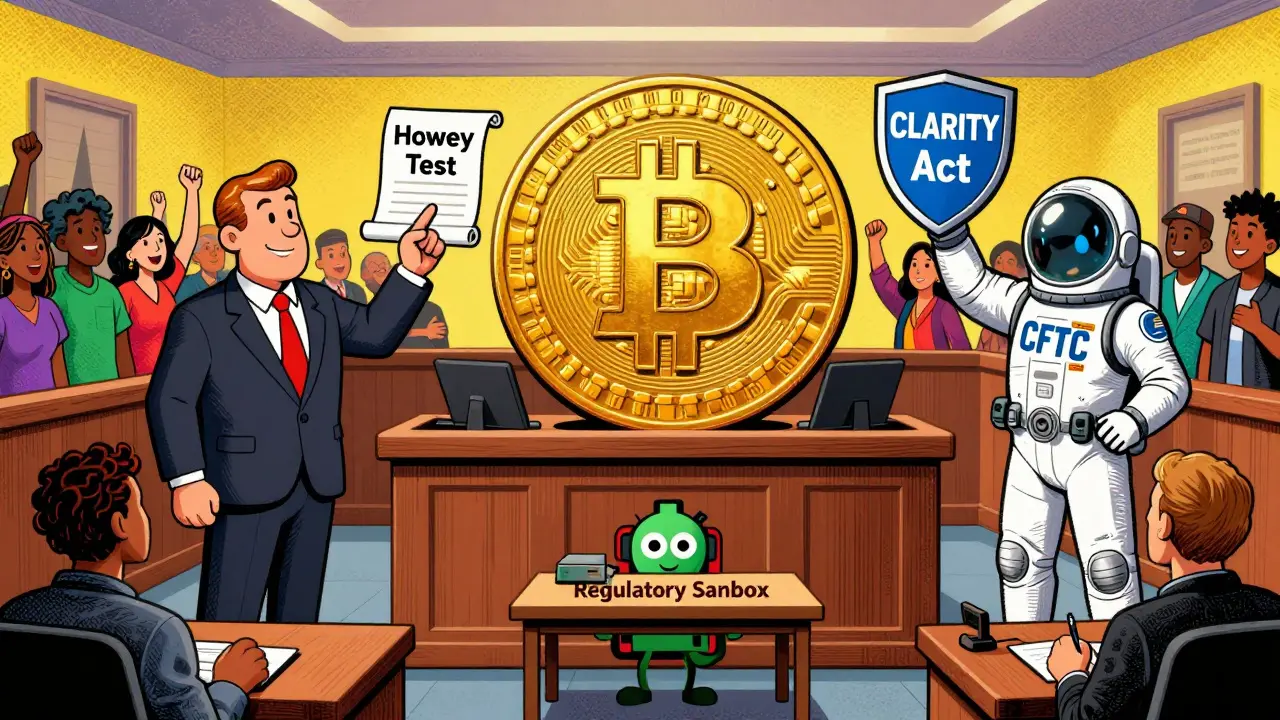
The big question isn’t whether crypto is a security. It’s which crypto is. In the U.S., the SEC used to chase crypto companies with lawsuits, claiming almost every token was an investment contract under the Howey Test. That changed in July 2025. SEC Chair Paul Atkins announced Project Crypto, stating outright that most crypto assets are not securities. This wasn’t a soft shift-it was a policy reset. The Howey Test still exists, but now the SEC is building clear guidelines to help businesses know when they’re crossing the line. If you’re selling a token that promises profits based on someone else’s effort-like a startup raising money with a promise to build a network and pay dividends-you’re likely selling a security. But if you’re trading Bitcoin or Ethereum on a decentralized exchange, where no single group controls the network, you’re likely dealing with a digital commodity, not a security. The CLARITY Act, expected to pass in early 2026, gives the CFTC clear authority over these decentralized digital commodities. The SEC keeps control over tokens that act like stocks-those tied to a company, with promises of returns, or issued through ICOs. This split finally ends years of jurisdictional fights between the two agencies.U.S. Rules: The New Framework
The U.S. now has three major pillars governing crypto under securities and financial law:- GENIUS Act: This law, passed in late 2025, defines payment stablecoins as digital dollars. Issuers must hold 100% reserves in cash or U.S. Treasury bills, get monthly audits, and register with federal regulators. Only approved issuers can create them-no more shady stablecoins floating around with no backing.
- CLARITY Act: Sets the CFTC as the main regulator for decentralized crypto assets (like Bitcoin, Solana, Cardano). The SEC keeps authority over securities-like tokens. No more confusion over who’s in charge.
- OCC Interpretive Letter 1183: National banks can now legally custody crypto, issue stablecoins, and run nodes on blockchain networks. No more asking for permission. No more red tape. This single move opened the door for JPMorgan, Bank of America, and others to fully enter the crypto space.
Europe’s MiCAR: The Strictest Playbook
The European Union’s Markets in Crypto-Assets Regulation (MiCAR) went live in January 2026. It’s the most detailed, rules-heavy framework in the world. If you’re operating in the EU-or even just serving EU customers-you need a license. MiCAR requires:- All crypto exchanges and wallet providers to be licensed by national regulators
- Full identity verification for anyone sending or receiving over €1,000 in crypto-even to self-hosted wallets
- Stablecoin issuers to publish monthly reserve reports and hold enough liquid assets to cover every token in circulation
- Transparency rules for token whitepapers, including risks, team backgrounds, and technical specs
Asia: The Innovation Hubs
While Europe tightens the screws, Asia is building fast-track lanes for crypto. Singapore has a two-tier licensing system: one for large exchanges, another for small startups. It’s the only country that lets you test crypto products under a regulatory sandbox without full licensing. Many DeFi projects now base their legal entity here. Hong Kong launched its own exchange licensing regime in 2025. It requires cold storage, insurance for user funds, and regular audits. It also plans to regulate crypto derivatives and lending platforms-making it the most comprehensive market in Asia. Bahrain and the UAE have become popular for crypto firms looking for fast licensing and low taxes. Both offer sandbox programs and have signed mutual recognition agreements with the U.S. and Singapore. In contrast, Japan still treats crypto as property for tax purposes but requires all exchanges to be registered with the Financial Services Agency. It’s not as open as Singapore, but it’s stable and trusted.Where Crypto Is Banned-And Why
Not every country is welcoming. China banned all crypto trading, mining, and exchanges in 2021-and it hasn’t changed. The government still calls crypto a “financial risk” and has shut down over 1,200 mining operations since then. Brazil took a different path. In 2023, it passed the Cryptoassets Act, making the central bank the main regulator. It doesn’t ban crypto-it just wants to control it. All providers must register, report suspicious activity, and follow anti-money laundering rules. Violations can lead to prison time. India still taxes crypto at 30% with no deductions, but doesn’t ban it. The Reserve Bank of India has blocked banks from serving crypto firms, but courts have ruled that citizens still have the right to trade. The result? A thriving underground market and a government still trying to catch up.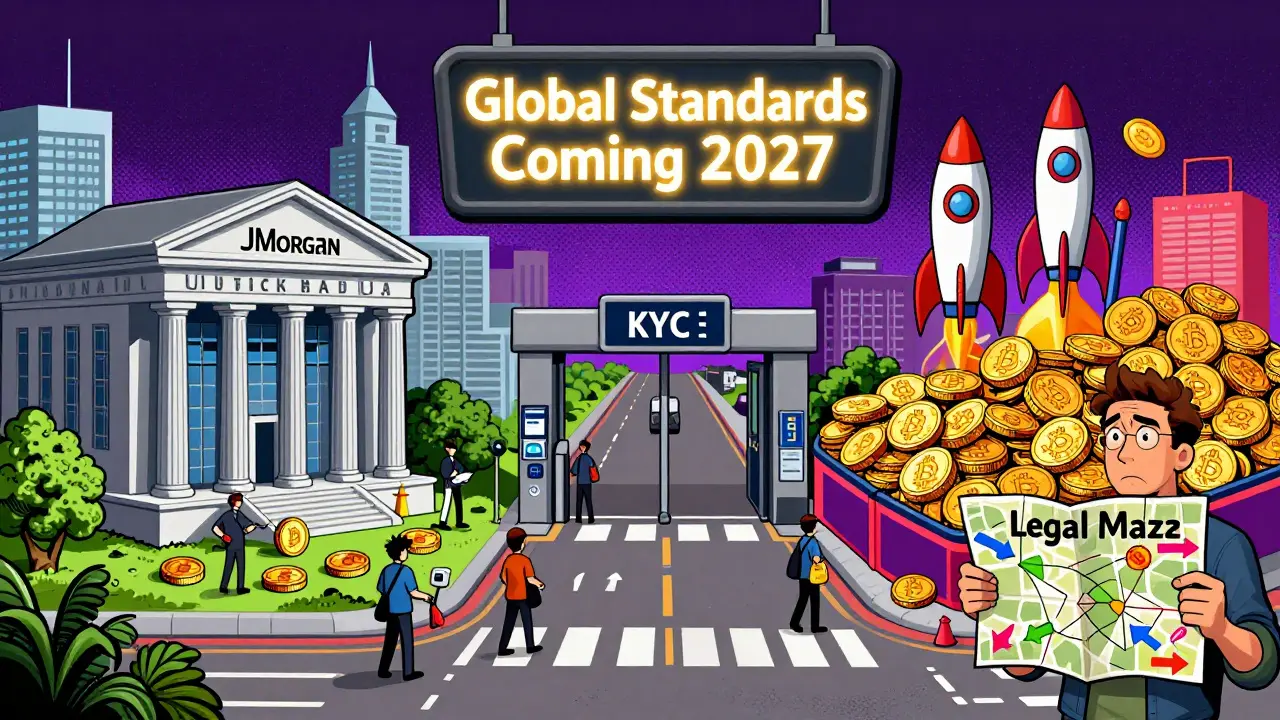
The Real-World Impact: Who Wins and Who Loses
The new rules aren’t just paperwork-they change who can play. Big players win. Coinbase, Binance (outside the U.S.), and Kraken now have legal teams in every major jurisdiction. They can afford compliance, audits, and licensing. They’re getting bank accounts, insurance, and institutional investors. Small startups struggle. A team in Austin building a DeFi protocol might spend $200,000 just to comply with MiCAR and U.S. state money transmitter laws. Many never make it past the legal stage. Users gain protection. If your exchange goes under, you’re more likely to get your money back. Stablecoins are now backed by real cash. Scams are easier to track. But complexity grows. A company operating in the U.S., Europe, and Singapore has to follow three different rulebooks. One token might be a security in the U.S., a commodity in the EU, and unregulated in Singapore. Legal advice isn’t optional anymore-it’s the cost of doing business.What You Should Do Right Now
If you’re holding crypto:- Track where you bought it and when. Keep records of every trade.
- Know your country’s tax rules. Don’t assume the IRS rules apply everywhere.
- Use licensed exchanges. Unregulated platforms can vanish overnight.
- Ask: Is this a security? If yes, you need a lawyer who understands SEC rules.
- Don’t promise returns. That’s the fastest way to trigger securities law.
- Check local licensing rules. Even if you’re based in the U.S., serving EU customers means MiCAR applies.
- Consider jurisdiction. Singapore or Dubai might be cheaper than trying to navigate 50 U.S. state laws.
- Map out your user base. Where are your customers? That determines your legal obligations.
- Plan for audits. The SEC, CFTC, and EU regulators are watching. Monthly reserve reports are now standard.
- Don’t ignore state laws. Even with federal rules, New York’s BitLicense, California’s consumer protection laws, and Texas’s money transmitter rules still apply.
The Future: More Coordination, Less Chaos
The good news? Countries are starting to talk to each other. The Financial Stability Board and the IMF are pushing for global standards. The U.S. and Singapore have signed a crypto regulatory cooperation agreement. The EU is working with Hong Kong on mutual recognition of licenses. By 2027, we may see a few key global standards emerge:- Standard definitions for “security” vs. “commodity” crypto
- Shared reporting formats for stablecoin reserves
- Common anti-money laundering rules for cross-border transfers
Is Bitcoin a security under U.S. law in 2026?
No. Bitcoin is classified as a digital commodity under the CLARITY Act, which gives the CFTC primary jurisdiction. The SEC no longer considers Bitcoin a security because it’s decentralized, has no central issuer, and doesn’t promise returns based on others’ efforts. This is a major shift from past SEC positions.
Can I legally operate a crypto exchange in the U.S. without a license?
No. Even with federal laws like the CLARITY Act, you still need state-level money transmitter licenses in most states. The GENIUS Act also requires stablecoin issuers to register federally. Operating without these licenses risks fines, asset seizures, and criminal charges.
Does MiCAR apply to U.S.-based crypto companies?
Yes-if you serve customers in the European Union. MiCAR applies to any service provider offering crypto services to EU residents, regardless of where the company is based. That means a U.S. exchange with even one EU user must comply with MiCAR’s licensing, KYC, and reserve requirements.
What happens if I trade crypto in a country where it’s banned?
In countries like China or Nigeria, individual trading is often tolerated, but running an exchange or promoting crypto services is illegal. Penalties vary: fines, account freezes, or even imprisonment for businesses. As a private user, you’re unlikely to be targeted-but your bank might block transactions or report activity to authorities.
Are stablecoins regulated the same everywhere?
No. The U.S. requires 100% reserve backing under the GENIUS Act. The EU under MiCAR requires similar backing but adds monthly public reporting. Singapore requires audits but allows some flexibility in reserve types. In contrast, unregulated stablecoins still exist in places like El Salvador or Venezuela-but they’re risky and often unstable.
Steve Fennell
January 20, 2026 AT 09:38Wow, this is actually one of the clearest breakdowns I’ve seen on crypto regulation in 2026. The split between CFTC and SEC finally makes sense-no more regulatory whack-a-mole. Just wish more people understood that Bitcoin isn’t a security. It’s a commodity, plain and simple. 😊
Mathew Finch
January 21, 2026 AT 10:58Of course the U.S. gets it right while Europe strangles innovation with paperwork. MiCAR isn’t regulation-it’s a bureaucratic chokehold. If you’re not based in America, you’re basically a second-class crypto citizen. 🇺🇸
Ryan Depew
January 22, 2026 AT 15:58Let’s be real-most of these laws are just big firms protecting their turf. The CLARITY Act? Nice. But good luck getting a small dev team to afford the compliance audits. Meanwhile, the big exchanges are laughing all the way to the bank with their legal departments on retainer. 💸
Shamari Harrison
January 23, 2026 AT 21:18For anyone holding crypto, especially across borders: keep meticulous records. Every swap, every purchase-even buying coffee with ETH-triggers a taxable event. The IRS doesn’t care if you didn’t cash out. And if you’re in the EU, MiCAR’s KYC rules mean even your self-custody wallet isn’t private anymore. Don’t get caught off guard.
Arnaud Landry
January 25, 2026 AT 03:23They say it’s a legal maze now… but I’ve seen the documents. There’s a backdoor. The SEC’s ‘Project Crypto’ was pushed through right after three top regulators retired. Coincidence? Or was it a quiet handoff to the same players under new names? I’ve got a friend who worked at a compliance firm-he said the new rules were drafted by former Wall Street lawyers who still own crypto. I’m not paranoid. I’m informed. 🕵️♂️
Chidimma Catherine
January 26, 2026 AT 11:44As someone from Nigeria where crypto is the only financial lifeline for millions the government refuses to serve I just want to say thank you for highlighting the global divide. In Lagos we use crypto because we have to not because its trendy. The fact that MiCAR or GENIUS Act even acknowledge stablecoins as legitimate is a win. But please dont forget the people outside the U.S. and EU who are just trying to survive. We need global standards not just for compliance but for dignity
Nathan Drake
January 26, 2026 AT 16:28It’s interesting how we’ve turned finance into a legal engineering problem. We used to trust markets. Now we trust lawyers. The real innovation isn’t in blockchain-it’s in the ability to navigate 50 different regulatory regimes. Are we building a decentralized future… or just outsourcing control to bureaucracies with better logos?