

When a single wallet moves $10 million worth of Bitcoin, the whole market holds its breath. That’s not hype - it’s reality. Crypto whales, the tiny group of investors who control massive amounts of digital assets, don’t just sit on their holdings. They move. And when they do, prices react - often violently.
You’ve probably seen the headlines: "Whale Buys 5,000 BTC, Bitcoin Surges 8%" or "Whale Dumps XPL, Price Crashes 20% in Minutes." These aren’t coincidences. They’re predictable patterns driven by a handful of actors holding disproportionate power. And if you’re trading crypto, especially altcoins, you’re already playing in their game - whether you realize it or not.
What Exactly Is a Crypto Whale?
A crypto whale isn’t a mythical creature. It’s a wallet - sometimes owned by a person, sometimes a fund, sometimes an exchange - that holds enough cryptocurrency to move markets. There’s no official threshold, but experts agree: if you control more than 0.1% of a coin’s total supply, you’re likely a whale. For Bitcoin, that’s around 1,700 BTC. For a smaller token like XPL, it might be just 500,000 tokens.
Here’s the real kicker: 40% of all Bitcoin is held in fewer than 2,000 wallets, according to Bitstamp’s 2023 analysis. That means a tiny fraction of participants controls nearly half the network’s value. And in altcoins? The concentration is even worse. Some tokens have over 30% of supply locked in five wallets. That’s not decentralization. That’s a vulnerability.
How Whales Move Prices: The Mechanics
Whales don’t just dump coins on the open market. That would be too obvious - and too expensive. Instead, they use sophisticated tactics that exploit how exchanges work.
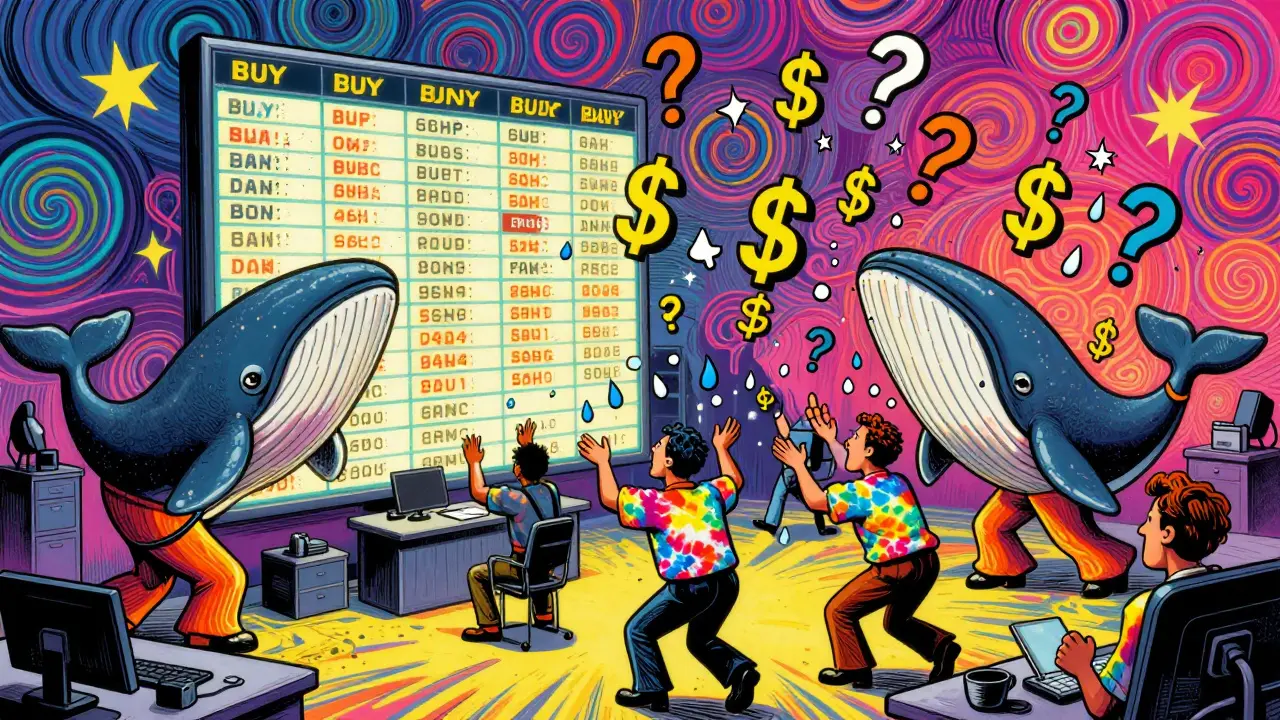
- Buy Walls and Sell Walls: A whale places a massive limit order - say, 10,000 ETH at $3,200 - to create a "wall" of buy or sell pressure. This doesn’t mean they’re ready to trade. It’s psychological. When retail traders see a wall of buy orders, they rush in, pushing the price up. When they see a sell wall, panic sets in. Whales then quietly buy the dip or sell into the rally.
- Whale Wall Spoofing: This is when a whale places a huge order they never intend to execute. It’s a fake signal. The order vanishes seconds before it’s filled. But in those seconds, dozens of automated trading bots and nervous retail traders react. The price spikes or drops. The whale profits. CoinLedger documented this technique in over 60% of major altcoin pump-and-dump events in 2023.
- Wash Trading: A whale buys and sells the same asset between multiple wallets they control. This creates fake volume. It tricks algorithms into thinking demand is high. Exchanges with weak monitoring can’t tell the difference. The SEC charged Binance in March 2023 with exactly this - alleging coordinated whale-like activity to inflate trading volume.
- Market Order Bombing: When a whale executes a large market order, they consume every available bid or ask in the order book. If they sell 20,000 XPL at once, they wipe out all the buy orders below $1.40. That triggers stop-losses. Then more selling. Then more. Prices can drop 15% in 30 seconds - not because of news, but because of one transaction.
Take the August 2023 XPL crash. Huang Licheng, a known whale, moved 700,000 tokens out of his wallet. The price swung from $1.50 to $1.12 in under 20 minutes. Retail investors lost $8 million in unrealized value. Not because of a hack. Not because of bad news. Just because one wallet decided to sell.
Why Some Coins Are More Vulnerable
Not all crypto is equal when it comes to whale influence.
Bitcoin? Still vulnerable, but harder to manipulate. With a daily trading volume over $20 billion, you’d need a $500 million move to shift the price 5%. That’s rare. Most Bitcoin whales focus on futures markets - betting on price direction without owning the coin. That’s how they influence spot prices without touching the underlying asset.
Altcoins? Totally different story. Tokens with daily volume under $50 million are sitting ducks. Nansen’s 2023 data shows that a single transaction exceeding 5% of daily volume can swing prices by 10-15% in minutes. That’s why tokens like XPL, SHIB, or PEPE see wild swings. A whale doesn’t even need to be rich - just holding 1% of the circulating supply can be enough to control the price.
Here’s a simple rule: If a coin’s daily volume is less than 10x its market cap, it’s easy to manipulate. Most altcoins fail this test. Bitcoin? Its volume is 20x its market cap. That’s why it’s resilient.
Whales Aren’t Always Evil
It’s easy to paint whales as villains. But that’s not fair.
Many whales are long-term holders - institutions, early adopters, or even crypto-native families who believe in the tech. They accumulate over months. They don’t dump. Their buying supports the market. Nansen’s analysis shows that legitimate whales often show steady, gradual accumulation patterns - not sudden spikes.
Even during the March 2020 crash, when Bitcoin fell 50% in a week, whales were the ones buying. They absorbed the sell-off. Without them, the crash would’ve been worse. They’re a double-edged sword: they can crash markets - or stabilize them.
The real problem isn’t whale ownership. It’s opacity. When a whale moves, you don’t know why. Are they rebalancing? Exiting? Manipulating? Without context, every move looks like a threat.
How to Protect Yourself
You can’t stop whales. But you can stop being their victim.
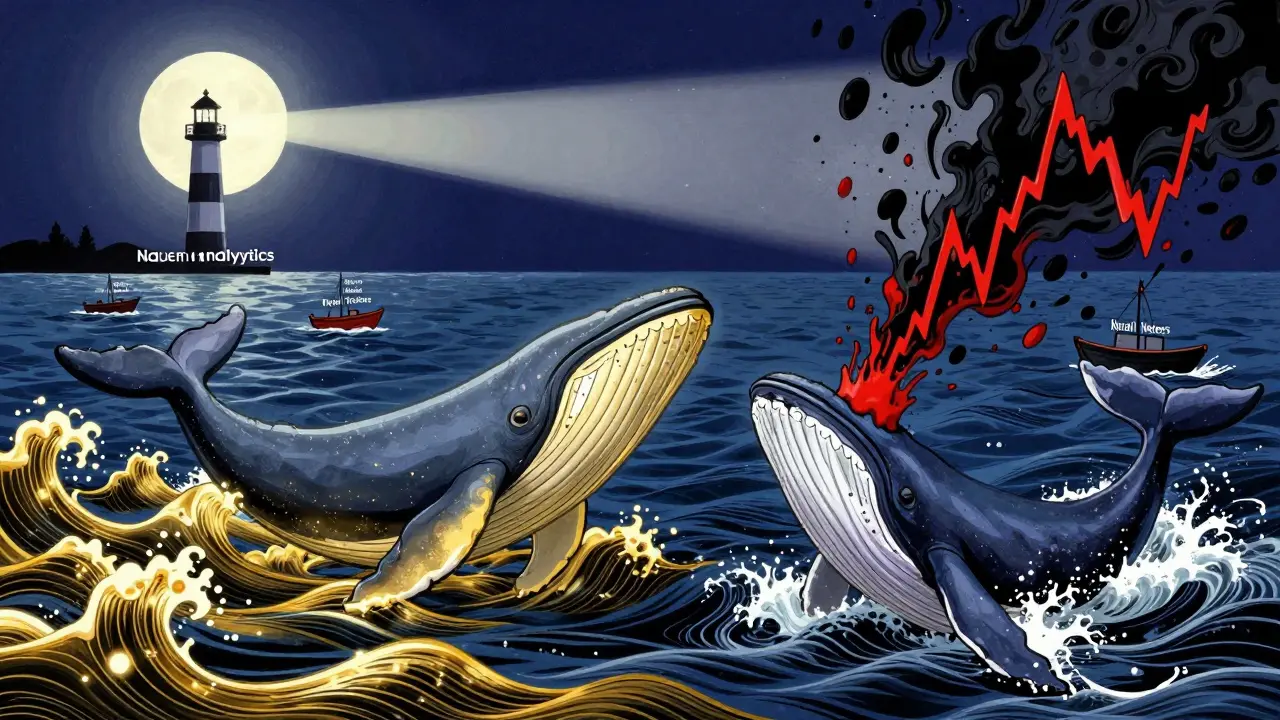
- Track, Don’t Chase: Use free tools like Blockchain.com Explorer or Whale Alert’s Telegram channel to monitor large transactions. But don’t buy just because a whale bought. Verify. Was it an exchange wallet? A mining pool? Or a known manipulator? Nansen says 43% of "whale alerts" from free services are just exchange deposits - not market-moving moves.
- Set Stop-Losses: If you hold altcoins, set stop-loss orders 5-8% below your entry. This won’t save you from every dump, but it’ll prevent total ruin. OneSafe recommends this for anyone holding tokens under $100 million in market cap.
- Avoid Low-Liquidity Coins: If a token’s daily volume is under $20 million, treat it like a high-risk stock. Only invest what you can afford to lose. Most of the "100x" altcoin stories end in 99% losses because of whale manipulation.
- Watch the Order Book: Before buying, check the depth chart. Are there huge sell walls just below the current price? That’s a red flag. Are there massive buy walls above? That’s a trap - likely spoofed.
- Wait 24 Hours: After a major whale move, wait. Most manipulations play out in under an hour. The real signal comes after the panic. If the price holds, it might be genuine accumulation. If it keeps falling, it’s likely a dump.
The Future: Will Whales Fade Away?
Regulators are watching. The CFTC has launched three enforcement actions since 2022 targeting spoofing and wash trading. The SEC’s case against Binance in 2023 sent shockwaves through the industry. Exchanges are now required to monitor large transactions more closely.
Technology is also changing. On-chain analytics tools like Nansen and Glassnode are becoming more accurate. Whale hunting - where small traders try to front-run known whale wallets - is growing. That’s good. It means whales can’t operate in the dark anymore.
By 2025, Nansen predicts that whales controlling less than 0.5% of a token’s supply will have minimal impact on assets with daily volume over $100 million. That’s a big shift. It means the market is maturing.
But here’s the truth: as long as crypto has asymmetric rewards - the chance to make 10x on a small bet - there will be whales. And as long as retail traders chase quick gains without understanding market structure, whales will keep winning.
The game isn’t rigged. It’s just unbalanced. The smartest traders don’t fight whales. They watch them. They learn their patterns. And they trade around them - not with them.
How do I know if a large crypto transaction is from a whale or an exchange?
Most "whale" alerts from free services like Whale Alert are actually exchange movements. To tell the difference, check the wallet address. Exchange wallets usually have a prefix like "Binance_" or "Coinbase_" and are linked to known deposit addresses. True whales use unique, non-exchange wallets. Tools like Nansen classify wallets by behavior - accumulation, distribution, or exchange activity - making it easier to spot real whale moves.
Can whales manipulate Bitcoin as easily as altcoins?
Not really. Bitcoin’s massive daily trading volume ($20B+) means you’d need a $1B+ move to shift the price 5%. That’s nearly impossible for one wallet. Most Bitcoin whales influence price through futures markets - betting on direction without owning BTC. Altcoins with low volume ($10M-$50M daily) can be moved by a $1M transaction. That’s why altcoins are far more vulnerable.
Do whales always make money?
No. The August 2023 XPL dump by Huang Licheng resulted in an $8 million unrealized loss. Whales can misread the market, get caught in stop-loss cascades, or overextend. Not every whale move is smart. Many are just gambling. That’s why tracking whale activity is useful - not because they’re infallible, but because their mistakes create volatility you can trade around.
Should I use whale tracking tools to time my trades?
Yes - but only as one signal. WhaleStats reports that 62% of their 150,000 followers use whale alerts, but 87% say they combine them with on-chain data and volume analysis. Relying only on whale alerts leads to false signals. Always verify: Is this a real whale? Is the volume real? Is the price action consistent? Whale movement is a clue - not a command.
What’s the safest way to trade during whale activity?
Stay out of low-volume altcoins. Use stop-losses. Avoid FOMO. If you see a whale buy, wait 24 hours. If the price holds and volume increases, consider entering. If it drops, stay away. The best traders don’t chase whales - they wait for the dust to settle and then look for real momentum, not fake signals.
Danny Kim
February 26, 2026 AT 23:38So let me get this straight - a guy moves 700k XPL and suddenly we’re all supposed to panic like it’s the end of the world? 🤨
Meanwhile, my grandma bought 3 Bitcoin in 2013 and still hasn’t sold. Guess she’s the real whale. Or maybe she’s just not on Telegram.
Whale alerts are basically crypto’s version of those ‘BREAKING: Dog eats taco’ notifications. Half the time it’s just Binance moving coins between their wallets. Chill out.
Also, if you’re trading altcoins because a ‘whale’ bought them, you’re not investing - you’re just giving your money to someone who already has 100x yours. I’m not mad. I’m just disappointed.
Cathy Sunshine
February 28, 2026 AT 07:00How profoundly ironic - we live in a decentralized utopia, yet the market is governed by the same oligarchic logic that doomed feudalism.
Whales are not merely actors - they are the inevitable manifestation of capitalism’s gravitational collapse into symbolic capital.
When you trade based on whale movements, you are not participating in a market - you are surrendering your autonomy to the spectral hand of liquidity asymmetry.
Is this not the modern myth of Sisyphus, where the rock is not stone, but a 0.1% wallet threshold? And we, the laborers, cheer as it rolls back down?
Perhaps the blockchain was never meant to liberate. Perhaps it was designed to make exploitation elegant. Elegant. And terrifying.
Mae Young
February 28, 2026 AT 19:02Oh, so now we’re pretending that ‘whales’ are some mysterious, evil force - like vampires, but with more Ethereum and fewer capes?
Let me guess: the author thinks retail traders are ‘victims’ - as if they didn’t voluntarily sign up for a market where 40% of the supply is held by 2,000 wallets?
Wait - did you read the part where it says ‘whales stabilized Bitcoin in 2020’? Then why are you acting like they’re the enemy?
It’s not that whales are bad - it’s that you’re bad at trading.
And you’re blaming the ocean for your inability to swim.
Also - ‘whale alert’ notifications? Please. I’ve seen more legitimate trades from my cat’s keyboard than from those things.
And yes - I used four exclamation points. Sue me.
Also - you’re welcome.
Cheryl Fenner Brown
March 1, 2026 AT 20:00so like… if a whale buys 1000 btc… should i buy too?? 🤔
or is that just like… buying a house because your neighbor painted their door blue??
i mean i saw a whale tweet ‘buy buy buy’ and then i lost $300 😭
now i just stare at the chart and cry quietly
also i use whale alert but like… 70% of the time its just binance moving money??
sooo… what even is a real whale?? 🤷♀️
ps: i still love crypto tho 💖
Michael Teague
March 2, 2026 AT 13:51Whales are just rich people being rich people. That’s not a surprise. That’s just capitalism.
Why are we acting like this is new? The stock market’s been like this since 1929.
Just don’t trade altcoins. That’s it. That’s the whole strategy.
If you’re losing money on PEPE or SHIB, it’s not because whales are evil. It’s because you’re gambling.
Stop reading memes. Stop chasing alerts. Just hold BTC and wait.
It’s that simple. I’m not even trying to be deep here.
Just… don’t be dumb.
kati simpson
March 2, 2026 AT 22:40i think the real issue here is that people treat crypto like a casino but act like it’s a bank
if you dont know what a whale is you probably shouldnt be trading
but if you do know what a whale is and still chase every alert you’re just asking for trouble
ive watched this happen for years
someone sees a big buy and thinks ‘this is my chance’
but its never their chance
its always the whales’ chance
the market doesn’t care about your dreams
it just moves
and you either learn how to read it or you get swept away
no drama needed
just facts
and patience
Cory Derby
March 3, 2026 AT 11:54Thank you for this clear, thoughtful breakdown. I appreciate how you distinguished between manipulation and legitimate accumulation.
Many people overlook the stabilizing role whales play during market stress - especially in 2020 and 2022.
It’s also important to note that institutional adoption is gradually reducing the impact of individual whales - as liquidity increases, manipulation becomes exponentially harder.
For new traders, I’d recommend focusing on two things: volume-to-market-cap ratios and wallet behavior patterns, not just transaction alerts.
Tools like Nansen and Glassnode are invaluable - but only if you understand what the data is telling you.
Whales aren’t the enemy. Ignorance is.
Keep learning. Stay humble. And never trade on emotion.
Shannon Black
March 3, 2026 AT 20:07While the article presents a compelling narrative, I must note that the framing of whales as malevolent actors risks oversimplifying complex market dynamics.
Historically, concentrated ownership has always existed in nascent markets - from tulip bulbs to railroad stocks.
What distinguishes crypto is its transparency: every transaction is recorded on-chain, unlike traditional finance, where insider trading is often obscured.
Perhaps the real challenge is not eliminating whales, but educating retail participants to interpret on-chain data with rigor.
Regulatory clarity, not demonization, will foster sustainable market development.
Thank you for contributing to this essential dialogue.
Trenton White
March 4, 2026 AT 07:05Interesting piece.
One thing I noticed - most people who panic about whales never check if the wallet is even real.
Like, 60% of "whale buys" are just exchange deposits.
And yet, everyone rushes to buy the moment Whale Alert pings.
It’s like watching a weather app and running inside because it says "chance of rain" - even if it’s 80°F and sunny.
Maybe we need better tools.
Or maybe we just need to stop being so reactive.