
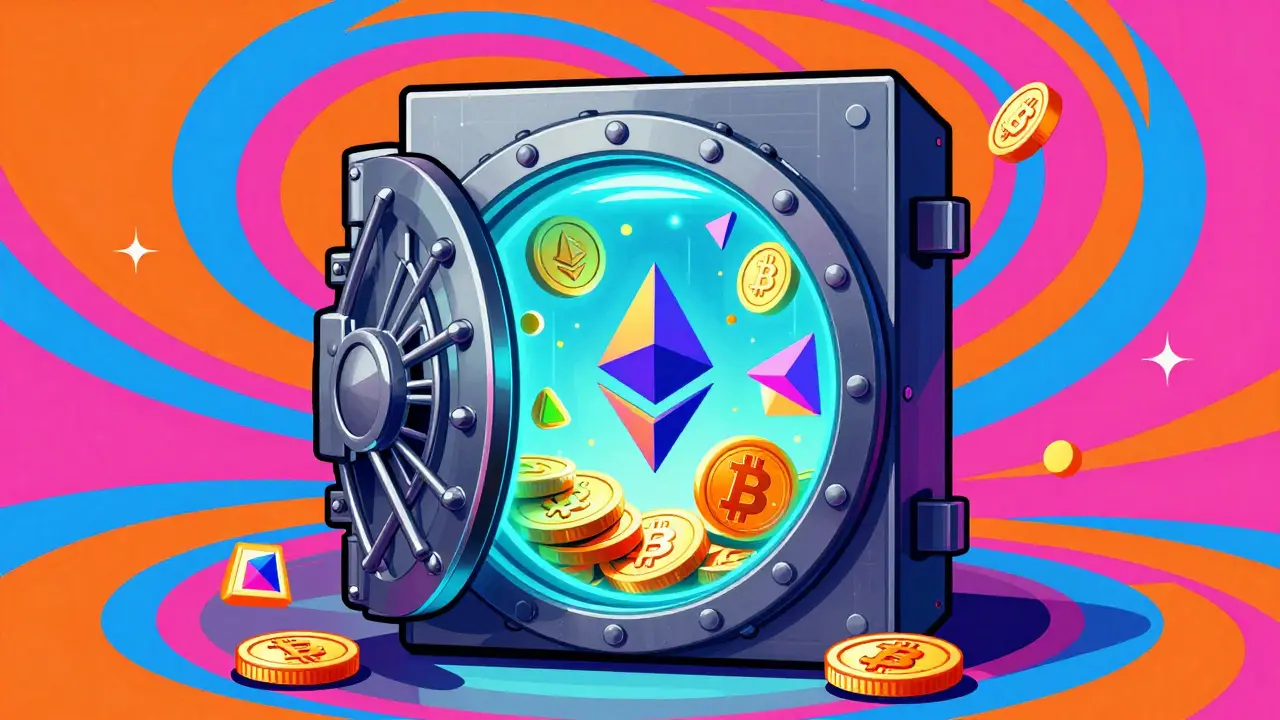
Imagine walking into a bank and trying to gauge its health by looking at the total amount of cash sitting in its vaults. That is essentially what Total Value Locked, commonly known as TVL, does for decentralized finance. It is the single most watched number in the crypto world right now. But here is the catch: just because a protocol has billions locked up doesn't mean it is actually making money or serving users well. In fact, high TVL can sometimes be a trap.
If you are investing in decentralized finance protocols, relying on TVL alone is like judging a restaurant solely by how many people are waiting in line. You need to know if they are eating good food, paying fair prices, and coming back again. This guide breaks down exactly how TVL works, why it matters, and more importantly, when it lies to you.
What Is TVL and How Is It Calculated?
Total Value Locked represents the total dollar value of assets deposited into a smart contract. Think of it as the digital equivalent of Assets Under Management (AUM) in traditional banking. When you deposit Ethereum into a lending platform or add tokens to a liquidity pool, that value counts toward the protocol's TVL.
The calculation is straightforward but dynamic. The formula looks like this:
TVL = (Quantity of Asset 1 × Price of Asset 1) + (Quantity of Asset 2 × Price of Asset 2) + ...
For example, if a protocol holds 10,000 ETH and the price of ETH is $2,500, that specific asset contributes $25 million to the TVL. Since crypto prices change every second, TVL fluctuates constantly. A protocol might not lose a single user, but if the market crashes 20%, its TVL drops 20% instantly. This volatility means you have to look at trends over time, not just a snapshot on a Monday morning.
Why TVL Became the Gold Standard
During the 2020 DeFi summer, platforms like Uniswap, Aave, and Compound exploded in popularity. Investors needed a quick way to compare these new types of financial services. Traditional metrics like market cap were confusing because token prices were often speculative and detached from actual usage. TVL offered a clearer picture: it showed real capital deployed into working systems.
High TVL signals three critical things:
- Liquidity Depth: More money in the pool means traders can execute large orders without causing massive price slippage.
- User Trust: People do not lock millions of dollars into code they fear will get hacked. High TVL suggests confidence in security and governance.
- Adoption Scale: It indicates how many users are actively utilizing the protocol for borrowing, lending, or trading.
Ethereum remains the backbone of this ecosystem, hosting over $96 billion in TVL across various layers and applications. However, other chains like Solana and Arbitrum are growing rapidly, changing the competitive landscape.
The Hidden Dangers: When TVL Lies
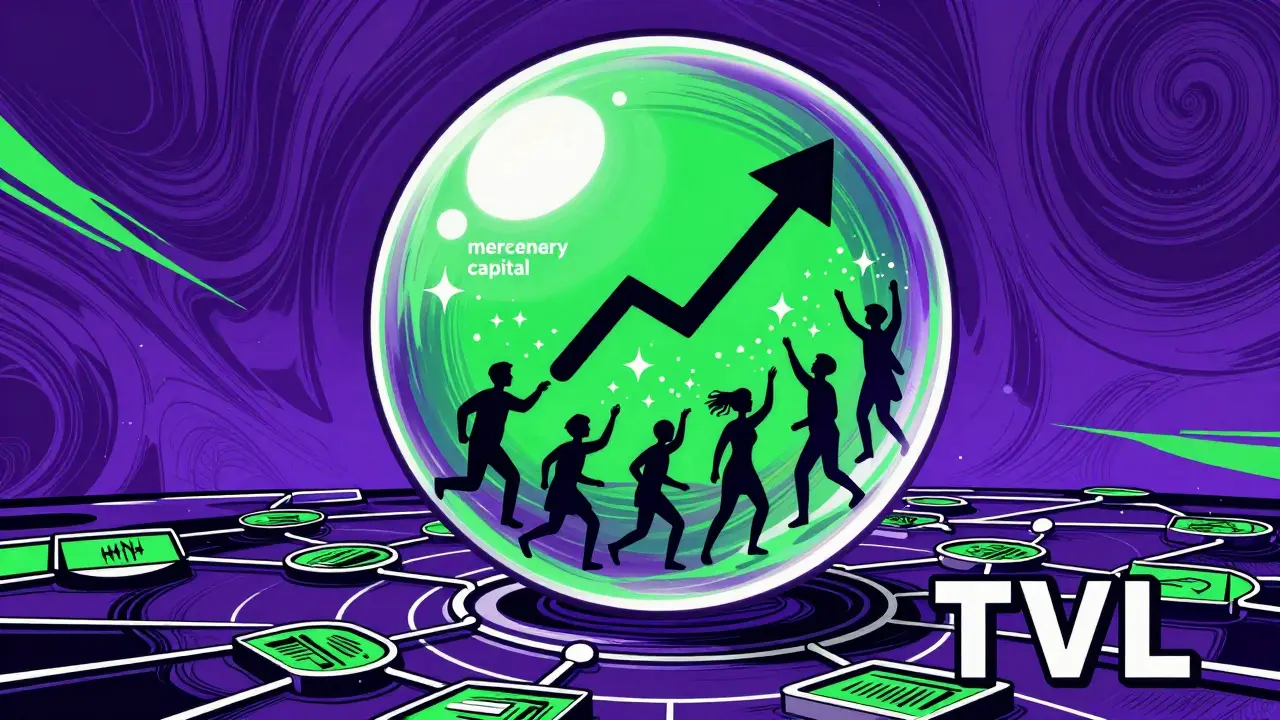
Here is where most investors get burned. TVL is easily manipulated. Protocols can inflate their numbers through "infinite loops" or aggressive yield farming incentives. If a protocol pays 100% APY to attract deposits, TVL will skyrocket. But once those rewards stop, the capital flees immediately. This is known as "mercenary capital."
Consider a hypothetical scenario: Protocol A has $1 billion in TVL but generates only $10,000 in fees daily. Protocol B has $100 million in TVL but generates $1 million in fees daily. Which one is healthier? Protocol B is clearly more sustainable. Relying only on TVL would lead you to choose the failing business.
Another issue is double-counting. Some derivatives protocols count the same underlying asset multiple times as it moves through different layers of leverage. This inflates the perceived size of the ecosystem without adding real economic value.
Beyond TVL: Metrics That Actually Matter
To truly measure success, you must combine TVL with other key indicators. Here is a comparison of essential metrics:
| Metric | What It Measures | Why It Matters |
|---|---|---|
| TVL | Total assets locked | Shows scale and trust |
| Protocol Revenue | Fees generated | Indicates sustainability |
| Unique Active Users | Daily/Monthly addresses | Shows real adoption |
| APY Stability | Consistency of returns | Reveals incentive structure |
| Transaction Volume | Value traded/borrowed | Measures activity intensity |
Protocol Revenue is perhaps the most important companion to TVL. If a protocol earns enough fees to cover its operational costs and reward token holders, it is building long-term value. Look for the "fee-to-TVL" ratio. A higher ratio means the protocol is efficient at generating income from its locked capital.
Unique Active Users help distinguish between whale-dominated pools and broad community adoption. A protocol with 10,000 small users is often more resilient than one with 10 whales holding 90% of the TVL.

How to Analyze TVL Like a Pro
Do not just look at the raw number. Context is everything. Here is how to interpret TVL data effectively:
- Compare Against Peers: Is the protocol gaining or losing share relative to competitors? If Uniswap’s TVL grows while SushiSwap’s shrinks, capital is flowing to the stronger brand.
- Check the Composition: What assets are locked? Stablecoins indicate utility for payments and trading. Volatile assets like ETH or BTC might signal speculation or hedging.
- Monitor Trends: Use charts to see weekly and monthly trends. Sudden spikes often correlate with new token emissions or marketing campaigns. Gradual, steady growth is a sign of organic adoption.
- Look at Cross-Chain Data: Many protocols operate on multiple blockchains. Aggregated TVL gives a fuller picture than looking at Ethereum alone.
Tools like DefiLlama and Nansen provide detailed breakdowns of these metrics. They allow you to filter out "ghost" TVL from infinite loops and see the net value actually at work.
The Future of TVL Measurement
As DeFi matures, TVL is evolving. We are seeing the rise of Real World Assets (RWAs) being tokenized and locked into protocols. These include treasury bills, real estate, and commodities. Unlike volatile crypto, these assets provide stable, predictable yields, changing how we view TVL stability.
Additionally, Layer 2 solutions and cross-chain bridges are making TVL tracking more complex. Capital moves faster than ever, requiring real-time analytics rather than daily updates. The future of protocol evaluation will likely combine on-chain data with off-chain sentiment analysis, creating a holistic health score that goes beyond simple dollar amounts.
Remember, TVL is a starting point, not the final answer. It tells you how much trust exists, but you must dig deeper to find out if that trust is earning its keep.
Is high TVL always a good sign?
Not necessarily. High TVL can be driven by unsustainable incentives, such as extremely high APYs that attract mercenary capital. Once the incentives dry up, the TVL may crash. Always check if the protocol generates sufficient revenue to justify the locked value.
How is TVL different from market cap?
Market cap reflects the total value of a project's circulating tokens, which is often driven by speculation and investor sentiment. TVL measures the actual amount of capital users have deposited into the protocol to use its services. TVL is generally a more grounded indicator of real economic activity.
Can TVL be manipulated?
Yes. Protocols can inflate TVL through techniques like infinite loops, where the same asset is counted multiple times as it moves through different contracts. They can also offer excessive rewards to temporarily boost deposits. Analysts use tools to filter out this "ghost" TVL.
What should I look at besides TVL?
You should analyze protocol revenue, fee generation rates, unique active users, transaction volume, and APY stability. These metrics provide a comprehensive view of a protocol's health, sustainability, and actual user engagement.
Why does TVL fluctuate so much?
TVL is calculated in USD based on the current market price of the locked assets. Since cryptocurrency prices are highly volatile, the TVL will rise and fall with the market even if the quantity of assets remains constant. Additionally, users frequently move capital in response to changing yields.
What is the role of stablecoins in TVL?
Stablecoins represent a significant portion of TVL in many protocols. Their presence often indicates strong utility for lending, borrowing, and trading, as users seek to earn yield on low-volatility assets. High stablecoin TVL can suggest a robust, practical use case for the protocol.
How do Layer 2 networks affect TVL?
Layer 2 networks like Arbitrum and Optimism host their own DeFi ecosystems. As users migrate to cheaper, faster chains, TVL shifts accordingly. Tracking cross-chain TVL provides a more accurate picture of a protocol's overall reach and adoption.
What are Real World Assets (RWAs) in DeFi?
RWAs are physical assets like real estate, gold, or government bonds that are tokenized and brought onto the blockchain. Including RWAs in TVL adds stability and introduces new yield sources, potentially reducing reliance on volatile crypto markets.
Larry Port
May 16, 2026 AT 08:18TVL is basically a vanity metric for most protocols right now. It tells you nothing about whether the project actually makes money or if it is just burning tokens to keep people interested. You have to look at revenue and fee generation to see if a protocol is sustainable. Most of these DeFi projects are just yield farms in disguise.
Zara Zaman
May 16, 2026 AT 15:53This guide is completely missing the point of how institutional money works.
I do not care about your little retail users or their feelings. The only thing that matters is liquidity depth for large orders. If I can move $50 million without slippage, the protocol is successful regardless of whether some random guy on Twitter thinks it is a scam. Stop focusing on these amateur metrics like active users. They are noise. Real capital cares about security audits and insurance coverage, not how many emojis people use in Discord.
You need to understand that high TVL attracts the big players who actually drive the market. Without them, you are just a playground for kids playing with fire. Do not insult my intelligence by suggesting that revenue per user is more important than total scale. Scale creates network effects that small protocols can never replicate. This is basic economics.
Kimberly Herbstritt
May 16, 2026 AT 23:58Actually, I think high TVL is often a red flag for me personally.
I have seen so many protocols inflate their numbers with mercenary capital that leave the second incentives drop. It feels like a house of cards waiting to collapse. I prefer smaller protocols with loyal communities because they seem more resilient to market shocks. Just my two cents though!
Ankush Pokarana
May 18, 2026 AT 11:32the concept of tvl being a lie is somewhat misleading because it depends entirely on how you define value in a decentralized system where trust is algorithmic rather than interpersonal which means we must consider the philosophical implications of locking assets into code that cannot be trusted in the traditional sense but must be verified through mathematical proof which leads us to question whether the act of locking itself is a form of commitment or merely a speculative bet on future governance rights which complicates the simple narrative of tvl as a health metric because it ignores the temporal aspect of capital deployment where short term yields attract different types of actors than long term staking rewards thus creating a dichotomy between passive holders and active participants that cannot be captured by a single number
Sarah C
May 19, 2026 AT 21:00I really appreciate this breakdown. It helps clarify why I should not just look at the biggest numbers on DefiLlama. Thank you for sharing this perspective.
Sharada Vakkund
May 21, 2026 AT 10:01Great points here! I think the community would benefit from seeing more examples of how RWAs are changing the TVL landscape.
It is fascinating to see stable assets like treasury bills entering the mix. Does anyone else feel like this will make DeFi more accessible to mainstream investors who are scared of volatility?
Sudarshan Anbazhagan
May 22, 2026 AT 00:41one must acknowledge that the reliance on tvl as a primary metric is fundamentally flawed due to its susceptibility to manipulation through infinite loops and double counting mechanisms which distort the true economic activity within the protocol thereby necessitating a more nuanced approach that incorporates multiple data points including revenue streams user retention rates and cross-chain interoperability metrics to form a comprehensive understanding of protocol health which is often overlooked by casual observers who lack the technical expertise to discern between genuine adoption and artificial inflation of locked value