

Order Book Market Depth Calculator
Bid & Ask Analysis
Enter your order book data to calculate support and resistance levels
Results
| Price ($) | Volume (BTC) | Cumulative |
|---|---|---|
| - | - | - |
| - | - | - |
| - | - | - |
| Price ($) | Volume (BTC) | Cumulative |
|---|---|---|
| - | - | - |
| - | - | - |
| - | - | - |
Spread: - ($)
Spread (%): -
When you look at a price chart, you only see what’s already happened. But what if you could see what’s about to happen? That’s where order book data comes in. It’s not just another indicator-it’s the real-time heartbeat of every market, from Bitcoin to Apple stock. Unlike moving averages or RSI, order books show you the actual buy and sell orders waiting to be filled. This isn’t theory. It’s live supply and demand, laid bare.
What Exactly Is an Order Book?
An order book is a live list of all pending buy and sell orders for a specific asset. On crypto exchanges like Coinbase or Binance, it updates every millisecond. On the left side, you see bids-the prices buyers are willing to pay. These are sorted from highest to lowest. The top bid is the best price a buyer will pay right now. On the right, you see asks-the prices sellers are willing to accept. These go from lowest to highest. The lowest ask is the best price a seller will take.
The gap between the highest bid and the lowest ask? That’s the bid-ask spread. A tight spread-like 0.1% on Bitcoin-means lots of buyers and sellers are active. A wide spread-say 2% on a small altcoin-means low liquidity. You don’t want to trade when the spread is wide. You’ll pay more to enter and get less when you exit.
Market Depth: Seeing Beyond the Top Price
Most traders only look at the top bid and ask. That’s like judging a crowd by the person standing right in front of you. Market depth shows you what’s behind them. If you see 50 BTC being bid at $60,000, and another 120 BTC at $59,950, and 200 more at $59,900, that’s a strong support zone. Sellers won’t push the price down easily-there’s too much buying power stacked below.
Same for the ask side. If there’s 300 BTC sitting at $60,100, $60,200, and $60,300, that’s resistance. Buyers will struggle to push through unless they’re willing to pay more and eat through all those orders. This isn’t guesswork. It’s measurable. You can see the exact volume waiting at every price level.
Order Flow: Tracking the Real Money
Order flow is what happens when large orders hit the book. You’ll see a sudden spike in bids-maybe 500 BTC snapped up at $60,000 in under two seconds. That’s not random. That’s institutional buying. It’s often followed by a price jump. Or you might see a long string of small sell orders hitting the top ask, one after another. That’s distribution-smart money slowly selling.
Watch for iceberg orders-large orders broken into smaller pieces to avoid moving the market. You’ll notice a price level keeps getting replenished even after being eaten through. That’s a clue someone’s hiding a big position. Retail traders miss this. Pros use it to time entries and exits.
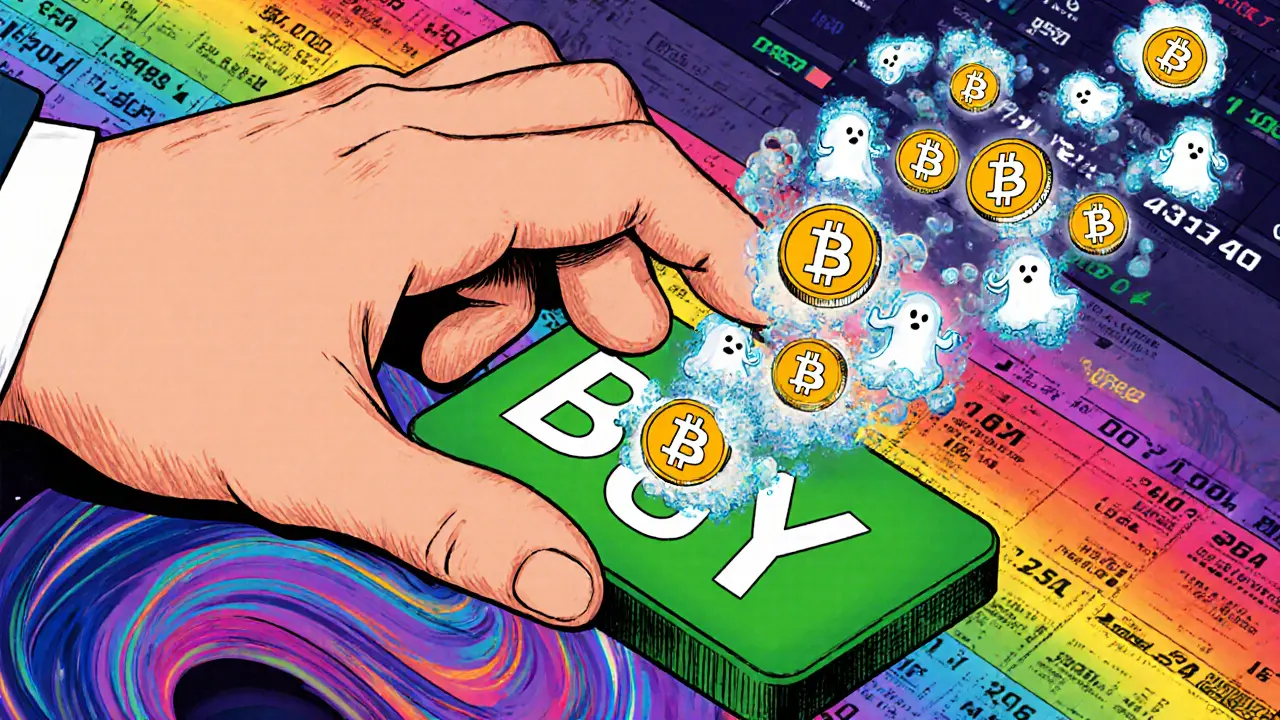
Why Order Books Beat Price Charts Alone
Price charts show you where the market has been. Order books show you where it’s going. A candlestick might close up, but if the order book shows 10x more sell orders than buy orders at the next price level, that rally is fragile. You’re not just trading history-you’re trading intent.
Traditional indicators like volume or MACD are lagging. They’re based on past trades. Order book data is leading. It tells you what’s coming before it happens. For example, if you see a sudden surge in buy orders at $59,500 on Ethereum, but the price hasn’t reached that level yet, you can position yourself ahead of the move. That’s the edge.
Red Flags: Spoofing and Fake Liquidity
Not everything you see is real. Spoofing is when someone places a huge buy or sell order-say, 1,000 BTC at $60,100-to scare others into moving. Then they cancel it before it fills. It’s manipulation. You’ll see orders appear and vanish in under a second. If you react to those, you’ll get burned.
How to spot it? Look for volume imbalance. If a large order shows up but the total volume at that level doesn’t increase, it’s likely fake. Also, if the order disappears right before the price hits it, that’s a red flag. High-frequency traders do this constantly. Your best defense? Don’t trade based on single orders. Look for patterns over time.
Tools and Platforms That Show Order Book Data
You don’t need fancy software to start. Most major crypto exchanges-Coinbase Pro, Binance, Kraken-show order books by default. Look for the depth chart tab. It’s usually a color-coded bar chart: green for bids, red for asks. The longer the bar, the more volume at that price.
For deeper analysis, traders use tools like TradingView (with order book plugins), Bookmap, or Cryptowatch. These show heatmaps-where the most activity is clustered. Some even replay order flow like a video, letting you see how the book changed over the last 5 minutes. That’s how you learn to read it.

How Long Does It Take to Get Good at This?
It’s not something you learn in a day. Most retail traders give up after a week. They’re overwhelmed by the noise. But if you spend 15 minutes a day watching the order book for one asset-say, Bitcoin-you’ll start seeing patterns. After a month, you’ll recognize when liquidity is thin. After three months, you’ll know when big players are accumulating or distributing.
Start simple. Watch the bid-ask spread. Is it tightening or widening? Then look at the top 5 levels on each side. Is volume growing on the bid side? That’s bullish. Is the ask side filling up? That’s bearish. You don’t need to predict every tick. Just spot the trends.
Order Books in Crypto vs. Traditional Markets
Crypto markets run 24/7. That means order book data never sleeps. You can see how Asian buying surges at 2 a.m. EST, or how U.S. traders unload before the weekend. Traditional markets have fixed hours. Their order books go quiet after close. Crypto gives you continuous signals.
But crypto also has lower liquidity on smaller coins. A $10 million order on Bitcoin barely moves the needle. On a $50 million market cap altcoin? That order could crash the price. That’s why order book depth matters even more in crypto. Always check the volume at each level before placing a large trade.
What Comes Next: AI and the Future of Order Book Analysis
Top trading firms now use machine learning to analyze order books at microsecond speeds. They don’t just watch-they predict. If 10,000 small buy orders appear in 3 seconds, their algorithms flag it as accumulation. If 50 large sell orders hit the top ask in a row, they signal distribution.
Soon, these tools will be available to retail traders. Some platforms already combine order book data with social sentiment-like Twitter trends or Reddit activity-to confirm signals. Imagine seeing a spike in buy orders AND a surge in positive mentions about a coin. That’s a high-probability setup.
The future isn’t about guessing. It’s about reading the market’s hidden language. And order book data is the dictionary.
SHIVA SHANKAR PAMUNDALAR
November 28, 2025 AT 00:16Order books are just fancy graphs that make you feel smart while you’re still losing money. I’ve watched them for weeks. Saw the same patterns. Still got rekt twice last month. Maybe I’m just bad at this. Or maybe the market is rigged. Either way, I’m going back to HODLing.
Shelley Fischer
November 29, 2025 AT 15:46While the technical exposition of order book mechanics is largely accurate, it is critically incomplete without addressing the systemic asymmetry of access. Institutional actors possess co-located servers, direct market access, and algorithmic front-running capabilities that render retail order book analysis fundamentally reactive rather than predictive. The notion that this data offers a 'true edge' is, in practice, a neoliberal myth peddled to retail traders.
Michael Fitzgibbon
November 30, 2025 AT 14:33I used to think order books were magic. Then I watched one during a flash crash. All those big green bars? Vanished in 0.3 seconds. The market didn’t care what I saw-it just moved. I’ve learned to respect it now. Not as a crystal ball, but as a mirror. It shows you what people are afraid of, not what they believe. Quietly watching, not chasing, has saved me more than any indicator ever did.
Komal Choudhary
December 2, 2025 AT 13:15OMG I tried this last week with Shiba and lost $800 in 10 minutes. Like why is there 200k SHIB at $0.000008 but the price drops to $0.0000075 and boom-no bids? Someone’s spoofing. Or maybe the devs are dumping? I’m just tired of trading. Can we just go back to memes?
Tina Detelj
December 3, 2025 AT 20:57Wait-so you’re telling me that every time I see a huge bid at $60,100 on BTC, and then it vanishes… that’s not just ‘market noise’-it’s manipulation? And the ‘deep liquidity’ I thought was safety… is just a trap? And the ‘accumulation’ I celebrated… was a honeypot? And the ‘smart money’… are the same ones who caused the 2022 crash? And now you’re telling me AI is learning to predict this? So… we’re all just lab rats in a game designed by robots for robots-and we’re paying for the privilege of watching?!
Wilma Inmenzo
December 5, 2025 AT 20:41Order books? LOL. You think they’re real? Nah. They’re fed by the Fed. Every bid and ask is pre-programmed by Quant Hedge Funds with ties to the SEC. The ‘depth chart’? A placebo. The ‘spread’? A tax. The ‘iceberg orders’? They’re not hiding-they’re leading you. They want you to think you’re reading the market. Meanwhile, your portfolio’s being drained via latency arbitrage while you stare at colors. Wake up. The market isn’t a game. It’s a surveillance state with a ticker.
priyanka subbaraj
December 6, 2025 AT 05:35Everyone talks about order books like they’re profound. They’re not. They’re just numbers. And you’re still losing. Just admit it.
George Kakosouris
December 7, 2025 AT 16:36Let’s cut through the noise: order book analysis is only viable if you’re operating at sub-10ms latency with direct FIX API access to Binance/FTX. Retail traders are playing chess against a quantum computer with a flip phone. The ‘patterns’ you think you see? They’re artifacts of HFT front-running and spoofing algos. You’re not trading liquidity-you’re liquidity bait. If you’re not co-located, you’re not trading-you’re donating. The ‘edge’ is a myth sold by influencers who’ve never touched a depth chart with real capital. Stop romanticizing the order book. It’s a slaughterhouse with pretty colors.