
Blockchain AI Data Integrity Cost Calculator
Cost Estimator
Estimated Implementation Cost
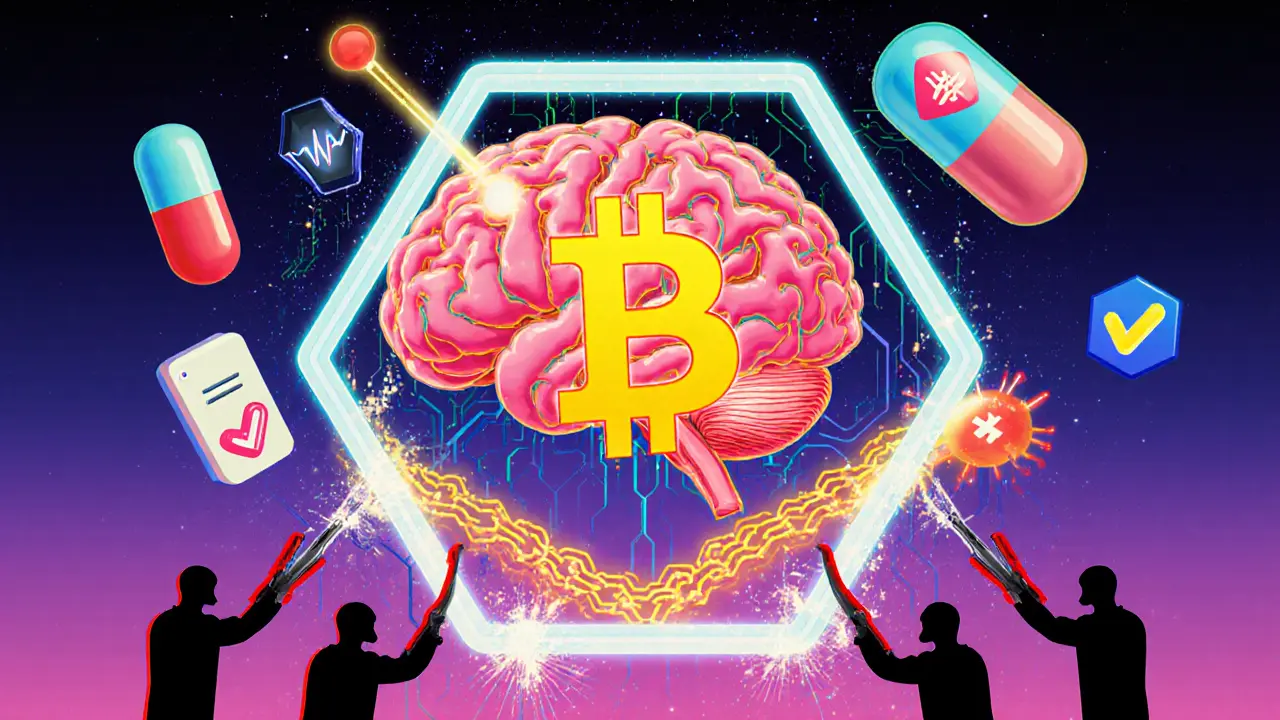
Imagine an AI system that recommends life-saving medical treatments. It’s accurate 98% of the time. But what if it was trained on manipulated data? What if someone quietly changed a few patient records to skew the results? Without a way to prove where the data came from, you have no way to trust the decision - no matter how smart the AI seems. This isn’t science fiction. It’s happening right now in hospitals, banks, and self-driving car systems. That’s where blockchain AI data integrity comes in.
Why AI Needs Blockchain
Artificial intelligence learns from data. But most AI systems don’t keep a clear record of where that data came from, who touched it, or when it was changed. That’s called a lack of data provenance. And it’s a huge problem. In 2023, IBM found that 74% of enterprise AI projects failed because stakeholders didn’t trust the outputs. Not because the models were wrong - but because no one could verify the data. Blockchain fixes this by creating an unchangeable log of every data transaction. Every time a new dataset is added to train an AI model, it’s recorded as a block. Each block contains a unique digital fingerprint (hash) of the data, plus the hash of the previous block. Change even one letter in the original data? The hash changes. And suddenly, every block after it becomes invalid. The system knows something was tampered with. This isn’t just about security. It’s about accountability. If an AI denies a loan application, regulators can ask: "Show me the exact data used to make that call." With blockchain, they can trace every row, every timestamp, every version of the training set - back to the original source.How It Actually Works
Let’s say a pharmaceutical company uses AI to detect defects in pills during manufacturing. The AI analyzes thousands of images from production-line cameras. But how do you know those images weren’t altered to hide flaws? Here’s what happens with blockchain:- Each image is hashed - turned into a unique digital signature.
- The hash, along with the camera ID, timestamp, and batch number, is added to a blockchain block.
- The block is sent to multiple computers across the network (nodes), not stored in one central server.
- Once confirmed by consensus (usually in under 10 seconds on permissioned networks), the block is locked.
- The AI model trains on the original images, but only the hashes are stored on-chain.
- At any point, auditors can re-hash the original images and compare them to the stored hashes. If they match? The data is untouched.
Blockchain vs. Traditional Databases
You might think: "Why not just use a secure database with access logs?" Because centralized databases can be hacked, altered, or deleted - and no one knows until it’s too late. A single admin with bad intentions can rewrite logs. A ransomware attack can wipe the whole system. Blockchain doesn’t have a single point of control. It’s distributed. To alter data, you’d need to change the same block on over half the network simultaneously - which, with current cryptography, is computationally impossible without controlling the majority of the network’s power. NIST tested this in 2022. They simulated data tampering in 100 AI training datasets. Traditional databases caught 71% of the changes. Blockchain caught 100%. Every single one. But blockchain isn’t perfect. It’s slower. A typical blockchain network handles 2,000 to 3,500 transactions per second. A regular database? Millions. So you don’t use it for everything. You use it for the critical parts: the data fingerprints, the model versions, the audit trails.
Who’s Using This Right Now?
You won’t find this in your phone’s photo app. But you’ll find it in places where mistakes cost lives or millions. - Pharmaceuticals: Companies like Merck and Pfizer use blockchain to track AI-driven quality control data. Every batch of medicine is tied to a blockchain record of the training data used to detect contaminants. - Finance: Banks like JPMorgan and Goldman Sachs use it to verify AI models that approve loans or flag fraud. After the SEC cracked down on "black box" trading algorithms in 2023, firms that could prove data integrity saw a 220% spike in investment. - Autonomous vehicles: Waymo and Cruise store hashes of sensor data on blockchain. If a self-driving car makes a wrong turn, investigators can check if the training data was corrupted - or if the system was fed misleading images. - E-commerce: eBay uses blockchain-AI integration to detect counterfeit listings. The AI scans product images and descriptions, while blockchain ensures the training data (thousands of real vs. fake product examples) hasn’t been tampered with. These aren’t experiments. They’re live systems. According to Gartner’s 2023 survey, 68% of top pharmaceutical firms and 52% of major financial institutions have already deployed this tech.The Downsides - And How to Avoid Them
This isn’t a magic bullet. There are real trade-offs. First, cost. Setting up a permissioned blockchain network (the kind used for enterprise AI) can add 35-50% to project budgets, according to Stanford’s AI Lab. If you’re building a recommendation engine for a streaming service? Probably not worth it. Second, complexity. You need people who understand both AI and blockchain. That’s rare. A 2023 survey by DataAutomation found 73% of companies struggled to find skilled staff. Third, speed. Blockchain isn’t fast enough for real-time AI decisions. If your AI needs to respond in under 50 milliseconds - like in high-frequency trading or emergency medical alerts - blockchain’s 1-10 second confirmation time is too slow. The fix? Hybrid architecture. Only store hashes and metadata on-chain. Keep the heavy data - images, sensor logs, video feeds - in secure, encrypted off-chain storage. Use blockchain only to verify: "Did this data change?" Not to store it. IBM’s Blockchain Center of Excellence recommends starting small. Pick one high-risk AI model. Track just its training data. Prove it works. Then expand.
What’s Next?
The technology is evolving fast. In 2023, IBM launched Watson AI integrated with Hyperledger Fabric 3.0 - a blockchain platform designed for enterprise data exchange. Microsoft Azure now offers blockchain services priced at $0.45/hour for consortium nodes. Startups like Oasis Labs sell AI data integrity modules for $2,500/month. New tools are emerging: - Zero-knowledge proofs: Let you prove data is valid without revealing what it is. Imagine proving a patient’s record is accurate without showing their name, diagnosis, or history. - Decentralized oracles: Connect AI models to real-world data (like weather, stock prices, sensor readings) in a tamper-proof way. - Standardized protocols: The Enterprise Ethereum Alliance released universal standards in mid-2023 so different blockchain-AI systems can talk to each other. And regulation is catching up. The EU AI Act, effective in 2025, requires full documentation of training data provenance. The FDA now accepts blockchain-verified data as legal evidence for medical AI approvals. By 2026, Gartner predicts blockchain-backed data integrity will be "table stakes" for any AI system in healthcare, finance, or government.Should You Use It?
Ask yourself these questions:- Is your AI making decisions that affect people’s safety, money, or rights?
- Do regulators or auditors need to verify your data?
- Have you ever had a stakeholder question the source of your training data?
- Is your data stored in one place, controlled by a few people?
Blockchain doesn’t make AI smarter. It makes AI trustworthy. And in a world where AI decisions shape our lives, that’s not optional - it’s essential.
Can blockchain prevent AI from making biased decisions?
No, blockchain doesn’t fix bias in AI. It only proves whether the data was altered. If an AI is trained on biased data - like historical loan denials that favored certain demographics - blockchain will faithfully record that biased data. It won’t change it. But it will let you see exactly where the bias came from, so you can fix it. Transparency is the first step to fairness.
Is blockchain for AI data integrity only for big companies?
No. While big firms lead adoption, startups can use cloud-based services like Microsoft Azure Blockchain or Oasis Labs for as little as $2,500/month. You don’t need to build your own network. You just need to protect the data that matters most - like training sets for medical or financial AI. Start with one model. Scale from there.
Does blockchain slow down AI training?
Not if you do it right. Storing full datasets on-chain would be too slow. The best practice is to store only cryptographic hashes of the data on the blockchain, while keeping the actual files in fast, encrypted off-chain storage. The AI trains on the original files. Blockchain only verifies integrity before and after training. This adds less than 15-20% to verification time, with no impact on training speed.
What’s the difference between public and permissioned blockchain for AI?
Public blockchains like Bitcoin are open to anyone - great for crypto, terrible for enterprise AI. Permissioned blockchains (like Hyperledger Fabric or Ethereum Enterprise) restrict access to approved participants - like your company, auditors, and regulators. They’re faster, more private, and designed for business use. For AI data integrity, you always want permissioned.
Can blockchain be hacked?
The blockchain itself isn’t hacked - it’s mathematically impossible to alter a block without changing every block after it, which requires controlling over 50% of the network’s computing power. But the data *before* it’s hashed can be compromised. If someone steals your training data and replaces it with fake data before hashing, the blockchain will record the fake. That’s why you need secure data collection systems - blockchain is the last line of defense, not the first.
How do I start implementing blockchain for AI data integrity?
Start with one high-risk AI model - say, a fraud detection tool in your finance team. Identify the key data inputs. Set up a permissioned blockchain network using a cloud service like Azure Blockchain. Hash the training data before training begins. Store the hashes on-chain. After training, re-hash the final model inputs and compare them to the original hashes. If they match, your data is intact. Document the process. That’s your proof. Then expand.
jeff aza
November 27, 2025 AT 18:16Look, I get it - blockchain for AI data integrity sounds sexy, but let’s not kid ourselves: you’re trading 3,000 TPS for 2,500 TPS, adding latency, complexity, and cost… just to store hashes? The real issue is data governance, not cryptography. You don’t need a blockchain to audit data provenance - you need RBAC, immutable logging via SIEM tools, and zero-trust architecture. Blockchain is overkill unless you’re dealing with adversarial multi-party environments - which 95% of enterprises aren’t.
Vijay Kumar
November 28, 2025 AT 11:11Humanity trusts machines more than truth now. Blockchain doesn't fix bias - it just makes lies permanent. You think a hash protects justice? No. It protects the illusion of justice. The real problem is not data tampering - it's that we let algorithms decide who gets a loan, a drug, or a life. The blockchain is just a fancy tombstone for our moral laziness.
Vance Ashby
November 28, 2025 AT 15:00Bro, I tried this at my startup - used Azure Blockchain + AI model for fraud detection. Took 3 weeks to set up, $8k in cloud fees, and the dev team nearly quit. But… it actually worked? Like, we caught a fake invoice that slipped through because the training data had been tweaked. So yeah, it’s a pain… but worth it for high-stakes stuff. 🤷♂️
Brian Bernfeld
November 30, 2025 AT 01:57Let me tell you something - this isn’t just about tech, it’s about accountability. In healthcare, if an AI denies a cancer patient treatment because of corrupted data, someone dies. And no one gets fired. No one goes to jail. Blockchain changes that. It’s not about speed. It’s about having a digital paper trail that even the CEO can’t erase. I’ve seen hospitals go from zero audit compliance to 100% because of this. The cost? Tiny compared to a lawsuit, a recall, or a death. This isn’t optional - it’s the bare minimum for ethical AI. If you’re not doing this, you’re not just cutting corners - you’re gambling with lives.
Ian Esche
November 30, 2025 AT 15:02Why are we letting foreign blockchain platforms dictate how American AI systems operate? Microsoft and IBM are great, but this is critical infrastructure - we need U.S.-built, U.S.-controlled, U.S.-audited blockchain networks. No more Hyperledger Fabric from Europe. No more Oasis Labs from Silicon Valley startups. If we want to lead in AI, we need sovereign data integrity - built here, owned here, protected here. This isn’t innovation - it’s national security.