

The landscape of digital finance in the United States shifted permanently on July 18, 2025. That is when President Donald J. Trump signed the GENIUS Act, officially known as the Guiding and Establishing National Innovation for U.S. Stablecoins Act of 2025, into law. This was not just another piece of legislation; it was the first comprehensive federal framework specifically designed to regulate stablecoins. For years, the industry operated in a gray area, relying on patchwork state laws and vague guidance. Now, there is a clear rulebook. If you are involved in the crypto space, whether as an issuer, a user, or an investor, understanding these new restrictions is no longer optional-it is essential for survival.
The GENIUS Act does not take effect immediately. It is scheduled to go live on January 18, 2027, or 120 days after implementing regulations are issued, whichever comes first. This creates a critical transition period throughout 2026. Market participants have roughly eighteen months to align their operations with the new federal standards. The goal of this legislation is to protect consumers, strengthen the US dollar’s status as the global reserve currency, and bring order to a market that has historically been prone to opacity and risk.
Who Can Actually Issue Stablecoins Under the GENIUS Act?
The most significant restriction in the GENIUS Act concerns who gets the license to print digital money. In the past, any tech company with sufficient capital could launch a stablecoin. That era is over. The act limits issuance strictly to "permitted payment stablecoin issuers." This narrows the field dramatically to two main groups:
- Insured Depository Institutions: This includes traditional banks and credit unions that already hold federal charters and insurance.
- Federal Reserve-Approved Nonbanks: Non-bank financial institutions can apply for approval from the Federal Reserve, but they must demonstrate robust compliance capabilities before being granted permission.
If your entity falls outside these categories, you cannot issue payment stablecoins in the United States. The definition of a "payment stablecoin" under the act is specific: it is a digital asset used as a means of payment or settlement, where the issuer is obligated to redeem it for a fixed amount of monetary value (usually the US dollar) and maintains a stable value relative to that peg. This excludes speculative tokens or assets backed by volatile cryptocurrencies like Bitcoin or Ethereum.
This shift forces a consolidation of the market. Independent crypto-native firms that previously issued stablecoins will likely need to partner with established banks or acquire banking licenses to continue operating legally. The barrier to entry has risen significantly, favoring incumbents with deep regulatory experience.
The 1:1 Reserve Requirement: No More Black Boxes
Transparency was the biggest complaint against stablecoins prior to 2025. Users often did not know exactly what backed their digital dollars. The GENIUS Act eliminates this ambiguity with strict reserve requirements. Every permitted issuer must maintain reserves equal to 100% of the outstanding stablecoins in circulation. This is a hard 1:1 ratio.
But not all assets count as valid reserves. The act specifies that reserves must be held in low-risk, highly liquid instruments. Acceptable assets include:
- Physical currency (cash)
- U.S. Treasury bills
- Repurchase agreements (repos) cleared by approved central counterparties
- Other low-risk assets explicitly approved by regulators
Issuers are prohibited from holding risky corporate bonds, commercial paper, or other illiquid assets in their reserve pools. Furthermore, these reserves must be segregated. Issuers cannot commingle customer reserve assets with their own operational funds, except in very limited circumstances. This segregation ensures that if an issuer goes bankrupt, the stablecoin holders’ assets remain protected and distinct from the issuer’s creditors.
To enforce this, the act mandates regular audits by registered public accounting firms. These audit results must be reported to regulators, ensuring that the backing of the stablecoin is verifiable at all times. This addresses the core fear that led to previous market crashes: the uncertainty of whether the digital token actually had real-world value behind it.
Custody Rules and the Ban on Rehypothecation
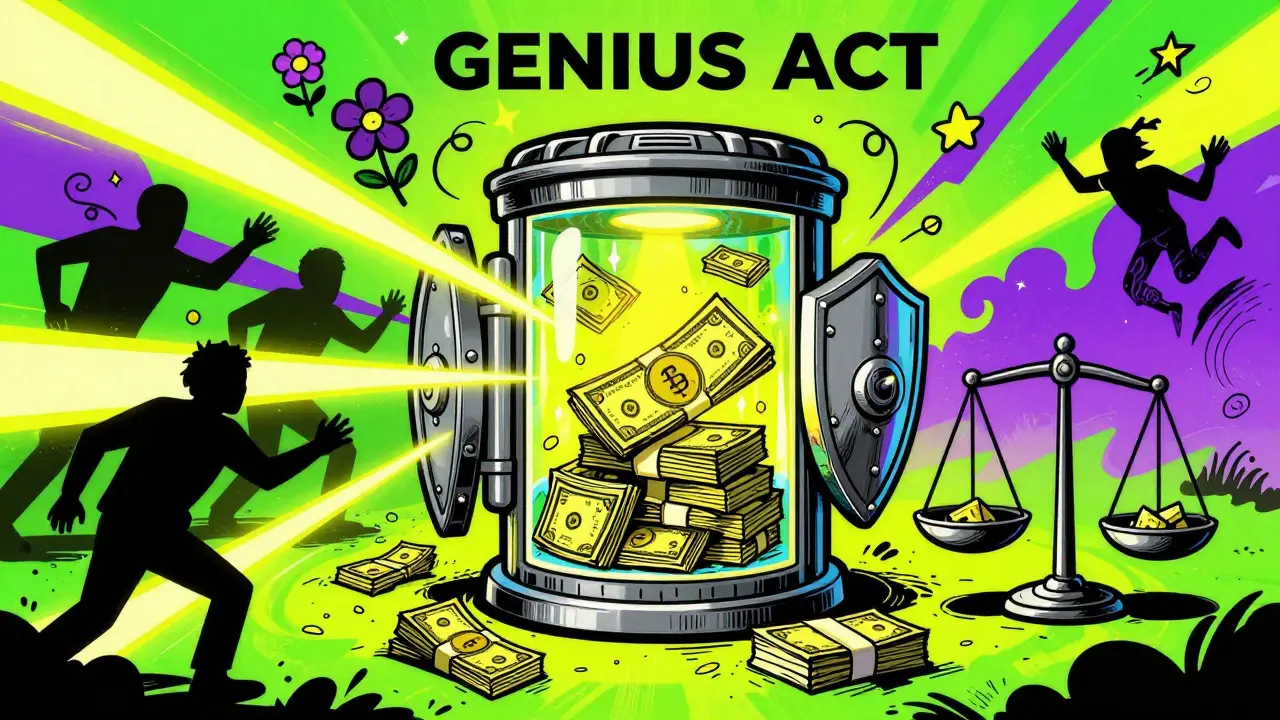
How the reserves are stored is just as important as what they are. The GENIUS Act imposes strict custody requirements. Custodial and safekeeping services for payment stablecoin reserves, collateral, or private keys can only be performed by entities under federal or state banking regulator oversight. This effectively bans unregulated third-party custodians from handling the backbone of the stablecoin system.
A crucial provision in the act is the prohibition on rehypothecation. In traditional finance, brokers often pledge client collateral to secure their own loans. The GENIUS Act forbids stablecoin issuers from doing this with reserve assets. You cannot take the Treasury bills backing my stablecoin and use them as collateral for your own liquidity needs, unless it is strictly to create liquidity to meet reasonable redemption expectations. Even then, pledging Treasury bill reserves is only allowed for short-term repurchase agreements cleared by approved central clearing counterparties or with prior regulatory approval.
This rule prevents the kind of chain-reaction failures seen in past financial crises. It ensures that the assets backing your digital dollar are always available to back your digital dollar, rather than being leveraged elsewhere in the financial system.
AML, CFT, and Consumer Protection
Innovation without oversight leads to crime. The GENIUS Act recognizes this by mandating full compliance with the Bank Secrecy Act (BSA). All permitted issuers must implement rigorous anti-money laundering (AML) and counter-financing of terrorism (CFT) measures. This means Know Your Customer (KYC) protocols are not just best practices; they are legal requirements.
The legislation also bolsters consumer protection. While the specific details of consumer safeguards are being fleshed out in the implementing regulations, the intent is clear: users must be protected from fraud, misrepresentation, and operational failures. The act prohibits payment stablecoin issuance in the United States unless conducted by a permitted issuer, creating a clean break between regulated, safe stablecoins and unregulated, risky digital assets.
Interestingly, the act includes an exclusion for persons providing hardware or software to facilitate customer self-custody. This means that non-custodial wallets and decentralized storage solutions are not classified as custodians under this framework, preserving some level of user autonomy and privacy for those who choose to hold their own keys.
The Role of the Stablecoin Certification Review Committee (SCRC)
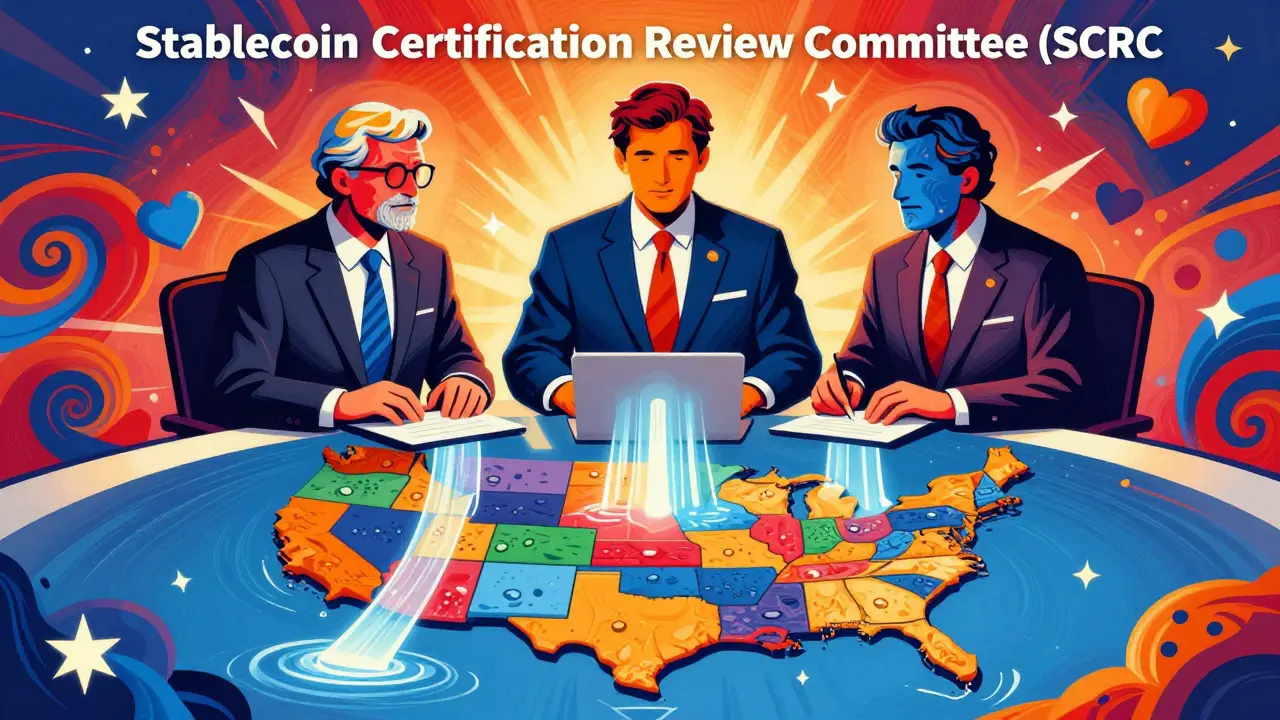
Regulation requires enforcement, and the GENIUS Act establishes a powerful oversight body: the Stablecoin Certification Review Committee (SCRC). Chaired by the Secretary of the U.S. Department of the Treasury, the SCRC includes the Chair of the Federal Reserve and the Chair of the Federal Deposit Insurance Corporation (FDIC).
The SCRC’s primary job is to ensure consistency across the country. Because the U.S. has a dual banking system, states also have the power to regulate financial institutions. The SCRC determines whether a state’s stablecoin regulatory framework is "substantially similar" to the federal requirements. If a state’s rules are deemed insufficient, the federal framework may preempt them, or the state may be required to adjust its regulations to align with federal standards.
This committee aims to prevent a race to the bottom, where issuers might flock to states with lax regulations. However, questions remain about how effectively the SCRC can harmonize fifty different state approaches. Some analysts worry that fragmentation may persist, especially since state-issued stablecoins are exempt from certain parts of the federal framework. Nevertheless, the existence of the SCRC provides a centralized point of authority that did not exist before.
| Aspect | Pre-GENIUS Act Status | Post-GENIUS Act Requirement |
|---|---|---|
| Issuer Eligibility | Open to any entity with capital | Limited to insured depository institutions or Fed-approved nonbanks |
| Reserve Composition | Varying mixes of cash, bonds, and commercial paper | Strictly low-risk assets: Cash, T-Bills, approved repos |
| Auditing | Voluntary or informal attestations | Mandatory regular audits by registered public accounting firms |
| Custody | Often handled by unregulated third parties | Must be under federal or state banking regulator oversight |
| Rehypothecation | Common practice for liquidity management | Prohibited, except for limited short-term repo agreements |
Global Context and Future Implications
The GENIUS Act positions the United States as a leader in digital asset regulation, joining jurisdictions like Hong Kong, which passed its own Stablecoin Ordinance in May 2025. By establishing clear rules, the U.S. aims to attract innovation while maintaining the dominance of the US dollar in international trade. The act explicitly mentions bolstering national security and strengthening the dollar’s reserve status.
For the global market, this means that U.S.-based stablecoins will become more reliable and transparent, potentially increasing their adoption in cross-border payments. However, it also raises the cost of compliance. Smaller players may struggle to meet the stringent requirements, leading to further market consolidation among large, well-capitalized institutions.
As we move through 2026, the focus shifts to implementation. Regulators will issue detailed guidelines, and companies will scramble to adapt. The 18-month window is tight, but necessary to build the infrastructure required for a compliant, secure, and efficient stablecoin ecosystem. The era of wild west crypto is ending; the era of regulated digital finance has begun.
When does the GENIUS Act officially take effect?
The GENIUS Act is scheduled to take effect on January 18, 2027. However, it could become effective earlier, specifically 120 days after the final implementing regulations are issued by federal agencies, whichever date comes first. This creates a compliance deadline that market participants must prepare for throughout 2026.
Can non-bank companies still issue stablecoins?
Yes, but only if they receive explicit approval from the Federal Reserve. The act restricts issuance to insured depository institutions (like banks and credit unions) and nonbank financial institutions that demonstrate compliance capability and gain Federal Reserve approval. Unapproved tech companies cannot issue payment stablecoins.
What assets can back a stablecoin under the new rules?
Stablecoin reserves must be held 1:1 in low-risk, highly liquid assets. Approved assets include physical currency, U.S. Treasury bills, and repurchase agreements cleared by approved central counterparties. Riskier assets like corporate bonds or commercial paper are generally excluded from the reserve pool.
Does the GENIUS Act affect self-custody wallets?
No, the act includes a specific exclusion for persons providing hardware or software to facilitate customer self-custody. This means that non-custodial wallet providers are not subject to the same strict custody and regulatory oversight as institutional custodians, preserving user autonomy for those who hold their own private keys.
Who oversees the implementation of the GENIUS Act?
The Stablecoin Certification Review Committee (SCRC) oversees the framework. It is chaired by the Secretary of the Treasury and includes the Chairs of the Federal Reserve and the FDIC. The SCRC ensures that state regulations are substantially similar to federal standards and monitors overall compliance.
Is rehypothecation of stablecoin reserves allowed?
Generally, no. The act prohibits issuers from rehypothecating collateral held in reserves. Exceptions are extremely limited, allowing only for short-term repurchase agreements cleared by approved central counterparties or with prior regulatory approval, specifically to meet reasonable redemption expectations.
Alex Di Mango
August 10, 2026 AT 05:09It's actually pretty refreshing to see some structure finally coming to this space, even if it feels a bit late in the game. The part about limiting issuers to banks or Fed-approved nonbanks is going to shake things up for sure, but I think it's necessary for mainstream adoption. People need to know their money isn't just backed by vibes and hope anymore.
Ken G
August 10, 2026 AT 17:44typical government overreach disguised as safety they want to control every dollar you hold in digital form its all about surveillance and killing privacy the feds will track every transaction and then freeze your account if they dont like what you bought with it trust the people not the system
Erica Johnson
August 12, 2026 AT 05:14@Ken G oh please, get off your high horse for a second :) you act like regulation equals total loss of freedom but have you ever tried using crypto on a Tuesday? half the time the liquidity is trash anyway. besides, if you are buying stuff legally why do you care if the feds see it? probably something to hide huh ;)
the real issue here is that small players are getting crushed by big banks again which is boring but realistic. we should be focusing on how the reserve requirements protect us from another terra luna style collapse rather than crying about imaginary conspiracies.
Lorraine Surringer
August 14, 2026 AT 03:34i mean honestly its kinda scary thinking about how much power these new committees have but at least self custody wallets are safe right? that gives me a tiny bit of comfort i guess. i just hope the audits are real and not just rubber stamps like everything else these days ugh
Amor Jordan
August 14, 2026 AT 05:33I really appreciate that the post clarified the exclusion for hardware and software providers facilitating self-custody! It’s such a crucial distinction because it preserves that core element of user autonomy that many of us value so deeply. While the institutional side gets heavily regulated, knowing that my Ledger or Trezor isn’t suddenly classified as a custodian under federal oversight brings a huge sense of relief.
The ban on rehypothecation is also a massive win for stability, ensuring that the assets backing our tokens aren’t being leveraged into oblivion somewhere else. It might feel restrictive at first, but long-term security is worth the trade-off for peace of mind. Let’s hope the transition period goes smoothly without too much market panic!