
When the FATF puts a country on a list, it isn't just a diplomatic slap on the wrist. It creates a ripple effect that hits Virtual Asset Service Providers (VASPs) immediately. If you're using an exchange in a listed jurisdiction, you're not just dealing with your local laws; you're dealing with a global risk rating that tells every bank and partner in the world that your region is "high risk." For the crypto world, which thrives on permissionless movement, these lists are the ultimate permission gate.
The Breakdown: Blacklists vs. Greylists
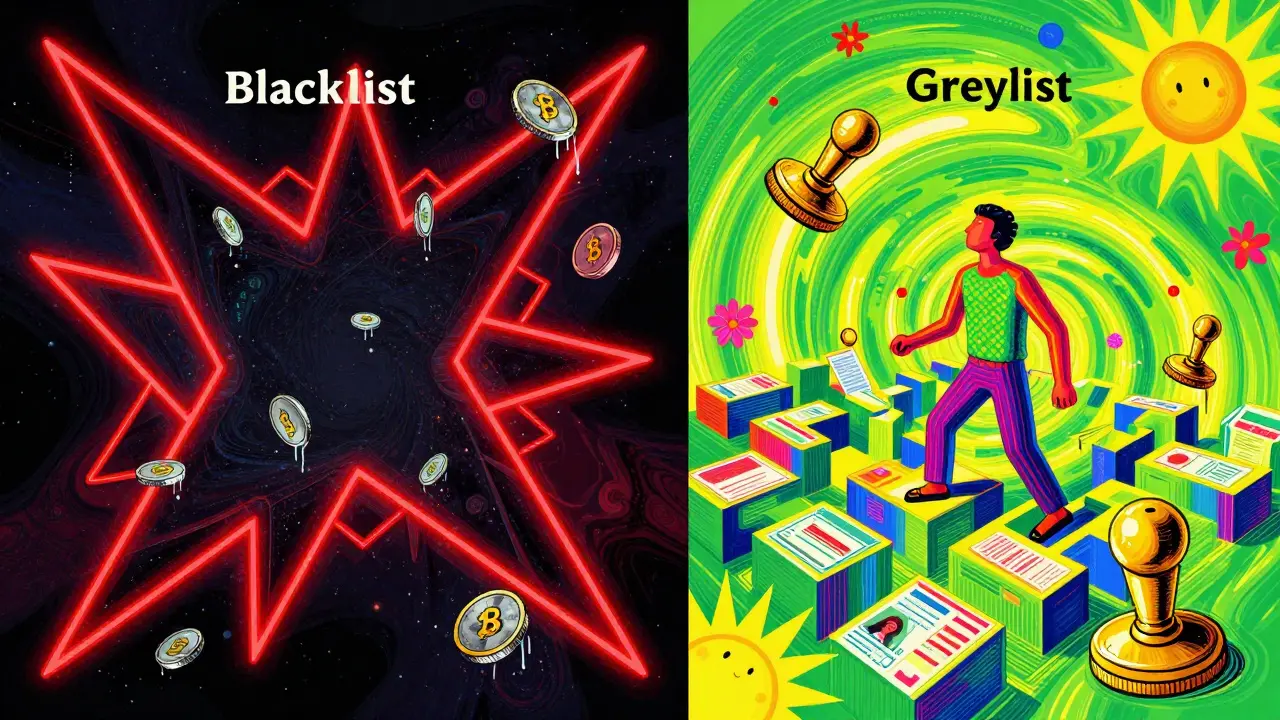
To understand the restrictions, we first have to distinguish between the two levels of monitoring. The blacklist is the "nuclear option," while the greylist is more of a "probationary period." As of mid-2025, the distinction is stark.
The Blacklist is reserved for jurisdictions with severe strategic deficiencies. We're talking about North Korea, Iran, and Myanmar. For crypto operations, this usually means total blocks. Most major exchanges simply refuse to provide services to these regions to avoid catastrophic fines or losing their own banking licenses. If a transaction is linked to a blacklisted address, it's often flagged instantly by blockchain analytics tools and reported to authorities.
The Greylist, or "Jurisdictions Under Increased Monitoring," is where things get complicated. These countries-including Nigeria, South Africa, and newly added Bolivia-have agreed to fix their Anti-Money Laundering (AML) gaps. They aren't banned from the global system, but they are under a microscope. For a crypto user, this doesn't mean you can't use an exchange, but it does mean you'll face much stricter identity checks and higher chances of your account being locked for "routine verification."
| Feature | Greylist (Increased Monitoring) | Blacklist (High-Risk) |
|---|---|---|
| Service Access | Generally available, but limited | Often completely blocked |
| KYC Requirements | Enhanced Due Diligence (EDD) | Extreme scrutiny/Forbidden |
| Transaction Speed | Slower due to manual reviews | Immediate flags/Frozen funds |
| Institutional Risk | Medium to High | Prohibited/Critical |
How Greylisting Actually Hits Your Wallet
You might wonder why a government's failure to pass a law affects your ability to trade Bitcoin. It comes down to compliance costs. When a country like Vietnam or Kenya stays on the greylist, every exchange serving those users must implement Enhanced Due Diligence (EDD). This isn't just asking for a photo of your passport; it's asking for proof of where your money came from (Source of Funds) and monitoring every single move you make on the blockchain.
This creates a "compliance tax." Exchanges spend more money monitoring users in greylisted countries, and they pass that cost-or the risk-onto the user. Some platforms might simply decide that the revenue from a specific country isn't worth the headache of the extra reporting requirements. This leads to "regulatory arbitrage," where some smaller, less compliant platforms move in to fill the gap. But be careful: using an exchange that ignores FATF guidelines is a gamble. If that exchange gets shut down or loses its banking rails, your funds could vanish overnight.
The economic damage is real. Look at Pakistan's experience; they lost an estimated $38 billion by 2021 due to capital flight and restricted financial access after being greylisted. In the crypto world, this manifests as a lack of liquidity. If institutional investors are afraid to move money into a greylisted region, the local price of crypto might deviate wildly from the global spot price, creating volatile and risky markets.
The VASP Struggle: The Travel Rule and Beyond
For the companies running these platforms, the FATF's influence is felt through the Travel Rule. This is a set of guidelines requiring VASPs to share sender and receiver information for transactions over a certain threshold. In greylisted countries, the pressure to implement this rule is immense.
The problem is that blockchain is designed to be pseudonymous. Linking a wallet address to a real-world identity in a country with systemic corruption is a nightmare. For example, in South Africa, where political infighting has stalled anti-corruption efforts, creating a transparent digital trail is difficult when the official systems are broken. Crypto compliance teams have to rely on expensive blockchain analytics tools to guess where a user is located, even if the user is using a VPN.
This creates a cat-and-mouse game. Users in restricted zones try to bypass these checks, and the FATF responds by tightening the rules. This cycle often pushes users away from regulated exchanges and toward Decentralized Finance (DeFi) protocols. Since DeFi has no central CEO to subpoena or office to raid, it becomes the primary refuge for people in listed jurisdictions. However, the FATF is already drafting new guidance to target DeFi, meaning the "safe haven" of decentralized trading is shrinking.

Why Some Countries Never Leave the List
You'd think that once a country fixes its laws, it gets delisted. But the FATF isn't just looking at paperwork; it's looking at effectiveness. A country can pass every law the FATF asks for, but if they don't actually prosecute corrupt officials, they stay on the list. This is why we see a strong link between institutional corruption and greylist status. Corrupt officials have no incentive to stop money laundering if they are the ones benefiting from the bribes.
Then there's the geopolitical mess. Syria and Yemen are classic examples. Technically, they may have addressed their action plans, but the FATF can't send inspectors to verify the results because the countries are war zones. In these cases, the crypto restriction becomes a permanent fixture of the landscape, forcing the population to rely on state-backed digital currencies or black-market P2P trading to survive.
What to Watch for in 2026 and Beyond
As we move forward, the line between traditional finance and crypto will continue to blur. We are seeing the rise of Central Bank Digital Currencies (CBDCs), which give governments a tool to monitor transactions in real-time. For the FATF, this is a dream come true. A CBDC allows a government to automate compliance, potentially speeding up the delisting process-or, conversely, making the surveillance in greylisted countries even more intense.
We should also expect the Travel Rule to become a global standard without exception. The days of "no-KYC" exchanges are ending. If you live in a country that is currently under monitoring, the best move is to maintain meticulous records of your source of funds. When the exchange eventually asks for that proof during a random audit, having a clean paper trail is the only thing that will prevent your assets from being frozen for months.
Does being on the FATF greylist mean I can't use any crypto exchange?
No, it doesn't mean a total ban. Most exchanges still serve greylisted countries, but they will subject you to Enhanced Due Diligence (EDD). This means more paperwork, stricter identity verification, and a higher likelihood of your transactions being flagged for manual review before they are processed.
What happens if my country is on the FATF blacklist?
The restrictions are much more severe. Most reputable global exchanges will completely block users from blacklisted countries like North Korea or Iran to avoid severe legal penalties. Users in these regions often have to rely on decentralized exchanges (DEXs) or P2P markets, though these carry significantly higher security risks.
How does the FATF "Travel Rule" affect me?
The Travel Rule requires crypto service providers to share the personal data of the sender and receiver for transactions above a certain limit. If you are sending funds from a greylisted country, this information is scrutinized more heavily to ensure the funds aren't being used for money laundering or terror financing.
Can I avoid these restrictions by using a VPN?
A VPN can hide your IP address, but it cannot hide your identity once you go through KYC (Know Your Customer) verification. If you provide a passport from a greylisted or blacklisted country, the exchange will apply the corresponding restrictions regardless of your IP address. Attempting to bypass these rules can lead to permanent account bans.
Why do some countries stay on the greylist for years?
Technical compliance (passing a law) isn't enough; the FATF requires "effectiveness." This means the country must prove they are actually catching criminals and seizing illicit assets. In countries with high systemic corruption or ongoing war, proving this effectiveness is extremely difficult, leading to prolonged monitoring.
Prachi Bhadarge
April 20, 2026 AT 07:16Oh sure, because nothing says "financial freedom" like having to prove where every single cent came from just to move some tokens around.
The irony of using a decentralized technology only to have a bunch of bureaucrats in suits decide if your passport is "risky" enough is just peak comedy. It's a total joke that we're pretending this is about stopping terror when it's mostly just about making sure the big banks keep their stranglehold on the global flow of money. Honestly, if you're in a greylisted zone, you might as well just jump straight into DeFi and hope the frontend doesn't get nuked tomorrow. The "compliance tax" is just a fancy way of saying you're being penalized for your geography, which is just lovely.
Tracy Sperandio
April 22, 2026 AT 06:28This is an absolute clusterfuck of global proportions!
It is genuinely appalling how these sweeping mandates essentially strangle the economic vitality of entire regions based on the whims of a few regulatory overlords. We're talking about a colossal betrayal of the very ethos that crypto was built upon-financial sovereignty and the obliteration of gatekeepers! Imagine the sheer audacity of forcing a hardworking individual in Nigeria or Bolivia to jump through a thousand flaming hoops just to access their own wealth. It's a kaleidoscopic disaster of red tape and bureaucratic insanity that treats millions of innocent people like criminals before they've even clicked 'send'. We need to stop playing patty-cake with these regulations and demand a system that doesn't treat the Global South as a permanent probation ward. This isn't just a "ripple effect," it's a tidal wave of financial exclusion that's absolutely criminal in its execution. The sheer nerve of the FATF to claim this is for "effectiveness" while ignoring the systemic devastation it causes is truly a masterpiece of gaslighting. It's high time we stop pretending this is a fair game and call it what it is: a digital iron curtain designed to keep the power exactly where it's always been. The vibrant energy of emerging markets is being suffocated by a colorless, sterile, and oppressive regime of compliance that prioritizes paperwork over people. Absolutely disgraceful!
Kevin Lư
April 23, 2026 AT 23:54I mean, it's kind of obvious why they do it, right? If you don't follow the rules, you get the boot. Simple as that. I'm not saying it's perfect, but honestly, most of these countries probably have some shady stuff going on anyway, so why be surprised that they're on a list? It's just common sense to keep the bad actors out of the system so the rest of us can trade in peace.
Ankit Sindhu
April 25, 2026 AT 05:50I think it's important for us to remember that many people in these regions are just trying to support their families through volatile economies. While the rules are there for security, we should encourage a more inclusive approach to onboarding users so they don't feel forced into risky, unregulated spaces. Education on how to properly document funds can really help bridge that gap for those struggling with EDD.