
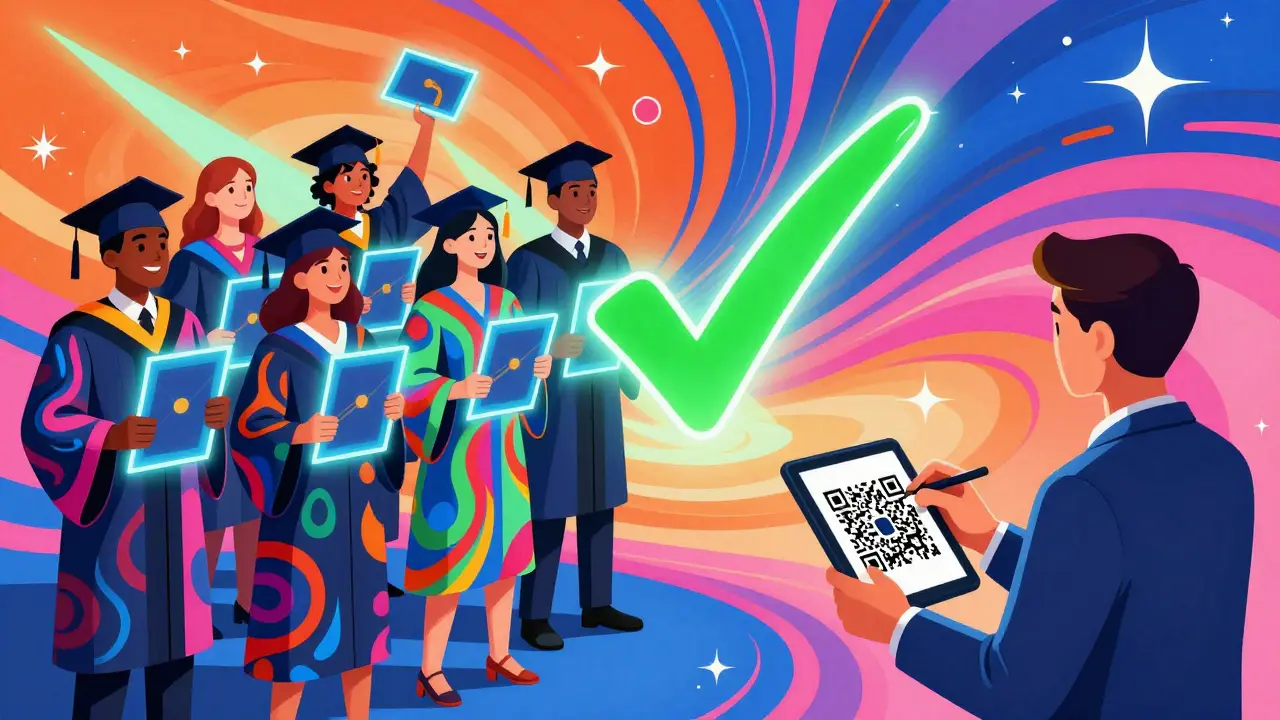
Imagine handing a recruiter your diploma. They don't call the university. They don't wait three days for an email response. Instead, they scan a QR code on your screen, and within seconds, a green checkmark confirms you really did graduate from Duke University with a Master’s in Financial Technology. This isn't science fiction; it is happening right now through Educational Certificates as NFTs.
For decades, verifying who actually earned a degree has been a messy, slow, and expensive process. Employers get burned by fake degrees, universities spend thousands answering verification requests, and students lose control over their own records. Non-fungible tokens (NFTs) are changing this dynamic. By turning academic achievements into unique, tamper-proof digital assets on the blockchain, schools can issue credentials that are instantly verifiable and permanently owned by the student.
Why Paper and PDFs Are Failing Us
Think about how you verify a college degree today. Usually, you ask the candidate to send a PDF or a scanned copy of their paper diploma. Then, you have to contact the registrar's office. This process takes anywhere from three to five business days. In some cases, especially with international degrees, it can take weeks. During this time, hiring managers are stuck waiting, and candidates are anxious.
Worse, fraud is rampant. Industry reports estimate that 15% to 20% of credential verification cases involve some form of document forgery or misrepresentation. A Photoshop-savvy applicant can easily alter dates, grades, or even the institution's name on a PDF. Traditional digital signatures help, but they don't prevent the file itself from being copied or modified after issuance. There is no central, immutable ledger that says, "This specific file was issued by this specific school at this specific time."
NFTs solve this by leveraging blockchain technology. Unlike cryptocurrencies like Bitcoin, which are fungible (one Bitcoin is identical to another), NFTs are unique. Each token has a distinct identity and cannot be exchanged one-for-one. This makes them perfect for representing singular achievements like a degree, a certification, or a completed course module. When a university issues an NFT diploma, it creates a permanent record on the blockchain that cannot be altered or deleted. If someone tries to forge it, the blockchain will simply not recognize it as valid because the cryptographic signature won't match the original issuance.
How NFT Diplomas Actually Work
You might be wondering what happens when you click "Accept" on your new digital degree. Behind the scenes, a few key technologies work together to make this secure and accessible.
- The Blockchain Layer: Most educational institutions use the Polygon network rather than Ethereum mainnet. Why? Because cost matters. On Ethereum, issuing a certificate could cost $1.50 or more in gas fees. On Polygon, that same transaction costs about $0.001. For a university issuing thousands of diplomas annually, this difference is massive.
- Storage via IPFS: The actual image of the diploma and its metadata (your name, graduation date, major) are stored on the InterPlanetary File System (IPFS). This is a decentralized storage protocol, meaning the file isn't hosted on a single server that could go down or be hacked. It is distributed across many nodes, ensuring the credential remains accessible forever.
- Smart Contracts: These are self-executing contracts with the terms of the agreement directly written into code. When the university signs off on your graduation, the smart contract automatically mints the NFT and sends it to your digital wallet. No middleman, no paperwork, just code executing a promise.
The result is a credential that contains cryptographic proof of authenticity. Anyone with the public link to your NFT can verify its origin without needing permission from the university. The metadata includes details like the course name, completion date, and accreditation status, all locked in place.
The Student Experience: Ownership vs. Access
The biggest shift here is psychological and practical: ownership. With traditional transcripts, the university holds the master record. You are essentially renting access to your own data. With an NFT diploma, you hold the asset in your Web3 wallet (like MetaMask or Coinbase Wallet). You decide who sees it, when they see it, and whether to revoke access later.
This empowers graduates significantly. Imagine applying for jobs abroad. Previously, you had to navigate complex apostille processes and pay for notarized translations. Now, you can share a verified link with employers in Singapore, Germany, or Brazil, and they can instantly confirm your credentials. A study by Indiana Publications found that 92% of students reported higher satisfaction with managing their credentials this way because they felt in control.
However, there is a catch. To receive an NFT, you need a digital wallet. This creates a technical barrier. According to BCDiploma.com, 68% of non-technology students struggle with setting up and securing these wallets. Losing your private key means losing access to your diploma forever. Universities are responding by providing physical recovery cards and integrating AI chatbots to guide students through the setup process, reducing helpdesk queries by nearly 70%.
Pros and Cons: Is It Worth the Hype?
No technology is perfect. While NFT credentials offer clear advantages, they also introduce new challenges that schools and employers must weigh carefully.
| Feature | Paper/PDF Diploma | NFT Certificate |
|---|---|---|
| Verification Time | 3-5 Business Days | Under 15 Seconds |
| Fraud Risk | High (15-20% fraud rate) | Near Zero (Cryptographically secured) |
| Ownership | Institution Controlled | Student Owned |
| Cost to Issue | $10-$50 per document | $0.001-$0.01 (Gas fees) |
| User Barrier | Low (Everyone understands paper) | High (Requires Web3 literacy) |
| Global Portability | Difficult (Needs translation/notarization) | Easy (Instantly verifiable worldwide) |
The speed and security benefits are undeniable. Verification drops from days to seconds. Forgery becomes virtually impossible. But the "User Barrier" row tells the real story. If a student doesn't understand blockchain, they feel excluded. Professor Mark Chen from Stanford University warned that this could create a new digital divide, where tech-savvy students benefit while others fall behind. Institutions must invest heavily in user education-spending an average of 120 staff training hours per 1,000 students-to bridge this gap.

Real-World Adoption: Who Is Leading the Way?
This isn't just theoretical. Several major players have already rolled out successful programs.
Duke University was a pioneer, issuing NFTs for its Master of Engineering in Financial Technology program in 2022. Graduates reported cutting their job application verification time from months to weeks. Singapore’s SkillsFuture initiative took it further, implementing NFT certificates across 23 polytechnics. Their 2023 annual report showed a 98% reduction in credential verification fraud. Singapore leads global adoption, with 78% of higher education institutions piloting or using NFT credentials.
In the United States, adoption is slower but growing. About 34% of research universities are exploring these systems, driven by the U.S. Department of Education's Blockchain Credentialing Initiative launched in early 2023. Europe lags slightly at 22% adoption, largely due to GDPR concerns regarding data privacy on public blockchains. However, platforms like OpenCerts are developing wallet-agnostic solutions that allow students to view credentials without fully managing private keys, easing regulatory fears.
Employers are taking notice too. LinkedIn’s 2023 Hiring Manager Survey found that 41% of Fortune 500 companies are interested in NFT credential verification, though only 12% have implemented it yet. The hesitation often comes from legacy HR systems that aren't built to read blockchain data. Integration requires APIs that can translate on-chain data into formats like JSON or XML that existing software can digest.
Challenges and Future Outlook
We are still in the "Innovation Trigger" phase of Gartner’s Hype Cycle for Digital Workplace Infrastructure. This means excitement is high, but widespread standardization is low. One major hurdle is interoperability. If University A uses Polygon and University B uses Solana, how does an employer verify both easily? ISO working group 35001 is currently developing international standards for blockchain credentials, expected by mid-2025, which should help unify these disparate networks.
Another concern is sustainability. Running multiple blockchain networks consumes energy and resources. Critics argue that maintaining separate ledgers for every university is inefficient. The future likely points toward consortium chains, where groups of universities share a single, permissioned blockchain layer, reducing redundancy and cost.
Despite these hurdles, the trajectory is clear. Gartner predicts that 60% of universities will offer NFT credentials by 2027. The World Economic Forum calls blockchain credentialing "inevitable" for global education systems seeking to combat fraud. As tools become more user-friendly-think Apple Pay-level simplicity for wallets-the friction will disappear. We are moving toward a world where your educational history is as portable and secure as your bank account.
Are NFT diplomas legally recognized?
Yes, increasingly so. The U.S. Department of Education and the European Commission have begun recognizing blockchain-based credentials, provided they meet specific privacy and data protection standards. However, legal recognition varies by country and sector. Always check with local labor laws, especially for government jobs in regions with strict cryptocurrency regulations like China or India.
What happens if I lose my crypto wallet?
If you lose your private key and do not have a backup (like a seed phrase or recovery card), you may lose access to the NFT. However, reputable educational platforms are implementing recovery mechanisms. Some store a hashed version of your identity on-chain while keeping the private key management simpler, or they provide institutional recovery options for verified alumni. Never share your private key with anyone.
Do NFT certificates cost money to issue?
The cost is negligible for the student. Issuing an NFT on networks like Polygon costs fractions of a cent ($0.001). Universities typically absorb this tiny fee as part of their administrative budget. The main cost for institutions is the initial setup of blockchain infrastructure, which can range from $75,000 to $120,000 for mid-sized schools.
Can employers verify NFT degrees without knowing blockchain?
Absolutely. The beauty of NFT verification is its simplicity for the end-user. An employer usually just clicks a link provided by the candidate. The platform displays a simple "Verified" badge with the details. They do not need to own a wallet or understand cryptography. Advanced HR integrations can even pull this data directly into applicant tracking systems.
Is my personal data safe on the blockchain?
Privacy is a top priority. Reputable systems do not store sensitive personal information (like Social Security numbers) directly on the public blockchain. Instead, they store a cryptographic hash-a unique fingerprint-of your data. The actual data remains on secure servers or decentralized storage like IPFS, linked to the NFT via the hash. This ensures immutability without exposing private details to the public internet.
Mark Corpuz
June 8, 2026 AT 23:50It is important to consider that the technology itself is neutral; the implementation determines its utility. The article mentions Polygon networks reducing gas fees to fractions of a cent, which addresses the economic barrier for institutions. Furthermore, the use of IPFS ensures that the metadata remains accessible even if specific nodes fail. We should not dismiss this innovation solely based on current user interface complexities, as those are likely to improve over time.
Sylvia Mossman
June 9, 2026 AT 03:15You are completely missing the point here. It is not about the tech stack; it is about control. Universities have hoarded our data for decades, charging us every time we need to prove we exist. Now they want to give it back in a format that requires us to be crypto experts? Please. It is just another way to gatekeep education under the guise of 'innovation.' Most people do not care about blockchain; they care about getting hired without jumping through hoops. If it is too hard for grandma to use, it is useless.
Kelly Tenney
June 10, 2026 AT 18:43I really appreciate the perspective on ownership though! It is so empowering to think that we finally hold our own credentials instead of begging schools for transcripts. I know the learning curve is steep right now, but remember when online banking was scary? We adapted. Maybe universities can offer better support systems, like the AI chatbots mentioned, to help everyone feel included. Let us encourage them to make this more user-friendly rather than shutting it down entirely!
Steven Jacobowitz
June 11, 2026 AT 13:33The interoperability issue is huge. You cannot just throw NFTs at the problem and expect HR departments to magically understand smart contracts. Until there is a universal standard like ISO 35001, we will have a fragmented mess where one university uses Solana and another uses Ethereum. It creates more work for employers, not less. The hype cycle is real, and we are definitely in the trough of disillusionment right now.