

You’ve probably seen the term "transaction sharding" tossed around in tech forums or vendor marketing decks. It sounds impressive-like your database can magically split up heavy transactions to run faster. But here’s the hard truth: transaction sharding isn’t a real thing. At least, not in the way most people think it is.
If you’re trying to scale a blockchain or a massive web application, understanding this distinction is critical. Confusing data partitioning with transaction handling can lead to months of wasted engineering time and costly performance bottlenecks. Let’s clear up the confusion once and for all.
The Reality Check: What Actually Exists?
To understand why "transaction sharding" is a myth, we first need to look at what actually exists: Data Sharding is a database architecture technique that splits a large dataset into smaller, independent units called shards, which are distributed across multiple servers.
Data sharding has been around since the early days of distributed systems. IBM laid the groundwork in the 1980s, but it really took off during the Web 2.0 boom around 2005-2007. Companies like Google needed to handle billions of rows of user data, so they built systems like Bigtable (documented in Chang et al., 2006) that could spread data horizontally across thousands of machines.
Today, major platforms rely on this. Netflix uses data sharding to keep query latency under 100 milliseconds even when handling datasets exceeding 100 terabytes. MongoDB, Cassandra, and Vitess all implement robust data sharding strategies. The goal is simple: horizontal scalability. You add more servers, and your system gets stronger.
So where does "transaction sharding" come from? It’s a misnomer. As Dr. Andy Pavlo, a database professor at Carnegie Mellon University, pointed out in his 2022 SIGMOD keynote, "Transactions aren’t sharded; data is." When people say "transaction sharding," they usually mean one of two things:
- Distributed Transactions: A single logical transaction that touches data on multiple shards.
- Transaction Processing Optimization: Techniques to make those cross-shard operations faster.
Vendors sometimes use the phrase "transaction sharding" to sound innovative, but experts like Baron Schwartz of Percona have reviewed hundreds of production systems and never found one that actually shards transactions themselves. They shard the data, then struggle to manage the transactions that span across those shards.
How Data Sharding Actually Works
Data sharding isn’t just "splitting data." It requires specific strategies to ensure even distribution and efficient retrieval. Here are the four main methods used in industry today:
- Range-Based Sharding: Data is split by value ranges. For example, customer IDs 1-1000 go to Shard A, and 1001-2000 go to Shard B. This is easy to understand but can lead to "hotspots" if certain ranges are queried more often.
- Hash-Based Sharding: A hash function (like SHA-256 or MurmurHash3) is applied to the shard key. This distributes data evenly. Facebook’s implementation of Cassandra achieved 98.7% even distribution using this method.
- Directory-Based Sharding: A central lookup service maps keys to shards. Vitess uses consistent hashing for this. It adds complexity but offers flexibility.
- Geo-Sharding: Data is stored physically close to users. Amazon DynamoDB Global Tables use this to reduce latency between US and EU regions to 200-300ms.
Each method has trade-offs. Hash-based sharding prevents hotspots but makes range queries difficult. Range-based sharding makes filtering easy but risks uneven load. Choosing the right strategy depends entirely on your access patterns.
The Real Challenge: Cross-Shard Transactions
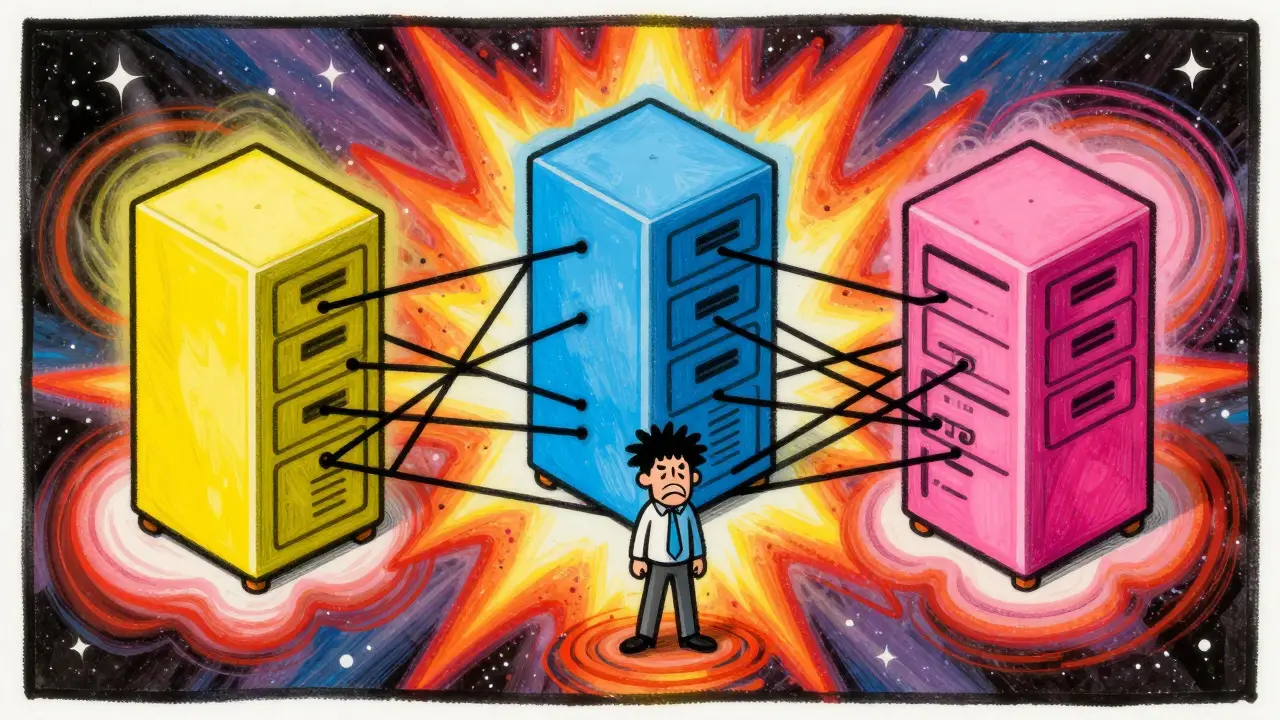
This is where the "transaction sharding" myth causes the most pain. In a non-sharded database, a transaction is atomic-it either succeeds completely or fails completely. In a sharded environment, if a transaction needs to update data on three different shards, things get complicated.
These are called Cross-Shard Transactions are operations that require coordination between multiple independent database nodes to maintain consistency.
Here’s the problem: Coordination takes time. According to Percona’s benchmark study from March 2023, cross-shard transactions in MongoDB 6.0 take 3-5 times longer than single-shard transactions. Microsoft’s 2023 research paper, "The Unbearable Weight of Cross-Shard Transactions," confirmed this, showing a 2.3x latency overhead even in state-of-the-art systems.
Why? Because the database has to use protocols like Two-Phase Commit (2PC) or the Saga pattern to ensure all shards agree on the outcome. If one shard fails, the whole transaction might roll back, causing delays and potential deadlocks.
This is why e-commerce platforms often see 40-60% performance degradation for shopping cart operations that span multiple shards (Gartner, 2022). The "sharding" didn’t break the transaction; the complexity of coordinating it did.
| Feature | Data Sharding (Real) | "Transaction Sharding" (Myth/Misconception) |
|---|---|---|
| Definition | Partitioning data across nodes | No standard definition; often refers to distributed transaction management |
| Primary Goal | Horizontal scalability, reduced storage per node | Reducing latency of multi-node commits (via optimization, not sharding) |
| Performance Impact | Linear scaling for reads/writes within a shard | Cross-shard transactions incur 2.3x-5x latency overhead |
| Complexity | High setup cost, complex routing | Requires sophisticated consensus algorithms (e.g., Paxos, Raft) |
| Industry Adoption | Universal (MongoDB, Cassandra, Spanner) | Non-existent as a distinct architectural pattern |
Blockchain Context: Sharding in Crypto
In the blockchain world, "sharding" is a buzzword for scalability. Ethereum, for example, has pursued sharding to increase throughput. But here too, the distinction matters.
Blockchain sharding typically refers to State Sharding is partitioning the global state of a blockchain network among different validator groups. Each shard processes its own subset of transactions. This is effectively data sharding applied to the ledger.
However, blockchains also face the cross-shard transaction problem. If you want to send tokens from Shard A to Shard B, the network must coordinate between both shards. Projects like Polkadot and Cosmos use relay chains or inter-blockchain communication (IBC) protocols to handle this. They don’t "shard the transaction"; they bridge the shards.
Misunderstanding this leads to unrealistic expectations. Some believe sharding will make every transaction instant and free. In reality, while intra-shard transactions are fast, inter-shard transactions still suffer from latency and security trade-offs. As of 2026, no major blockchain has fully solved the cross-shard atomicity problem without significant complexity.

Implementation Pitfalls and How to Avoid Them
If you’re planning to implement data sharding, avoid these common traps:
- Poor Shard Key Selection: Don’t pick a low-cardinality key (like "gender") or a monotonically increasing key (like timestamps) without careful planning. AWS recommends high-cardinality, frequently queried attributes. Bad keys cause hotspots, negating the benefits of sharding.
- Ignoring Rebalancing Costs: Adding new shards requires redistributing data. Cassandra’s nodetool rebuild process takes about 2 hours per TB of data. Plan for downtime or use systems with automatic rebalancing like Google Cloud Spanner.
- Overestimating Cross-Shard Performance: Assume cross-shard operations will be slow. Design your schema to minimize joins across shards. If you need frequent cross-shard queries, consider denormalization or application-level aggregation.
- Underestimating Learning Curve: DBAs report needing 3-6 months to master sharding concepts. Start small. Test with mock data. Use tools like Vitess or Citus that abstract some complexity.
Expert tip: Monitor your shard distribution closely. An 83% of sharding implementations experience hotspotting initially (DataStax, 2023). Use dynamic shard splitting to mitigate this.
Future Trends: Hiding the Complexity
The industry is moving toward making sharding invisible to developers. Google Spanner’s "Oscars" project aims to make sharding transparent to application code. AWS Aurora Serverless v2 introduced auto-sharding in 2022. By 2025, Gartner predicts 40% of new sharding implementations will use AI for dynamic rebalancing.
Meanwhile, the confusion around "transaction sharding" is fading. Stack Overflow questions containing the term dropped by 62% from 2021 to 2023. Education is improving. Vendors are being held accountable for precise terminology.
For now, focus on mastering data sharding. Understand how to choose shard keys, manage rebalancing, and optimize cross-shard transactions. That’s the real skill that will scale your system-and your career.
Is transaction sharding a real technology?
No, "transaction sharding" is not a recognized standard database architecture concept. It is a misnomer often used to describe distributed transaction management across sharded data. Experts like Dr. Andy Pavlo and Baron Schwartz confirm that only data is sharded, not transactions.
What is the difference between data sharding and database partitioning?
Database partitioning occurs within a single database instance, splitting tables into segments for management. Data sharding distributes these segments across multiple independent servers or nodes, enabling true horizontal scalability and fault isolation.
Why are cross-shard transactions slower?
Cross-shard transactions require coordination between multiple nodes using protocols like Two-Phase Commit. This adds network latency and locking overhead. Benchmarks show they can be 2.3x to 5x slower than single-shard transactions.
Which databases support data sharding?
Major databases supporting data sharding include MongoDB, Apache Cassandra, Google Cloud Spanner, CockroachDB, YugabyteDB, MySQL Cluster, and PostgreSQL extensions like Citus. Cloud services like AWS DynamoDB and Azure Cosmos DB also offer managed sharding.
How do I choose a shard key?
Choose a high-cardinality attribute that is frequently used in queries and ensures even data distribution. Avoid monotonically increasing values unless using hash-based sharding. AWS recommends analyzing access patterns to select keys that minimize cross-shard joins.