
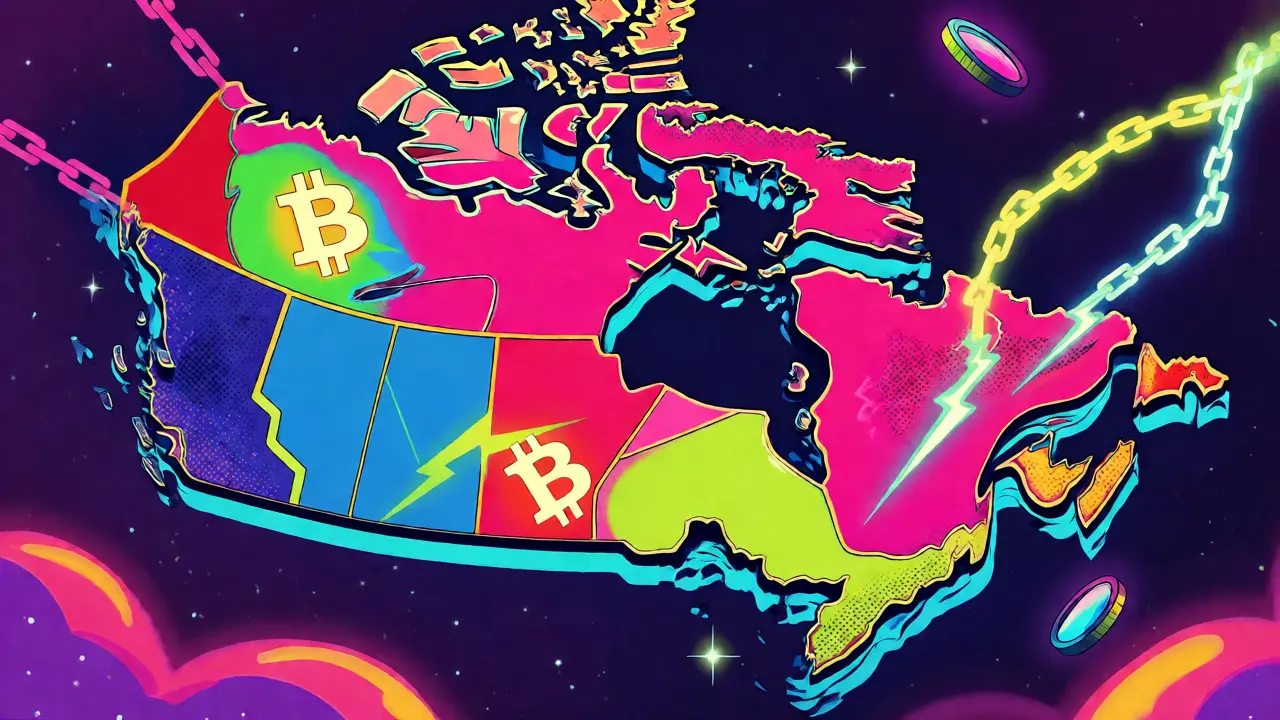
Thinking about buying Bitcoin in Toronto or mining Ethereum in British Columbia? You might assume the rules are the same across Canada. They aren't. While the federal government sets the baseline for taxes and anti-money laundering, each province pulls its own strings on how you can trade, mine, and hold digital assets. This patchwork of rules can trip up even seasoned investors.
Crypto regulations in Canada operate under a unique hybrid system. The Financial Transactions and Reports Analysis Centre of Canada (FINTRAC) handles the national safety net, but local securities commissions decide who gets to sell what to whom. If you're moving money between provinces or running a business, you need to know exactly where the lines are drawn.
The Federal Baseline: What Never Changes
Before we look at the map, let's clear up the national standard. No matter if you live in Halifax or Vancouver, certain things stay constant. Canada doesn't treat cryptocurrency as legal tender. It’s a commodity. That distinction matters because it triggers specific tax events every time you swap one coin for another or use it to buy coffee.
You must register with FINTRAC if you run a business that exchanges virtual currencies. This isn't optional. Since 2014, any entity acting as a Virtual Asset Service Provider (VASP) has had to follow strict anti-money laundering (AML) protocols. Think of it like opening a bank account; you have to verify who your customers are. Failure to report large transactions or suspicious activities can lead to heavy fines, regardless of which province you call home.
Taxes are also uniform federally. When you sell crypto for a profit, you pay capital gains tax. Currently, 50% of your gain is added to your income and taxed at your marginal rate. But here’s the twist: while the federal tax rate is fixed, your total bill changes based on your province’s income tax rates. So, selling $10,000 worth of Bitcoin in Ontario costs you more in taxes than selling the same amount in Alberta, simply because of provincial income brackets.
British Columbia: The Mining Battleground
If you’re into mining, BC is currently the most volatile jurisdiction. For years, cheap hydroelectric power made it a miner’s paradise. But the government got worried about grid stability and environmental impact. In December 2022, they hit pause, allowing BC Hydro to suspend new mining projects for 18 months. This wasn't just a suggestion; it was a hard stop.
As of May 2024, those temporary measures turned into permanent law through amendments to the BC Utilities Commission Act. Now, the province can outright prohibit or restrict electricity supply to crypto miners. If you’re planning to set up rigs in BC, don’t assume you’ll get power. You need explicit approval, and the bar is high. The province prioritizes residential and industrial users over speculative mining operations.
For traders, BC follows the general Canadian securities rules, but enforcement is active. The British Columbia Securities Commission (BCSC) works closely with other western regulators. Platforms like Kraken and Crypto.com have secured authorization here, but they face ongoing scrutiny regarding their marketing claims and risk disclosures.
Quebec: Energy Costs and Strict Oversight
Quebec takes a different angle on mining. Instead of banning it outright, they priced it out for smaller players. In January 2023, the Régie de l'énergie approved a specific rate structure for new crypto mining projects. If your setup uses at least 50 kilowatts of capacity, you’re looking at a rate of 16.603¢ per kWh. Compare that to the subsidized rates older miners enjoy, and you see the strategy: discourage new, energy-hungry entrants while protecting existing contracts.
Quebec’s approach to trading platforms is equally rigorous. The Autorité des marchés financiers (AMF) requires platforms to meet high standards for investor protection. They’ve been quick to issue warnings against unregistered foreign exchanges targeting Quebec residents. If you’re using an app that doesn’t explicitly list AMF registration, you might be operating in a grey area.
Language laws add another layer. All communications from registered crypto businesses must comply with French language requirements. This includes terms of service, customer support interactions, and marketing materials. Ignoring this can result in penalties separate from financial regulations.

Ontario: The Hub for Institutional Trading
Ontario is the financial heart of Canada, and its regulator, the Ontario Securities Commission (OSC), is often the trendsetter for the rest of the country. Most major institutional crypto products launch here first. If you want access to regulated crypto ETFs or structured notes, Ontario usually leads the way.
The OSC enforces strict Know Your Client (KYC) rules. Unlike some jurisdictions that allow anonymous trading on certain decentralized platforms, Ontario insists on full identity verification for centralized exchanges. This aligns with global trends toward transparency but frustrates privacy-focused users.
For businesses, Ontario offers clarity but demands compliance. The province hosts the headquarters of many fintech startups. To operate legally, you need registration with the OSC unless you qualify for an exemption. Recent decisions, such as the amended approval for Newton Crypto Ltd. in March 2025, show that the OSC is willing to work with compliant entities but won’t hesitate to shut down non-compliant ones.
Alberta and the Prairies: Resource-Driven Rules
Alberta’s economy revolves around oil and gas, and that influences its crypto stance. The province has historically been friendly to energy-intensive industries, including mining. However, the Alberta Securities Commission (ASC) maintains tight control over investment products. They’ve authorized several platforms, including Kraken and Netcoins, ensuring that retail investors have access to legitimate options.
Manitoba and Saskatchewan follow similar patterns to Alberta, relying on the broader Western Canadian Securities Administrators framework. There’s less divergence in trading rules compared to BC or Quebec. The main challenge here isn’t regulatory complexity but market depth. Fewer local exchanges mean fewer choices, forcing residents to rely on national players authorized in multiple provinces.
Atlantic Provinces and Territories: Emerging Markets
In Nova Scotia, New Brunswick, Prince Edward Island, and Newfoundland and Labrador, the regulatory environment mirrors the federal baseline with minor local tweaks. These regions generally adopt the CSA guidelines without significant independent legislation. The Canadian Securities Administrators (CSA) provides a unified front, so a platform authorized in Ontario is typically recognized here, though you should always check the local regulator’s website for specific exemptions.
Energy availability is rarely an issue for miners in these areas, but climate concerns are growing. As of 2026, there are no specific bans on mining in Atlantic Canada, but local utilities monitor consumption closely. If you’re planning a large-scale operation, early engagement with local utility providers is essential to avoid unexpected rate hikes.
Platform Authorization: Who Can Trade Where?
Not all apps are available everywhere. Authorization is granted province by province. Here’s a snapshot of key players as of 2025:
| Platform | Parent Company | Key Authorized Provinces | Status Note |
|---|---|---|---|
| Kraken | Payward Canada Inc. | AB, BC, MB, SK | Widely accepted, strong compliance record |
| Crypto.com | Foris DAX CAN ULC | National (via CSA) | Decision May 8, 2025 |
| Newton | Newton Crypto Ltd. | ON, AB, BC | Amended Decision March 12, 2025 |
| NDAX | Ndax Canada Inc. | ON, BC, AB | Decision April 1, 2025 |
| Fidelity Digital Assets | Fidelity Investments | ON (Exempt Marketplace) | Clearing Agency status since Jan 2023 |
Notice that Fidelity operates differently. It’s not a retail exchange in the traditional sense but acts as an exempt marketplace and clearing agency. This distinction matters for institutional clients who need secure custody solutions rather than day-trading interfaces.
Common Pitfalls and How to Avoid Them
Many Canadians get tripped up by assuming federal legality equals provincial ease. Just because crypto is legal in Canada doesn’t mean your specific activity is permitted in your province. Here are three common mistakes:
- Ignoring Provincial Income Tax: Calculating your capital gains tax without factoring in your province’s specific surtaxes or brackets. Always use a calculator tailored to your residency.
- Mining Without Approval: Setting up hardware in BC or Quebec without checking current utility restrictions. You could face shutdown orders or punitive rates.
- Using Unregistered Foreign Exchanges: Relying on overseas platforms that haven’t registered with FINTRAC or local securities commissions. If the platform fails, you may have no recourse under Canadian consumer protection laws.
Another trap is forgetting about GST/HST. Buying goods with crypto counts as a disposition event. You owe tax on the gain, plus sales tax on the purchase price. Many people miss this double-hit, leading to surprise bills during tax season.
Future Outlook: Tightening, Not Overhauling
Don’t expect a massive new law in 2026. The focus remains on tightening existing frameworks. Recent amendments to National Instrument 81-102 regarding Investment Funds show regulators are refining rules for public crypto funds. Expect more guidance on custody requirements and permitted asset types.
Provincial regulators will likely continue to assert authority over energy usage for mining. As climate goals become stricter, regions with high renewable potential but limited grid capacity may impose further limits. For traders, harmonization efforts within the CSA aim to reduce fragmentation, but true national uniformity remains elusive.
Your best strategy? Stay localized. Check your provincial securities commission’s website quarterly. Engage with local tax professionals who understand crypto nuances. And keep records meticulously-every transaction, every wallet transfer, every mining payout. In a fragmented regulatory landscape, documentation is your strongest defense.
Is cryptocurrency legal tender in Canada?
No, cryptocurrency is not legal tender in Canada. It is classified as a commodity. This means you cannot demand payment in Bitcoin, and merchants are not obligated to accept it. However, you can freely buy, sell, and hold it as an investment asset.
Do I need to register my crypto business with FINTRAC?
Yes, if your business facilitates the exchange of virtual currency for fiat currency or vice versa, you are considered a Money Services Business. Registration with FINTRAC is mandatory to comply with anti-money laundering laws, regardless of which province you operate in.
Why are crypto mining rules different in BC and Quebec?
Both provinces rely heavily on hydroelectric power. BC implemented legislative amendments to restrict new mining projects to protect grid stability. Quebec introduced higher electricity rates for new large-scale miners to manage energy demand. These regional differences reflect local infrastructure constraints and policy priorities.
Are all crypto exchanges authorized in every province?
No. Authorization is granted by provincial securities regulators. While many major platforms seek national approval, some only operate in specific provinces. Always check the Canadian Securities Administrators' list to ensure your chosen platform is authorized in your residence.
How does provincial tax affect my crypto profits?
While the federal capital gains inclusion rate is 50%, your total tax bill depends on your province's income tax rates. Residents of provinces with higher marginal tax rates, like Ontario or Nova Scotia, will pay more tax on their crypto gains than those in lower-tax provinces like Alberta or Saskatchewan.