

Imagine sending money home to your family in Kathmandu. You have two choices: wait days for a bank transfer with hefty fees, or send Bitcoin instantly via your phone, risking three years in prison if caught. This isn't a hypothetical scenario; it is the daily reality for thousands of Nepalis. As of October 2026, Nepal maintains one of the strictest anti-crypto stances in Asia. Yet, walk through the tech hubs of Lalitpur or talk to freelancers in Pokhara, and you will hear whispers about wallets, exchanges, and stablecoins. The law says no. Life says yes. So, how does this underground economy actually function?
The Legal Wall: Why Is It Illegal?
To understand the "how," you first need to grasp the "why." The Nepal Rastra Bank (NRB) is the central bank of Nepal that regulates monetary policy and banking operations. In September 2021, they issued a blanket ban on all cryptocurrency activities. This wasn't just a suggestion. Under the Foreign Exchange Regulation Act and the Electronic Transaction Act, trading, mining, and holding crypto are criminal offenses. The penalties are severe: up to three years in jail, fines triple the transaction amount, and confiscation of assets. The government’s logic is straightforward-they fear money laundering, unregulated capital flight, and the instability seen in other markets. They want control over every rupee moving across borders.
But here is the catch. The ban targets formal structures. It doesn't stop the technology. While the NRB pushes for its own Central Bank Digital Currency (CBDC), citizens are voting with their feet-and their wallets-toward decentralized options. The gap between state policy and street-level economics has created a shadow market that thrives on necessity rather than speculation.
Remittances: The Primary Driver
If there is one reason crypto survives in Nepal, it is remittances. Nepal’s economy relies heavily on money sent home by migrant workers in the Gulf, Malaysia, and Europe. Traditional channels like Western Union or local banks can be slow and expensive. For a worker earning modest wages, losing 5-7% in fees hurts. Enter cryptocurrency. Many migrants convert their earnings into USDT (Tether) or Bitcoin abroad. They then transfer these digital assets to relatives in Nepal using peer-to-peer (P2P) methods. The recipient sells the crypto locally for cash, often getting a better exchange rate than official banks offer. This arbitrage opportunity keeps the underground market liquid and active.
| Feature | Traditional Banking | Crypto (Underground) |
|---|---|---|
| Speed | 3-7 business days | Minutes to hours |
| Fees | 3-8% (often hidden) | 1-3% (network + spread) |
| Legal Status | Fully legal | Illegal (High risk) |
| Accessibility | Requires bank account | Smartphone only |
The P2P Network: How Transactions Happen
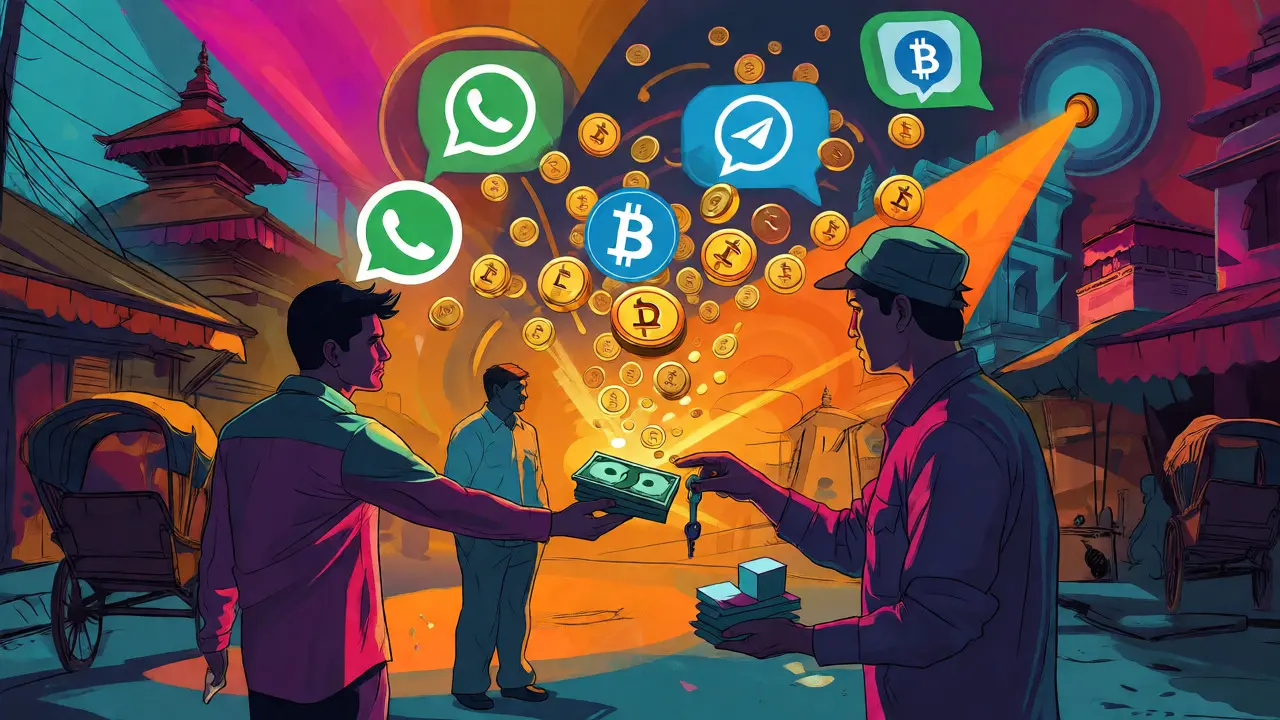
You might wonder, if you can't open a Binance account linked to a Nepali bank card, how do you buy crypto? The answer lies in informal Peer-to-Peer networks. These aren't always organized platforms. Often, they are WhatsApp groups or Telegram channels where buyers and sellers meet virtually. A freelancer in Kathmandu wants to pay for software subscriptions in USD. He finds a seller who has excess USDT from a remittance. They agree on a rate slightly below the official market rate but above the black-market dollar rate. The buyer sends NPR via mobile banking (like eSewa or Khalti) to the seller’s personal account. The seller transfers USDT to the buyer’s wallet. No exchange touches the money. No bank sees a foreign transaction. To the authorities, it looks like a standard domestic transfer between friends.
This method is fragile. There is no escrow service protecting either party. If the seller disappears after receiving the NPR, the buyer loses out. Conversely, if the buyer sends fake proof of payment, the seller risks losing their crypto. Trust is the currency here, not blockchain consensus. Yet, despite the risks, the volume is significant enough that police raids occasionally make headlines, seizing phones and laptops from suspected traders.
Freelancing and Global Payments
Nepal has a growing community of IT freelancers working for international clients. Platforms like Upwork or Fiverr often require PayPal or Payoneer, which can be cumbersome to link to Nepali banks due to KYC hurdles and withdrawal limits. Some freelancers bypass this by asking clients to pay in crypto directly. They hold the assets in non-custodial wallets like MetaMask or Trust Wallet. When they need cash, they offload it through the P2P network mentioned earlier. This allows them to earn global rates while navigating local restrictions. It is a workaround born of frustration with bureaucratic banking processes.
However, this strategy carries long-term risks. Since the source of income is technically unreported as foreign exchange inflow via proper channels, these freelancers may face tax audits or questions about the origin of their funds. The government is increasingly aware of these patterns, leading to more scrutiny on large, frequent mobile banking transactions.

Who Is Doing This?
The demographic driving this underground adoption is young, tech-savvy, and urban. Students studying computer science, early-career developers, and diaspora families form the core user base. Older generations tend to stick to gold or real estate, viewing crypto as a scam. But for the youth, blockchain represents modernity and financial autonomy. They see neighbors in India or Vietnam using regulated crypto exchanges and wonder why Nepal remains stuck in prohibition. This generational divide creates social pressure on the government to reconsider its stance, especially as neighboring countries begin to regulate rather than ban.
Interestingly, the ban has also spurred innovation in alternative fintech solutions. Local startups are experimenting with QR-code-based payments and closed-loop digital wallets that mimic some benefits of crypto without breaking the law. These "walled gardens" offer speed and convenience but lack the borderless nature of true cryptocurrencies.
Risks and Realities
Using crypto in Nepal is not for the faint-hearted. Beyond the legal threat of imprisonment, users face practical dangers. First, there is fraud. Without regulation, anyone can set up a fake exchange or run a Ponzi scheme labeled as "blockchain investment." Victims have no recourse because the contract itself is illegal. Second, liquidity issues can arise. During periods of high enforcement activity, sellers disappear, making it hard to convert crypto back to NPR quickly. Third, technological barriers remain. Not everyone understands seed phrases or private keys. Losing access to a wallet means losing your money forever, with no customer support hotline to call.
Despite these hurdles, the momentum continues. The sheer utility of fast, cheap cross-border transfers outweighs the perceived risk for many. As long as traditional banking fails to provide efficient, low-cost remittance corridors, the underground crypto market will persist. It operates in the shadows, adapting to each new police sweep or regulatory warning, surviving because it solves a problem the state hasn't addressed effectively.
Is owning Bitcoin illegal in Nepal?
Yes. The Nepal Rastra Bank explicitly bans all forms of cryptocurrency trading, mining, and holding. Possession can lead to fines and imprisonment under the Foreign Exchange Regulation Act.
How do people buy crypto in Nepal if banks block it?
Most use informal Peer-to-Peer (P2P) networks via apps like WhatsApp or Telegram. Buyers send Nepali Rupees via mobile banking services like eSewa or Khalti, and sellers transfer crypto directly to their wallets.
What are the penalties for using cryptocurrency in Nepal?
Penalties include up to three years in prison, fines up to three times the transaction value, and confiscation of assets involved in the crypto activity.
Why does Nepal ban cryptocurrency?
The primary reasons are concerns over money laundering, unregulated foreign exchange flows, potential fraud, and the desire to maintain control over the national monetary system.
Can I use crypto for freelance work in Nepal?
Technically, yes, many freelancers receive payments in crypto. However, converting it to usable local currency involves illegal P2P trades, so it carries legal risk regarding income reporting and foreign exchange compliance.