

So, you want to launch a crypto company in the UAE. You’ve probably heard the hype: zero personal income tax, world-class infrastructure, and a government that actually seems to like blockchain. But here’s the catch nobody tells you upfront: "UAE" isn't one single regulatory bucket. If you try to set up your exchange or wallet service without knowing which specific free zone is a special economic area with distinct legal and tax rules you’re entering, you could waste six months and $50,000 on the wrong paperwork.
The real challenge isn’t just registering a company; it’s navigating the split between federal regulators and specialized authorities like VARA the Virtual Assets Regulatory Authority, the world's first dedicated virtual asset regulator. This guide cuts through the noise. We’ll look at exactly where to register, what it costs, and how to avoid the compliance traps that sink many startups.
Why Choose a UAE Free Zone for Crypto?
Before we talk about licenses, let’s address why everyone is flocking here. It’s not just about the tax-free salary. For crypto businesses, the primary draw is regulatory clarity. In many countries, banks are terrified of crypto. They close accounts because they don’t understand the tech. In the UAE, particularly within designated free zones, banking relationships are becoming easier to establish because the regulators speak the same language as the entrepreneurs.
You get three main benefits:
- 100% Foreign Ownership: Unlike mainland UAE companies that sometimes require local sponsors, free zones allow you to own 100% of your business.
- Tax Efficiency: While corporate tax exists (9% on profits over AED 375,000), many free zone entities can qualify for 0% corporate tax if they meet specific "qualifying income" criteria. Plus, there’s no personal income tax on salaries or dividends.
- Regulatory Certainty: The UAE has moved from "wait and see" to active regulation. This scares off shady operators but attracts institutional money. If you have a VARA license, banks take you seriously.
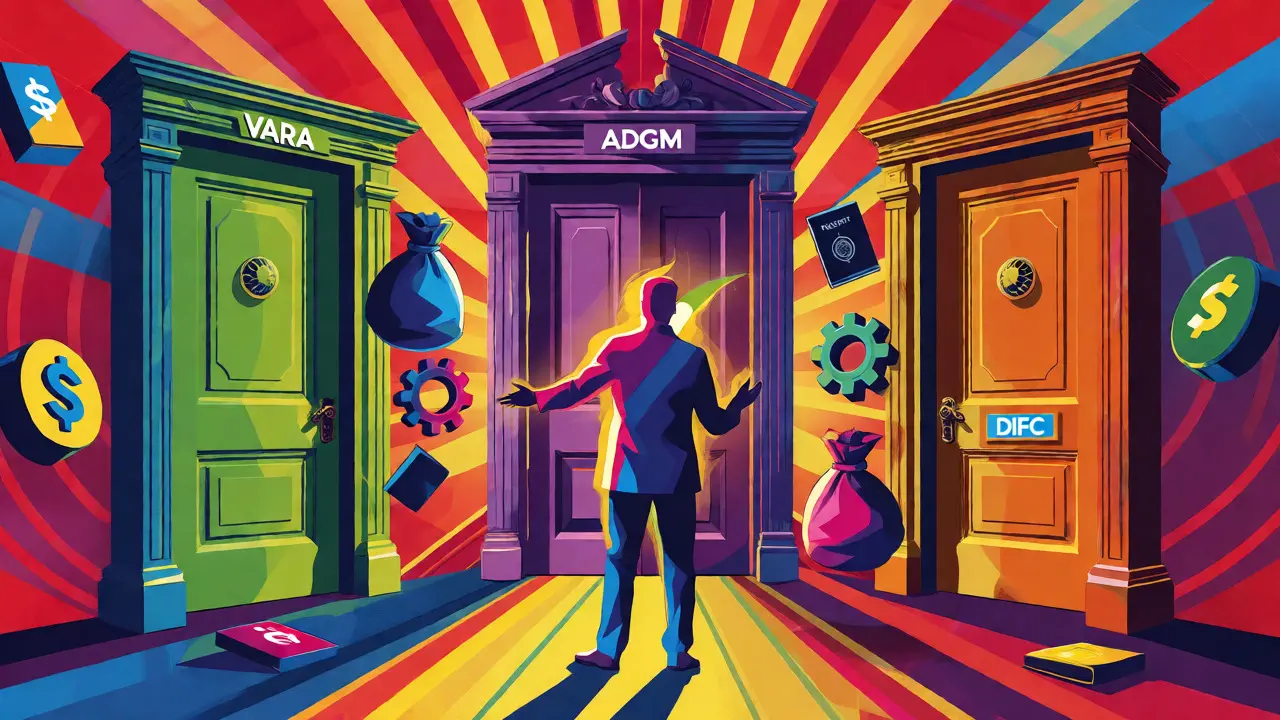
The Big Three: VARA, ADGM, and DIFC
This is where most people get confused. There are three main regulatory bodies you need to know. Choosing the wrong one is like trying to sell seafood in a hardware store-you might find customers, but it’s going to be messy.
1. VARA (Dubai): The Retail-Friendly Powerhouse
If you are building an exchange, a wallet app, or a broker targeting retail users, VARA regulates virtual asset activities in Dubai, excluding the DIFC is likely your home. Established in 2022, VARA operates under the Dubai World Trade Centre authority. Its biggest selling point is its modular licensing structure.
Unlike other jurisdictions that give you a blanket "crypto license," VARA lets you pick specific activities. Do you only want to offer custody? Get a custody license. Want to add trading later? Apply for that separately. This allows smaller startups to enter the market with lower initial capital requirements. However, don’t mistake this for being easy. VARA conducts strict fit-and-proper checks. They will scrutinize your founders' backgrounds, your source of funds, and your technology stack.
| Feature | VARA (Dubai) | ADGM (Abu Dhabi) | DIFC (Dubai) |
|---|---|---|---|
| Primary Focus | Retail & Institutional Mix | Institutional / High-Net-Worth | Traditional Finance Integration |
| Licensing Model | Modular (Activity-Specific) | Comprehensive Frameworks | Financial Services Standards |
| Min. Capital (Approx.) | AED 100k - 1.5M | Higher (Case-by-case) | High (Bank-grade standards) |
| Best For | Exchanges, Wallets, Brokers | Fund Managers, Custodians | Trading Facilities, Advisors |
2. ADGM (Abu Dhabi): The Institutional Gold Standard
The Abu Dhabi Global Market an international financial free zone with its own common law-based courts and regulations is different. It doesn’t use civil law; it uses English Common Law. This appeals heavily to Western investors and institutions. The Financial Services Regulatory Authority (FSRA) here is incredibly rigorous. Think of ADGM as the Singapore or London of the Middle East.
ADGM is less friendly to small retail startups. The compliance burden is heavy, the fees are higher, and the scrutiny is intense. But if you are launching a crypto hedge fund, a sophisticated custody solution for family offices, or a tokenized securities platform, ADGM offers prestige and access to deep liquidity pools. Their framework was one of the first in the world to formally regulate digital assets, dating back to 2018, so their case law and guidance are mature.
3. DIFC (Dubai): The Traditional Finance Bridge
Sitting inside Dubai but operating under its own legal system, the Dubai International Financial Centre a financial free zone regulated by the DFSA, focusing on traditional finance integration is regulated by the DFSA. DIFC is ideal if your crypto business is deeply intertwined with traditional finance. Are you offering crypto-backed loans? Or integrating crypto into existing banking products? DIFC makes sense.
However, note that DIFC does not fall under VARA’s jurisdiction. It has its own separate regime. This means if you want to operate in both DIFC and the rest of Dubai, you might need dual considerations. Most pure-play crypto exchanges skip DIFC unless they are already established financial institutions expanding into digital assets.

The Real Cost of Entry: Fees and Capital
Let’s talk numbers, because brochures often hide the fine print. Setting up in a UAE free zone involves two types of costs: government/regulator fees and operational costs.
For VARA, the paid-up capital requirement ranges from AED 100,000 ($27,000) to AED 1.5 million ($408,000), depending on your activity. Just because you pay this doesn’t mean you can withdraw it immediately; it must sit in a bank account to prove solvency.
Then there are the application fees. Expect to pay between AED 40,000 and AED 100,000 just to apply. Once approved, annual supervision fees range from AED 80,000 to AED 200,000. And that’s just the regulator. You also need:
- Free Zone Establishment License: ~AED 15,000-30,000 per year.
- Office Space: Even if you work remotely, many free zones require a physical flexi-desk or office. Budget AED 15,000-50,000 annually.
- Visa Costs: Each employee visa costs roughly AED 3,000-5,000 including medical tests and Emirates ID processing.
- AML Compliance Officer: You cannot run a crypto firm without a dedicated Anti-Money Laundering officer. Hiring one locally or outsourcing costs AED 5,000-15,000 monthly.
Realistically, for a lean startup aiming for a VARA license, budget $50,000 to $100,000 for the first year. That covers incorporation, license fees, basic office, and initial legal/compliance consulting. If you go for ADGM, double that figure.
Step-by-Step: How to Actually Set Up
Here is the workflow. It’s not linear, but these are the milestones.
- Define Your Activity Scope: Don’t say "we do everything." VARA wants specifics. Are you doing "Virtual Asset Broker-Dealer Service" or "Lending and Borrowing Service"? Pick narrow. You can expand later.
- Incorporate the Legal Entity: Register your company in the chosen free zone (e.g., DMCC for VARA). This gets you your trade license and lease agreement.
- Open a Corporate Bank Account: This is the hardest part. Banks will ask for your business plan, proof of source of funds, and expected transaction volumes. Start this early. Some banks reject crypto firms outright; others require high minimum balances ($100k+).
- Apply to the Regulator (VARA/FSRA): Submit your application via the regulator’s portal. Include your business plan, compliance manual, IT security policy, and founder CVs.
- Fit and Proper Test: Regulators will interview key personnel. Be ready to explain your experience in finance or tech. If you have past bankruptcies or unresolved lawsuits, disclose them now.
- Receive Provisional License: You might get a provisional approval allowing you to start operations while finalizing details.
- Full License & Ongoing Compliance: Once fully licensed, you must file quarterly reports, maintain insurance, and undergo periodic audits.
Pitfalls That Kill Crypto Startups in the UAE
I’ve seen companies fail not because their tech was bad, but because they ignored the human side of compliance.
Underestimating AML/KYC: The UAE applies strict Anti-Money Laundering laws. You need automated KYC tools (like Sumsub or Onfido) integrated into your app. Manual checks won’t scale. If you miss a suspicious transaction report, fines are severe.
Ignoring Token Classification: Not all tokens are created equal. VARA divides tokens into Category 1 (requires license + approval) and Category 2 (requires licensed distributor). Issuing a utility token incorrectly classified as a security can trigger SCA (Securities and Commodities Authority) intervention. Consult a lawyer before minting.
Banking Bottlenecks: Don’t assume you’ll open a bank account in week one. It can take 2-3 months. Plan your cash flow accordingly. Consider using e-money institutions or payment gateways initially if traditional banks stall.
VISA Restrictions: If you hire staff, ensure their visas are linked to the correct activity code. A mismatch between job title and visa category can cause renewal issues later.
Who Should Go Where? A Decision Guide
To simplify, here’s a quick heuristic:
- Choose VARA if: You are a retail-focused exchange, wallet provider, or broker. You want flexibility to start small and grow. You are based in Dubai.
- Choose ADGM if: You are managing funds, offering institutional custody, or dealing in tokenized securities. You prioritize legal certainty and prestige over low cost. You are okay with higher barriers to entry.
- Choose DIFC if: You are an existing financial institution adding crypto services. You need tight integration with traditional banking partners in Dubai.
Remember, the landscape is evolving. The Central Bank of UAE is piloting the Digital Dirham, which may impact stablecoin regulations soon. Stay agile. Join industry groups like the Dubai Blockchain Center to stay ahead of circular updates.
Can I run a crypto business in the UAE without a license?
Generally, no. Article 4 of Cabinet Resolution No. 111 prohibits engaging in virtual asset activities without approval. While some niche advisory roles might have gray areas, any activity involving custody, exchange, or brokerage requires a formal license from VARA, FSRA, or DFSA. Operating unlicensed risks heavy fines and forced closure.
How long does it take to get a VARA license?
Typically 3 to 6 months. The timeline depends on the completeness of your application and how quickly you respond to regulator queries. Complex applications involving novel token models or cross-border structures can take longer. Starting with a clean, well-documented submission speeds up the process significantly.
Is crypto taxed in the UAE?
There is no personal income tax on crypto gains for individuals. For businesses, the standard corporate tax rate is 9% on net profits exceeding AED 375,000. However, many free zone companies can qualify for 0% corporate tax if their income is deemed "qualifying." VAT at 5% generally applies to service fees, not the asset itself, but consult a tax advisor for specific transactions.
Do I need a physical office in the free zone?
Yes, almost always. Regulators and free zone authorities require a registered address. This can be a flexi-desk (shared workspace) for startups, costing around AED 15,000-20,000 annually, or a full office suite. Remote-only setups without a physical footprint are rarely accepted for licensed financial activities.
What is the difference between VARA and SCA?
SCA (Securities and Commodities Authority) is the federal regulator overseeing capital markets across the UAE. VARA is the local regulator specifically for virtual assets in Dubai (excluding DIFC). VARA handles day-to-day licensing and supervision of crypto firms, while SCA sets broader national policies and regulates tokenized securities that overlap with traditional investments.