
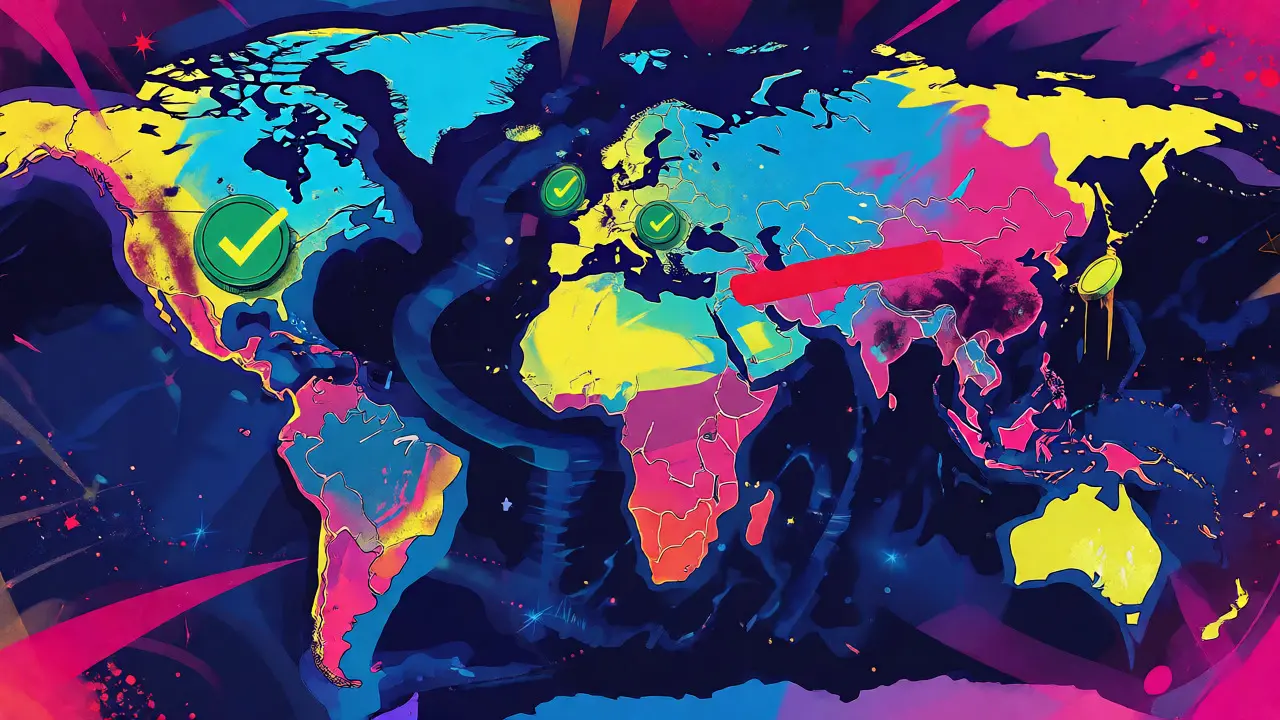
You might have heard that Coinbase is available in over 100 countries. But here’s the catch: availability doesn’t mean full functionality. If you’re trying to buy Bitcoin with your local bank account in Manila, Moscow, or Islamabad, you might hit a wall that doesn’t exist for someone in New York or London. This isn’t a bug; it’s a feature of global financial compliance.
The reality is messy. You can often download the app, but you might not be able to use it the way you want. Some regions get the full fiat-on-ramp experience, while others are stuck with self-custody wallets that don’t let you touch cash. Understanding these geographic crypto restrictions saves you from linking your bank account only to find out your deposit was rejected, or worse, your funds were held for review.
| Region Status | App (Fiat Trading) | Wallet (Self-Custody) | Key Restriction Driver |
|---|---|---|---|
| Fully Supported (US, UK, EU) | Yes (Bank, Card, PayPal) | Yes | Full Regulatory License |
| Partial Support (UAE, Singapore) | Limited (Cards/Wallets only) | Yes | Local Banking Integration Gaps |
| Restricted (Russia, Nigeria) | No | Yes (except sanctioned zones) | OFAC Sanctions / Local Bans |
| Blocked (Iran, North Korea) | No | No | Comprehensive Trade Embargoes |
Why Does Location Matter So Much?
It comes down to two main things: US sanctions and local laws. As a US-based company listed on NASDAQ, Coinbase has to play by Washington’s rules first. The Office of Foreign Assets Control (OFAC) maintains a list of sanctioned countries and entities. If you live in a place like Crimea or Iran, Coinbase simply cannot serve you because moving money there violates US law. Period. There’s no workaround for this without risking your account being frozen.
But it’s not just about sanctions. Even in non-sanctioned countries, local regulators might not have approved Coinbase yet. Take India, for example. While the Coinbase Wallet works globally, the main trading platform has faced hurdles with the Reserve Bank of India. Until they secure specific licenses, users there might find their ability to deposit rupees directly into the exchange limited or unavailable compared to competitors who moved faster locally.
The Great Divide: App vs. Wallet
This is where most confusion happens. You need to know which product you are using because the rules are totally different.
- The Coinbase App: This is the centralized exchange. It holds your keys. It connects to banks. Because it touches fiat currency (real money), it is heavily regulated. If your country isn’t on the "approved" list for banking partners, you can’t use this part effectively.
- Coinbase Wallet: This is a self-custody tool. You hold the keys. It interacts directly with blockchains like Ethereum. Because it doesn’t technically "hold" your money in a bank account, it’s available almost everywhere-except in places under total trade embargoes. You can swap tokens here even if you can’t buy them with a credit card on the App.
A user in Pakistan, for instance, might see the App as "unavailable" for deposits. But they can still install the Wallet, connect to decentralized exchanges (DEXs), and trade stablecoins. They just can’t easily turn their local currency into crypto through Coinbase itself.
Regional Breakdown: Where Do You Stand?
Let’s look at some hotspots where users frequently ask about access.
Europe: The MiCA Era
If you’re in the European Economic Area (EEA), you’re in good shape. The Markets in Crypto-Assets (MiCA) regulation came into full effect recently, forcing exchanges to get licensed. Coinbase adapted quickly, setting up its main entity in Luxembourg. This means users in Germany, France, and Italy get seamless SEPA transfers. However, smaller nations like Malta or Liechtenstein saw backend shifts to ensure compliance. Your service didn’t stop, but the legal entity serving you changed. Keep an eye on your terms of service updates-they’ll tell you which office handles your data now.
Asia: A Patchwork Quilt
Asia is tricky. Japan has strict rules, so Coinbase operates there with specific local partnerships. Singapore allows card payments but might restrict direct bank transfers depending on the partner bank. In the Philippines, despite high crypto adoption, the main App often lacks robust local peso integration compared to local players like PDAX. Users report having to use third-party converters before funding their Coinbase accounts, adding fees and time.
The Middle East and Africa
The UAE offers partial access. You can often use Apple Pay or debit cards, but traditional bank wires might be blocked due to anti-money laundering checks that vary by emirate. In Nigeria, the central bank’s stance has shifted multiple times. Currently, direct Naira deposits via the App are often restricted, pushing users toward peer-to-peer (P2P) markets or other exchanges that have stronger local banking ties.
Common Pitfalls and How to Avoid Them
Don’t assume your IP address tells the whole story. Many users try to bypass restrictions using VPNs. Here’s the danger: Coinbase uses more than just your IP to verify location. They check your billing address, phone number, and government ID. If you’re physically in Russia but claim to live in the US, and your credit card is issued by a Russian bank, you will likely fail verification. Worse, if you manage to trade and then withdraw, a mismatch can trigger a compliance freeze. One Reddit user reported losing $2,300 in pending transactions after using a VPN to access features unavailable in his home region.
Another trap is asset-specific restrictions. Even if your country is supported, certain tokens might be off-limits. For example, staking rewards for assets like Cardano (ADA) have been paused in some EU countries during regulatory transitions. Just because you can buy ADA doesn’t mean you can earn yield on it through Coinbase right now.

What To Do If You’re Restricted
If you find yourself in a country where Coinbase’s fiat services are limited, you have three realistic options:
- Use the Wallet Only: Buy crypto elsewhere (like Binance P2P or a local exchange) and transfer it to your Coinbase Wallet address. You keep custody, and you avoid the App’s geographic blocks.
- Look for Local Alternatives: Competitors like Kraken or regional exchanges often have deeper banking integrations in emerging markets. Kraken, for instance, supports more fiat currencies in developing economies than Coinbase currently does.
- Wait for Regulatory Clarity: This is the hardest advice to follow, but sometimes the best. As seen in Europe with MiCA, regulations can open doors. If your country is actively drafting crypto laws, Coinbase may enter once the framework is clear.
Looking Ahead: Will Restrictions Ease?
The trend is mixed. On one hand, global standardization (like MiCA) helps Coinbase expand efficiently. On the other, geopolitical tensions keep sanctions lists growing. Recent reports suggest that while Coinbase aims to grow its user base, it prioritizes compliance over rapid expansion in risky jurisdictions. This means fewer countries will suddenly get full access overnight. Instead, expect incremental improvements-maybe enabling card payments in one new country per quarter, rather than a blanket rollout.
For now, always check the official support page for your specific country before signing up. Don’t rely on outdated blog posts from 2023. The landscape changes fast, and what worked last month might require a new license today.
Can I use Coinbase in a sanctioned country if I use a VPN?
Technically, yes, you can access the website or app interface. However, Coinbase verifies your identity with government IDs and proof of address. If your documents show you reside in a sanctioned region, your account may be frozen, and funds could be withheld until compliance reviews are complete. Using a VPN to mask your location is against their Terms of Service and carries significant risk.
Is Coinbase Wallet available everywhere?
Almost. Coinbase Wallet is available in nearly every country except those under comprehensive US trade embargoes (like Iran, North Korea, Syria, and Cuba). Since it is a self-custody tool that doesn't hold fiat currency, it faces fewer regulatory hurdles than the main Coinbase Exchange App.
Why can't I deposit money from my bank in the Philippines?
While Coinbase is accessible in the Philippines, direct bank transfers in Philippine Pesos (PHP) are often limited or unavailable compared to card payments. Many users find that local exchanges offer better PHP liquidity. Coinbase primarily supports USD and major global currencies for direct banking integrations in many Asian markets.
Does Coinbase support crypto trading in Russia?
Since the 2022 sanctions, Coinbase has suspended all fiat services in Russia. You cannot deposit rubles or withdraw to Russian banks. While the Coinbase Wallet app can still be downloaded and used for blockchain interactions, the main trading platform's fiat on-ramps are disabled for residents of Russia.
How do I check if my country is fully supported?
Visit the Coinbase Help Center and search for "supported countries." Look for the distinction between "Available" (full services) and "Limited" (wallet only or restricted payment methods). Note that status can change based on local regulatory updates, so checking the live site is always safer than relying on cached search results.