
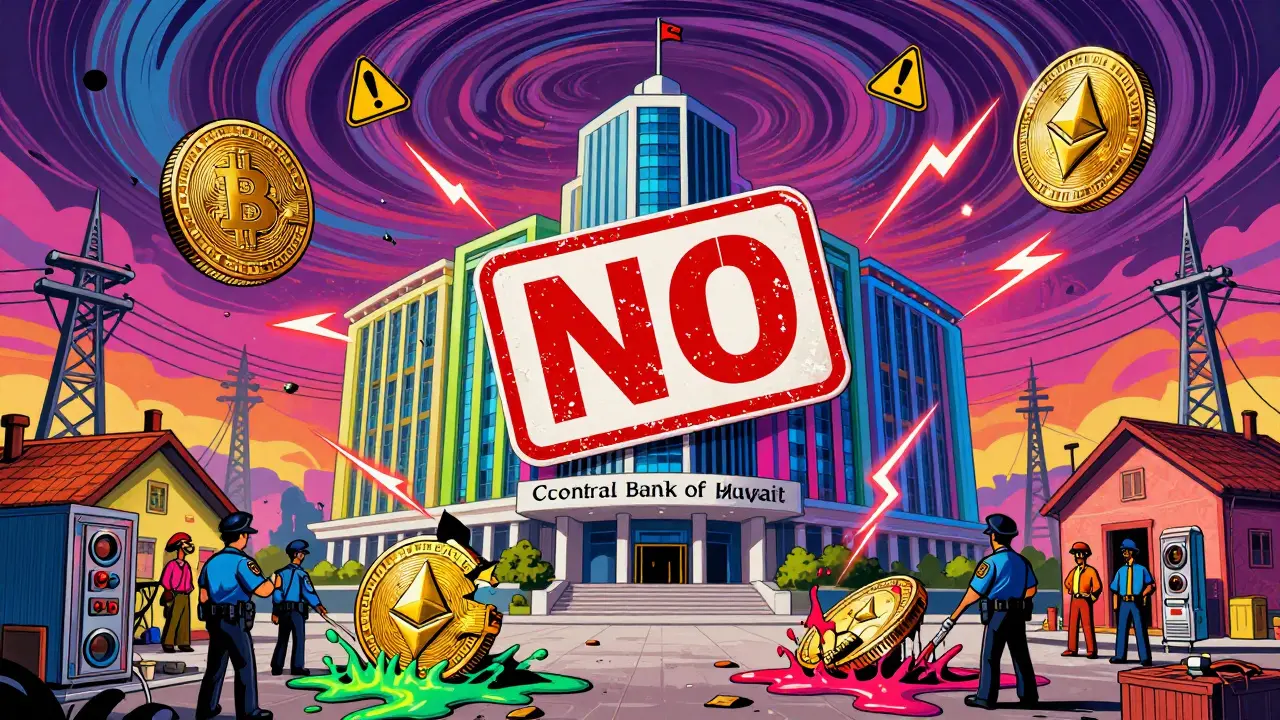
When the Central Bank of Kuwait issued its official crypto prohibition in July 2023, it didn’t just say no to Bitcoin or Ethereum. It shut the door on all cryptocurrency activity in the country - no trading, no payments, no mining, no investing. Not even a single transaction. This wasn’t a warning. It was a legal wall.
What Exactly Is Banned?
The ban covers everything. If it’s a digital asset, it’s illegal. That means you can’t use Bitcoin to buy coffee, trade Ethereum on a local exchange, or mine Litecoin in your garage. The Central Bank of Kuwait told every bank, finance company, and exchange under its control: zero tolerance. No exceptions. No loopholes. The Capital Markets Authority, Insurance Regulatory Unit, and Ministry of Commerce all jumped in with their own circulars. Together, they blocked four major areas:- Payments: You can’t pay for anything with crypto. No merchant can accept it. No app can process it.
- Investments: No one can sell you crypto as an investment. No advisory firms can recommend it. No funds can hold it.
- Licensing: No business can apply for a license to offer crypto services - because no such license exists, and none will ever be issued.
- Mining: Running a mining rig? Illegal. Even if you’re using your home electricity, you’re breaking the law.
Why Does Kuwait Care So Much?
Kuwait isn’t just being cautious. It’s reacting to real risks. The Central Bank says crypto threatens financial stability, enables money laundering, and undermines the country’s banking system. But there’s another reason - one that’s physical, not just financial. In 2024, Kuwait’s Ministry of Electricity, Water, and Renewable Energy found over 1,000 illegal crypto mining sites. These weren’t tiny setups. They were industrial-scale operations running 24/7, sucking up massive amounts of electricity. Kuwait has some of the cheapest power in the world - subsidized by the government. That made it a magnet for miners from around the region. Bitcoin mining alone was consuming 140,336 gigawatt-hours per year. That’s more than Ukraine or Malaysia used in a full year. Power grids were straining. Blackouts became a real threat to hospitals, schools, and homes. The government didn’t just see a financial risk - it saw a public safety crisis.How Are They Enforcing It?
This isn’t a paper ban. It’s enforced like a crime. The Ministry of Interior made it clear: mining violates multiple laws - the Industry Law, the Penal Code, the Communications and Information Technology Regulatory Authority Law, and even municipal regulations. Police and energy inspectors are actively raiding homes and warehouses. Miners aren’t just fined. They’re referred to criminal courts. Banks are required to monitor accounts for any sign of crypto activity. If you send money to a known exchange or receive payments from a wallet linked to mining, your account gets flagged. The Central Bank of Kuwait has instructed financial institutions to cut off anyone even suspected of involvement. The Ministry of Finance doesn’t recognize crypto as legal tender. The Ministry of Commerce warns consumers in ads and online portals: “Crypto is not protected. You lose your money, you have no recourse.”
How Does Kuwait Compare to Its Neighbors?
While Kuwait shuts the door, other Gulf countries are opening windows. The UAE has licensed crypto exchanges. Bahrain allows crypto trading under strict rules. Saudi Arabia is testing its own digital currency. Even Qatar, which once matched Kuwait’s hardline stance, is preparing to launch a legal crypto framework by mid-2025. Kuwait stands alone. It’s the only GCC country that hasn’t just rejected crypto - it’s gone out of its way to criminalize it. No pilot programs. No sandbox environments. No gradual transition. Just a hard stop.What About Central Bank Digital Currency (CBDC)?
You might wonder: if they hate crypto, why not make their own digital money? They’re thinking about it. The Central Bank of Kuwait has been quietly studying a sovereign digital currency - a CBDC. But here’s the key difference: a CBDC would be issued, controlled, and backed by the state. It’s not decentralized. It’s not anonymous. It’s just digital dinars. This fits Kuwait’s philosophy perfectly. The government wants control, not disruption. It wants transparency, not anonymity. It wants the efficiency of digital money - without the chaos of Bitcoin.
What’s Next for Kuwait?
There’s no sign the ban is easing. The government is doubling down. The Sukuk Law passed in 2024 strengthened Islamic finance tools, giving people legal, Sharia-compliant ways to invest - without touching crypto. The Financing & Liquidity Law authorized $97 billion in government bonds, keeping capital flowing through traditional channels. Miners caught after April 2025 face harsher penalties. Electricity companies now report suspicious usage patterns directly to authorities. The message is clear: if you’re mining, you’re not just breaking a rule - you’re breaking the law.What This Means for People in Kuwait
If you live in Kuwait, your options are simple:- Don’t buy crypto. It’s not protected. No one will refund you if you lose it.
- Don’t mine. You risk fines, prosecution, and having your power cut off.
- Don’t use it to pay for goods or services. Merchants who accept it could be shut down.
- Use traditional banking. Savings accounts, bonds, and government-backed investments are your only legal options.
Is cryptocurrency completely illegal in Kuwait?
Yes. All cryptocurrency activities - including trading, mining, payments, and investments - are banned under Kuwaiti law. The Central Bank of Kuwait, along with multiple government agencies, issued coordinated prohibitions in July 2023. There are no legal exemptions or gray areas.
Can I mine Bitcoin in Kuwait if I use solar power?
No. Mining is illegal regardless of the power source. The ban covers all forms of cryptocurrency mining, whether you’re using grid electricity, solar panels, or generators. The government’s focus is on the activity itself, not how it’s powered. Mining rigs are still considered violations of multiple laws, including those related to energy use and industrial regulations.
What happens if I’m caught mining crypto in Kuwait?
If caught, you could face criminal charges. Authorities have raided over 1,000 mining sites since 2024. Penalties include fines, confiscation of equipment, and possible jail time under the Penal Code and Communications and Information Technology Regulatory Authority Law. Your electricity supply may also be disconnected.
Can I use crypto to send money to family abroad from Kuwait?
No. Sending or receiving cryptocurrency across borders is still considered a violation of Kuwait’s financial regulations. Banks are required to monitor and report any crypto-related transactions. Even if you’re using a foreign exchange, the act of initiating the transaction from within Kuwait is illegal.
Is there any chance Kuwait will legalize crypto in the future?
There’s no indication of that. While neighboring countries like Qatar and the UAE are moving toward regulated crypto markets, Kuwait has doubled down on its ban. The government is focused on strengthening traditional finance, including issuing sovereign bonds and exploring a Central Bank Digital Currency - not private digital assets. Any future change would require a complete reversal of current policy, which is not expected.
Why does Kuwait have such strict rules compared to other Gulf countries?
Kuwait prioritizes financial control and infrastructure stability over innovation. Unlike the UAE or Bahrain, which see crypto as a way to attract global investment, Kuwait views it as a threat to its banking system and energy grid. The country’s subsidized electricity made it a hotspot for mining, leading to real power shortages. The government chose to eliminate the problem at its source rather than regulate it.
Rob Duber
January 29, 2026 AT 19:22So Kuwait just turned Bitcoin into a felony? 🤯 I mean, I get the power grid thing, but banning ALL crypto? That’s like banning smartphones because someone used one to text while driving. This isn’t regulation - it’s digital arson. Someone’s gonna start smuggling ASICs in camel saddles next.
Joshua Clark
January 29, 2026 AT 21:04It’s fascinating how Kuwait’s approach reflects a deeper cultural and institutional preference for centralized control - not just over finance, but over energy, technology, and even personal economic behavior. Unlike the UAE, which sees crypto as a tool for global financial positioning, Kuwait views it as an existential threat to its social contract: subsidized utilities, state-backed banking, and absolute regulatory certainty. The 1,000+ mining raids? That’s not just enforcement - it’s a symbolic purge of decentralized autonomy. The government isn’t just protecting the grid; it’s protecting its own legitimacy.
Brandon Vaidyanathan
January 31, 2026 AT 13:05Bro, this is peak ‘I’m not mad, I’m just disappointed’ energy. 🤦♂️ You can’t mine crypto in Kuwait? Cool. So what? You’re still allowed to buy a Lamborghini with cash, right? Or fly to Dubai for a weekend and trade on Binance? This ban is just theater. People will still do it - they always do. The real tragedy? Kuwait’s youth are being told ‘no’ before they even get to ask ‘why.’
Dahlia Nurcahya
February 2, 2026 AT 08:44I get where Kuwait is coming from - the power usage numbers are insane. But I also wonder if there’s a middle ground. What if they’d taxed mining instead of banning it? Or redirected the energy to public projects? Instead of criminalizing people, maybe they could’ve turned miners into grid stabilizers. Still, I respect their clarity. At least everyone knows the rules - even if they’re harsh.
Dylan Morrison
February 3, 2026 AT 05:24It’s like they’re saying: ‘We love tech… but only if we’re the ones holding the remote.’ 😅 A CBDC? That’s just digital dinars with a government badge. No anonymity, no decentralization - just a fancy bank app. I get it. Control = safety. But sometimes, safety feels like a cage. Still… I’m glad they’re thinking about digital money. At least they’re not ignoring the future.
Akhil Mathew
February 4, 2026 AT 08:21Interesting how Kuwait’s stance mirrors its oil-based economy - centralized, state-controlled, resistant to disruption. Meanwhile, India’s crypto scene is exploding, even without full legalization. People here use P2P, crypto remittances, DeFi - quietly. Kuwait’s ban might work on paper, but in practice? It just pushes activity underground. And underground = harder to monitor. Maybe they should’ve regulated, not outlawed.
Aaron Poole
February 5, 2026 AT 04:19Let’s be real - this isn’t about crypto. It’s about power. The government doesn’t want people moving money outside their system. It doesn’t want anonymous transactions. It doesn’t want citizens bypassing banks. The mining crisis was just the excuse. They saw an opportunity to shut down a threat to their authority - and they took it. Smart? Maybe. Fair? Not really. But in Kuwait, control isn’t a policy - it’s the foundation.
Robert Mills
February 5, 2026 AT 08:35Miners: you’re getting caught. Just stop. 😅