
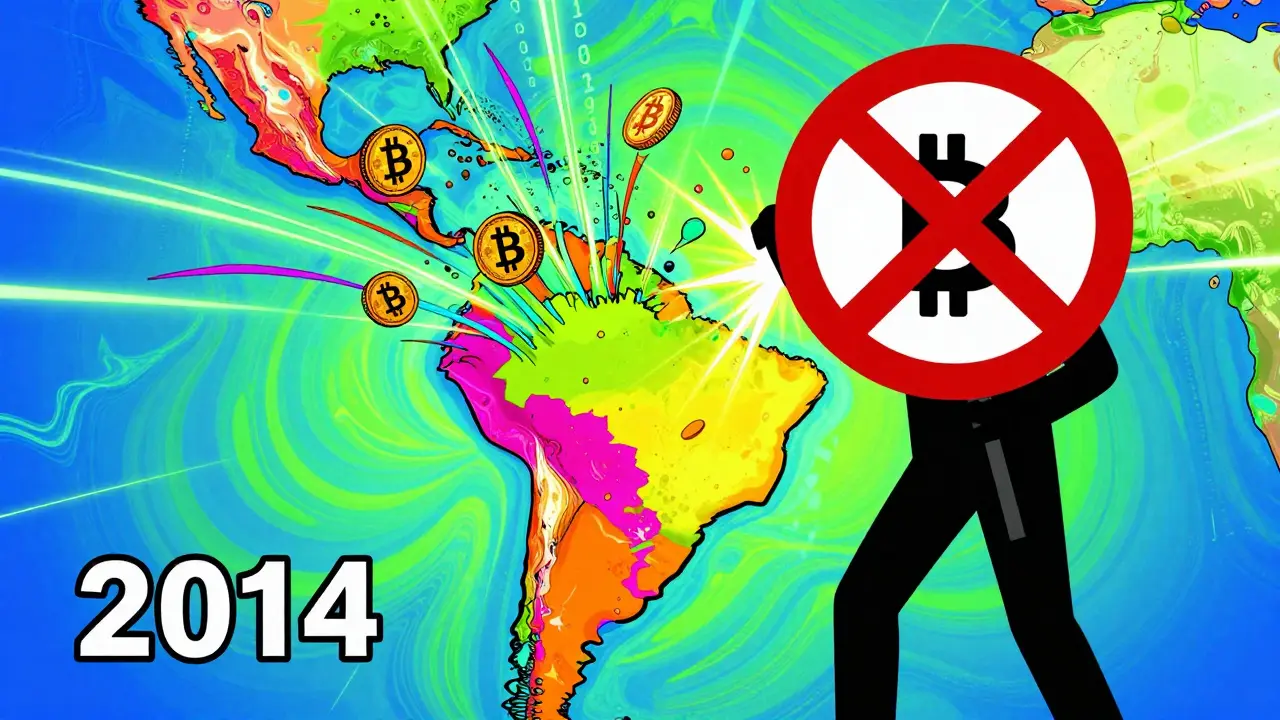
Back in May 2014, while most of the world was still figuring out what Bitcoin actually was, Bolivia made a bold move that shocked the financial community. The Central Bank of Bolivia (BCB) issued Resolution No. 24-14-001, becoming the very first national institution to formally ban Bitcoin and other cryptocurrencies. This wasn't just a warning; it was an outright prohibition on using any currency not issued or regulated by the government. At the time, Bitcoin was trading around $650, and the global market cap was a mere $3.5 billion. Yet, Bolivia decided to shut the door completely, predating similar strict measures in countries like China and Russia by several years.
This decision positioned Bolivia as the pioneer in cryptocurrency prohibition. But why did a small South American nation take such a hardline stance when others were hesitating? To understand this, we need to look at the specific resolution, the enforcement mechanisms, and the unintended consequences that followed over the next decade. This isn't just about history; it’s a case study in how blanket bans can drive activity underground rather than eliminate it.
The 2014 Resolution: A Total Prohibition
The core of Bolivia’s early crypto ban lay in Resolution No. 24-14-001, issued on May 6, 2014. The text was explicit: "It is illegal to use any kind of currency that is not issued and controlled by a government or an authorized entity." The resolution didn't just target Bitcoin; it listed specific altcoins including Namecoin, Peercoin, Quark, Primecoin, and Feathercoin. By naming these projects, the BCB showed they had done their homework, even if their conclusion was to ban them entirely.
The justification provided by the Central Bank was twofold: protect the boliviano (BOB), the national currency, and safeguard users from uncontrolled currencies that could lead to financial loss. In a country with a history of economic volatility, the fear of capital flight and monetary instability was real. The BCB argued that allowing alternative monetary systems would undermine national monetary policy. This view was supported by experts like Dr. Carlos Newland, former advisor to the Central Bank, who argued in his 2015 paper that emerging economies cannot risk systems that might destabilize their sovereign currency.
However, critics saw it differently. Dr. Rebecca Liao, a researcher at Stanford University, later described the ban as a protectionist measure that failed to address underlying economic vulnerabilities while cutting citizens off from global financial innovation. The IMF initially stayed neutral but shifted its stance by 2020, with Western Hemisphere Chief Alejandro Werner noting that blanket bans often prove ineffective and may simply drive activity underground.
How the Ban Was Enforced
A law on paper is one thing; enforcement is another. Bolivia’s approach was comprehensive. Commercial banks were barred from facilitating any crypto-linked transactions. Financial institutions faced penalties for non-compliance, and citizens were prohibited from denominating prices in unapproved currencies. Only the boliviano could serve as legal tender.
To make this work, the Financial System Supervisory Authority (ASFI) mandated strict compliance. Banks had to implement transaction monitoring systems capable of identifying cryptocurrency-related activity. Starting in 2016, institutions were required to report suspicious transactions exceeding 5,000 BOB (approximately $725) daily. For smaller banks, this learning curve was steep, taking 6-9 months to implement necessary controls according to ASFI’s 2017 assessment.
The practical reality, however, was messy. A 2020 survey by ASFI revealed that 63% of banks reported false positives in their transaction monitoring, struggling to distinguish legitimate international transfers from crypto activity. Documentation from the Central Bank was often high-level, leaving detailed implementation requirements to be clarified through circulars. This created a regulatory environment where banks were terrified of making mistakes, leading to overly cautious behavior that sometimes hurt legitimate customers.

Underground Adoption and User Experiences
Despite the strict ban, demand for cryptocurrency didn’t disappear; it went underground. By 2023, Chainalysis estimated that 1.2 million Bolivians-about 10.3% of the population-were engaging in crypto activity through informal channels. A 2021 survey by the Bolivian Digital Rights Observatory found that 68% of crypto users operated through informal means, with 41% reporting at least one successful transaction monthly.
Why did people keep using crypto? The primary driver was inflation hedging and remittances. With annual inflation rising to 5.2% in 2023, citizens sought ways to preserve their savings. Stablecoins, particularly USDT, became popular tools for protecting wealth against boliviano depreciation. One Reddit user, u/CryptoLaPaz, summed it up in 2022: "I've been using USDT to protect my savings from boliviano depreciation since 2019. The ban doesn't stop us, it just makes everything more expensive and risky."
Remittance corridors also grew significantly. Users reported avoiding traditional remittance fees of 15-20% by using platforms like LocalBitcoins and Paxful. However, this came at a cost. Average fees for Bitcoin conversions via P2P markets ranged from 8-12%, and security risks were high. The same 2021 study found that 23% of surveyed users had experienced fraud incidents. Between 2018 and 2023, Bolivia’s Financial Intelligence Unit documented 147 crypto-related fraud cases totaling approximately $2.3 million, though underreporting likely means the actual number is higher.
Comparative Context: Bolivia vs. The World
Bolivia’s 2014 ban was exceptionally stringent compared to its peers. While China implemented exchange restrictions in 2017 and tightened them further in 2021, Bolivia’s initial move was absolute. Russia proposed draft laws in 2014 but never enacted them. Thailand’s 2013 SEC warning was non-binding. In contrast, Japan established licensing requirements for exchanges in 2014 without prohibiting usage, and the U.S. took a targeted enforcement approach while recognizing crypto’s legal status for certain purposes.
| Country | Action Taken | Year | Scope |
|---|---|---|---|
| Bolivia | Total Ban on Usage & Transactions | 2014 | All cryptocurrencies banned; no legal tender status |
| China | Exchange Restrictions | 2017 | Banned ICOs and exchange services; mining later restricted |
| Japan | Licensing Framework | 2014 | Exchanges must register; Bitcoin recognized as property |
| Russia | Draft Legislation | 2014 | Proposed restrictions; never fully enacted into law |
| United States | Targeted Enforcement | 2014+ | FinCEN guidance; IRS treats as property; no federal ban |
This comparative table highlights how unique Bolivia’s position was. It ranked as the most restrictive jurisdiction in Latin America throughout the ban period, according to the Blockchain Association of Latin America’s 2022 regulatory index. Only Algeria and Egypt maintained comparable prohibitions globally. The advantage of Bolivia’s approach was theoretical protection of monetary sovereignty. The disadvantage became increasingly evident: by 2023, citizens lacked access to inflation-hedging instruments available in neighboring countries, and border regions saw economic activity flow across jurisdictions with more permissive regulations.

The Shift: From Ban to Regulation (2024-2026)
For ten years, the ban held firm. But the landscape changed. Neighboring El Salvador adopted Bitcoin as legal tender in 2021, creating a stark contrast. Meanwhile, Bolivia’s internal pressures mounted. Inflation rose, capital flight continued, and the underground market grew. Recognizing that the ban was ineffective, the government began to pivot.
On June 26, 2024, the Central Bank of Bolivia officially lifted the ban. This marked a complete regulatory reversal. Instead of prohibition, the new framework focused on oversight. Virtual Asset Service Providers (VASPs) were now required to register with ASFI, implement strict Anti-Money Laundering (AML) and Counter-Financing of Terrorism (CFT) protocols, and establish daily transaction reporting requirements. Crucially, while trading was allowed, the payment ban remained in place to protect the boliviano’s status as the sole legal tender for goods and services.
The impact was immediate and explosive. Central Bank data shows cryptocurrency transactions increased by 630% from $46.5 million in early 2024 to $294 million in the first half of 2025. By May 2025, total transaction value reached $430 million across more than 10,000 transactions. Carlos Neira’s Meru wallet platform reported a staggering 6,600% surge in Bolivian users following the ban’s removal, as covered by Bloomberg in August 2025.
Bolivia has also entered a memorandum of understanding with El Salvador’s National Commission of Digital Assets for regulatory knowledge transfer. This signals a strategic shift toward measured adoption rather than El Salvador’s all-in strategy. The Inter-American Development Bank suggests this measured approach may prove more sustainable, projecting adoption rates of 18% of the population by 2027, compared to El Salvador’s 23%, but with significantly lower fiscal risk exposure.
Key Takeaways for Investors and Observers
Bolivia’s journey offers several critical lessons. First, blanket bans rarely stop innovation; they just push it into the shadows where it becomes harder to regulate and tax. Second, economic realities like inflation and remittance needs are powerful drivers of adoption that regulation alone cannot suppress. Third, a balanced approach that allows trading while maintaining control over legal tender can offer both stability and opportunity.
- Ban Effectiveness: Bolivia’s 10-year ban reduced official adoption to zero but fueled a 27% increase in unregulated P2P transactions between 2018-2022.
- User Behavior: Despite risks, 68% of users relied on informal channels, driven by the need to hedge against inflation and reduce remittance costs.
- Regulatory Evolution: The 2024 shift to registration and AML/CFT compliance has led to a 630% surge in transparent, tracked transactions.
- Future Outlook: The Ministry of Economy projects crypto transaction volume to reach $1.2 billion by 2026, indicating strong, sustained demand.
As we look ahead to 2026, Bolivia stands as a testament to the resilience of decentralized finance. The country that once led the world in prohibition is now navigating the complexities of integration. For anyone interested in the future of money in emerging markets, Bolivia’s story is essential reading. It shows that while governments can set the rules, the market ultimately decides what works.
When did Bolivia ban Bitcoin?
Bolivia banned Bitcoin and other cryptocurrencies on May 6, 2014, through Resolution No. 24-14-001 issued by the Central Bank of Bolivia. This made it the first country to formally prohibit cryptocurrency usage.
Why did Bolivia ban cryptocurrency?
The Central Bank cited the need to protect the boliviano (national currency) and safeguard users from uncontrolled currencies that could lead to financial losses. They feared that alternative monetary systems would undermine national monetary policy and cause capital flight.
Is Bitcoin legal in Bolivia now?
Yes, as of June 26, 2024, the ban was lifted. Trading cryptocurrencies is now legal and regulated, with Virtual Asset Service Providers (VASPs) required to register with ASFI. However, cryptocurrencies cannot be used as legal tender for payments; only the boliviano holds that status.
What happened to crypto users during the ban?
During the ban, many users turned to informal peer-to-peer (P2P) platforms like LocalBitcoins and Paxful. A 2021 survey found that 68% of crypto users operated through informal channels. This led to higher fees (8-12%) and increased security risks, with 23% of users reporting fraud incidents.
How does Bolivia's current crypto regulation compare to El Salvador?
El Salvador adopted Bitcoin as legal tender, meaning it must be accepted for payments. Bolivia allows crypto trading and investment but maintains the boliviano as the sole legal tender for payments. Bolivia’s approach is considered more conservative, focusing on financial stability and AML/CFT compliance rather than full integration into the payment system.
Who enforces cryptocurrency regulations in Bolivia?
The Financial System Supervisory Authority (ASFI) is responsible for enforcing cryptocurrency regulations. They oversee the registration of Virtual Asset Service Providers (VASPs) and ensure compliance with Anti-Money Laundering (AML) and Counter-Financing of Terrorism (CFT) protocols.
Carl Hanzel
June 27, 2026 AT 08:37Another article celebrating the inevitable failure of state control while pretending it was some grand strategic move. The Central Bank didn't ban crypto to protect anyone; they banned it because they couldn't compete with a system that doesn't require their permission. It is always amusing to watch regulators pretend they are protecting citizens from 'risk' when the real risk is inflation eating away at their savings. The fact that Bolivia had to reverse course after ten years proves that markets don't care about your laws, only your inefficiencies.
Emma Rémond
June 28, 2026 AT 21:47The nuance here is lost on the average reader who simply sees 'ban' and 'lifted' as a binary switch. One must consider the macroeconomic implications of sovereign currency debasement versus the speculative volatility of unbacked digital assets. The Bolivian case study illustrates the friction between fiat hegemony and decentralized ledger technology adoption in emerging markets with high inflationary pressures. It is not merely about convenience; it is about the structural integrity of monetary policy frameworks.
ELNORA JEFFERSON
June 29, 2026 AT 10:07Boring.
Carol @minaszilda
June 29, 2026 AT 13:17It is interesting to see how people adapt when traditional systems fail them. Instead of judging those who used informal channels, we should understand their need for security. This shift shows that openness can lead to better solutions for everyone involved.
Trent Erman1
June 30, 2026 AT 12:21This is a huge win for financial freedom! 🚀 Seeing a country go from total prohibition to regulated trading in just over a decade is incredible progress. The surge in transactions shows that when you give people options, they thrive. Let's keep pushing for more countries to follow this balanced approach rather than trying to suppress innovation. 💪
Fiona Ellis
June 30, 2026 AT 22:27I wonder if the author has ever actually tried to send money across borders in Latin America? 😂 The fees are absurd. It is fascinating how quickly governments pivot once the underground economy becomes too large to ignore. I suppose they realized they could tax it instead of banning it. 🤷♀️
Jon Milton
July 1, 2026 AT 02:02The comparison to El Salvador is key here. Bolivia chose stability over hype, which might be smarter in the long run. However, the aggressive enforcement during the ban period created unnecessary suffering for ordinary citizens who just wanted to preserve their wealth. We need to remember that regulation should serve the people, not just the banks.