

Imagine a spreadsheet that everyone in the world can see, but no single person owns. You can add rows to it, but once a row is written, you can never delete or change it without everyone else noticing. That is the core promise of blockchain network architecture, which is the structural design enabling decentralized, secure data recording across multiple computers without a central authority. It sounds simple, but building this system requires solving some of the hardest problems in computer science.
The concept wasn't born in a boardroom. It emerged from a whitepaper published by the pseudonymous Satoshi Nakamoto in October 2008. The first real-world test-the Bitcoin genesis block-was mined on January 3, 2009. Since then, the technology has evolved from a niche experiment for digital cash into a foundational layer for global finance, supply chains, and identity management. By 2024, the market size was already estimated at over $31 billion, with projections hitting more than $1.4 trillion by 2030. But why is the architecture so complex? Why can’t we just use a regular database?
The Building Blocks: Nodes and Distributed Ledgers
To understand how a blockchain works, you have to look at who-or what-is running it. In traditional systems, one company (like Amazon or Google) controls the servers. In a blockchain, control is shared among nodes, which are individual computers connected to the network that store copies of the ledger and validate transactions.
Not all nodes are created equal. There are three main types you need to know about:
- Full Nodes: These are the heavy lifters. They download and verify every single transaction ever made on the network. For Bitcoin, a full node needs about 500GB of storage as of mid-2024. For Ethereum, an archive node can require over 15TB. They ensure the rules of the network are followed.
- Lightweight Nodes: Also called light clients, these don’t store the whole history. They only keep track of the headers (the summary info). This makes them perfect for smartphones or wallets where storage space is limited.
- Mining or Validator Nodes: These are the active participants. Depending on the network’s consensus mechanism, they either solve math puzzles (mining) or stake money (staking) to propose new blocks of transactions.
These nodes maintain a distributed ledger, which is a synchronized record of transactions replicated across all participating nodes in the network. Because every full node has a copy, if one computer goes offline or gets hacked, the network keeps running. There is no single point of failure. This redundancy is what makes the system resilient.
How Blocks Are Linked: Cryptography and Merkle Trees
Data in a blockchain isn’t stored in a continuous stream. It’s packaged into chunks called blocks, which are containers for a batch of verified transactions linked cryptographically to previous blocks.. Each block contains a header with specific metadata: a timestamp, a nonce (a random number used in mining), the hash of the previous block, and the Merkle root, which is a cryptographic hash representing all transactions in the block, allowing for efficient verification.
The Merkle tree structure is crucial here. Imagine you want to prove that a specific transaction exists in a block. You don’t need to show the entire block. You just show the path from that transaction up to the Merkle root. This allows lightweight nodes to verify transactions quickly without downloading everything. It’s like having a receipt that proves your purchase without needing the entire store’s inventory list.
What links these blocks together is cryptography. Specifically, hashing algorithms like SHA-256. If you change even a single character in a past block, its hash changes. Since the next block contains the hash of the previous one, that link breaks. To fix it, you’d have to recalculate the hashes for every subsequent block. On a large network, this is computationally impossible, making the ledger effectively tamper-proof.
Consensus Mechanisms: Agreeing on the Truth
In a centralized bank, the CEO decides if a transaction is valid. In a decentralized network, thousands of strangers must agree on the state of the ledger. This is solved through consensus mechanisms, which are protocols that allow distributed nodes to agree on the validity of transactions and the order of blocks.
There are two dominant models today:
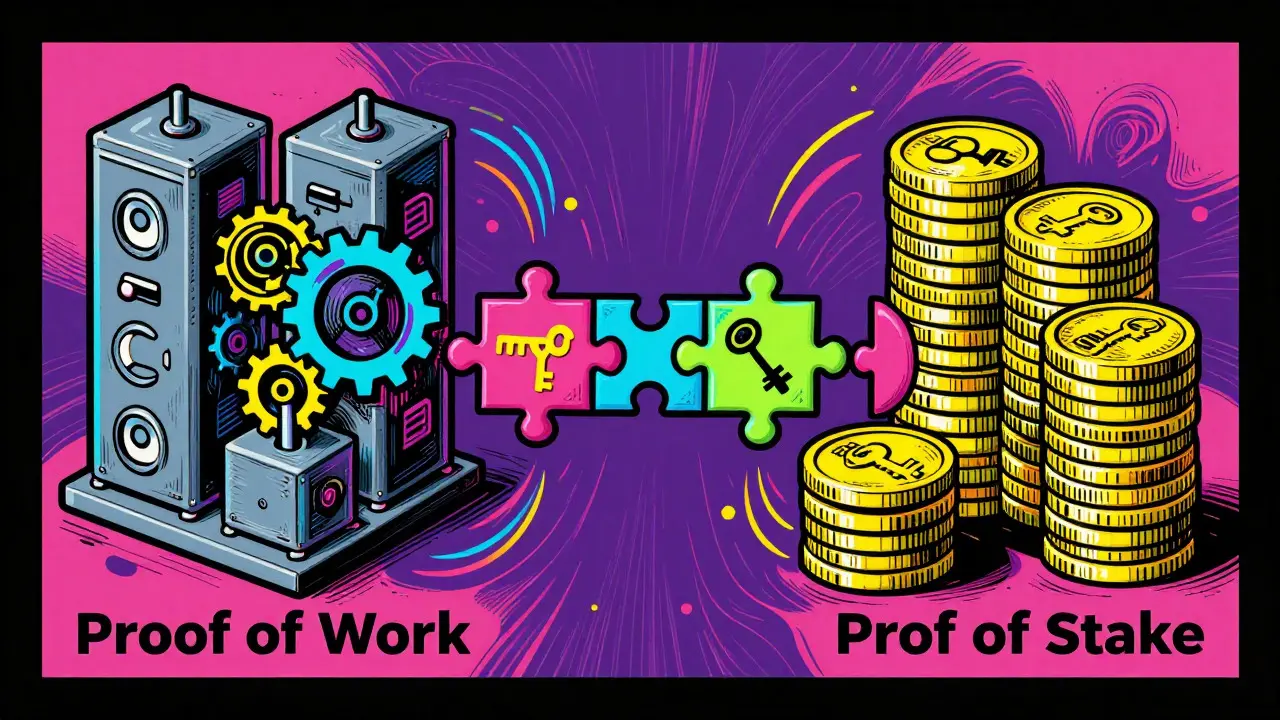
- Proof of Work (PoW): Used by Bitcoin. Miners compete to solve complex mathematical puzzles using computing power. The first to solve it gets to add the next block and receives a reward. It’s incredibly secure because attacking the network would require more computing power than the rest of the world combined. However, it’s energy-intensive and slow. Bitcoin processes about 7 transactions per second (TPS).
- Proof of Stake (PoS): Adopted by Ethereum in September 2022. Instead of buying hardware, validators lock up (stake) cryptocurrency-32 ETH for Ethereum-as collateral. They are randomly chosen to validate blocks. If they act maliciously, they lose their stake. PoS is far more energy-efficient and faster, handling 15-45 TPS natively, with potential for much higher throughput via upgrades.
Other networks experiment with different approaches. Solana, for instance, uses a hybrid model combining PoS with Proof of History, claiming speeds up to 65,000 TPS. The choice of consensus mechanism directly impacts the network’s speed, security, and decentralization.
Public vs. Private vs. Consortium Blockchains
Not all blockchains are built the same way. The architecture depends heavily on who is allowed to join and view the data. Here is how the three main models compare:
| Feature | Public Blockchain | Private Blockchain | Consortium Blockchain |
|---|---|---|---|
| Access Control | Permissionless (Anyone) | Permissioned (Single Org) | Permissioned (Group of Orgs) |
| Decentralization | High | Low | Medium |
| Speed (TPS) | Low (e.g., Bitcoin ~7) | High (e.g., Hyperledger ~3,500) | Medium-High (e.g., Corda ~1,000-5,000) |
| Transparency | Fully Transparent | Restricted | Shared Among Members |
| Use Case Example | Bitcoin, Ethereum | Internal Enterprise Records | R3 Corda, Supply Chain Alliances |
Public blockchains like Bitcoin and Ethereum are open to everyone. Anyone can read the ledger, send transactions, and participate in consensus. This maximizes trustlessness but limits speed.
Private blockchains, such as those built on Hyperledger Fabric, are controlled by a single organization. They offer high speed and privacy but sacrifice the decentralized trust that defines public blockchains. Critics argue they are often just expensive, slow databases.
Consortium blockchains sit in the middle. A group of organizations (like banks in a trade finance network) share control. R3’s Corda is a prime example, designed specifically for enterprise financial services where competitors need to collaborate without exposing sensitive data to the public.
The Scalability Trilemma
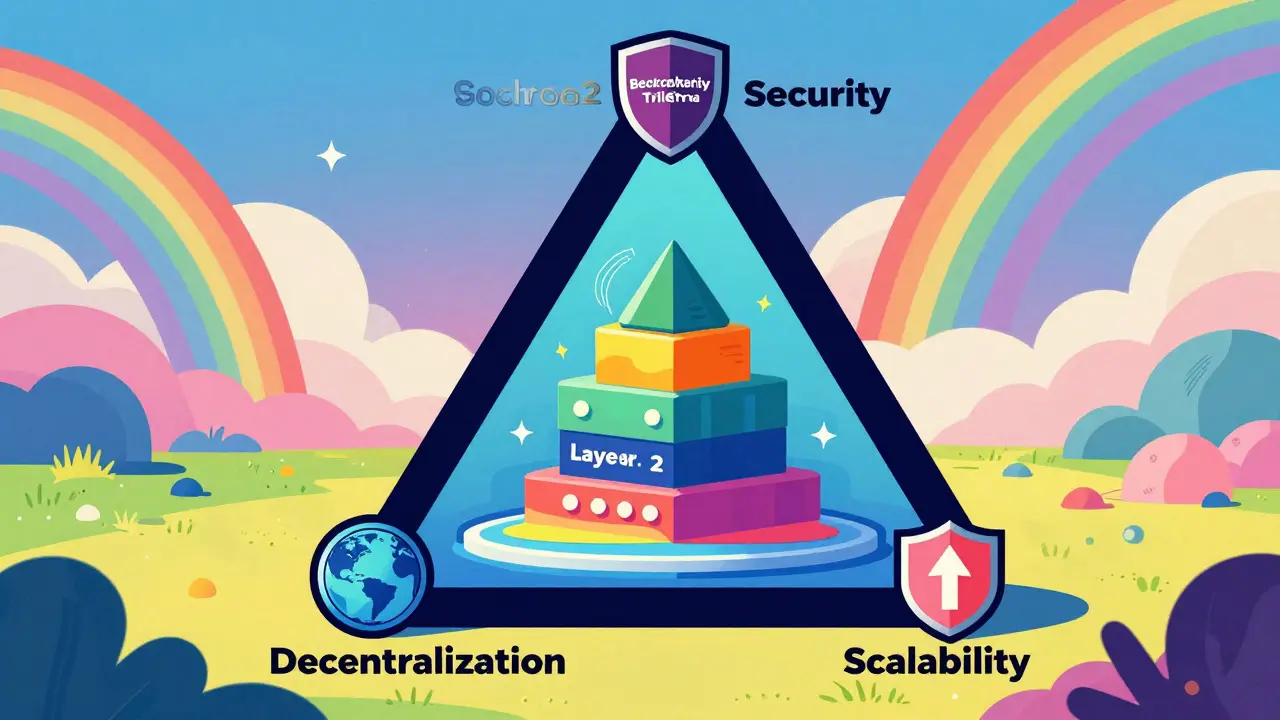
If blockchains are so powerful, why aren’t they everywhere yet? The answer lies in the Blockchain Trilemma, which is a theoretical framework stating that a blockchain can only optimize two of three properties: decentralization, security, and scalability. Proposed by Ethereum co-founder Vitalik Buterin in 2017, this concept remains a central challenge in network design.
You can have a network that is highly decentralized and secure, like Bitcoin, but it won’t be scalable (slow and expensive during peak times). You can have a network that is scalable and secure, like a private enterprise chain, but it won’t be decentralized. Or you can try to hit all three, but usually, one suffers.
This is why recent architectural innovations focus on breaking this trilemma. Layer 2 solutions, modular blockchains, and sharding are attempts to separate the functions of the network so each part can be optimized independently. For example, Ethereum’s Dencun upgrade in March 2024 introduced "proto-danksharding," which reduced Layer 2 transaction costs by roughly 90%. This allows the base layer to remain secure while offloading execution to faster, cheaper layers.
Real-World Challenges and Developer Reality
Building on blockchain is not plug-and-play. Developers face steep learning curves. According to a 2024 survey by the Blockchain Council, experienced engineers take 6-12 months to become proficient. Key skills include understanding elliptic curve cryptography, managing private keys securely, and writing smart contracts in languages like Solidity or Rust.
Security is a constant concern. In 2023, blockchain exploits resulted in $1.7 billion in losses, according to SlowMist. Cross-chain bridges were the biggest target, accounting for 67% of those losses. This highlights a critical architectural vulnerability: when two different blockchains try to talk to each other, the connection points are often weak.
Despite these challenges, adoption is growing. Financial services lead the way, followed by supply chain and government applications. The European Union’s MiCA regulation, effective June 2024, provides a clearer legal framework, encouraging institutional participation. Meanwhile, developer tools like Hardhat and Truffle Suite have matured, making development significantly easier than in the early days.
The future of blockchain architecture is likely modular and heterogeneous. Instead of one giant chain trying to do everything, we will see specialized chains interacting through standardized protocols. Celestia, launched in late 2023, exemplifies this by focusing solely on data availability, letting other chains build on top of it. As these pieces come together, the architecture will become less visible to the end-user, functioning seamlessly in the background of global commerce.
What is the difference between a node and a block in blockchain architecture?
A node is a physical or virtual computer that participates in the network by storing data and validating transactions. A block is a logical container within the software that holds a batch of verified transactions. Nodes process and store blocks, linking them together to form the chain.
Why is Proof of Stake considered better than Proof of Work?
Proof of Stake (PoS) is more energy-efficient because it doesn't require massive amounts of computing power to solve puzzles. It also tends to be faster and allows for easier upgrades. However, Proof of Work (PoW) is battle-tested and considered extremely secure due to the high cost of attacking the network physically.
Can a blockchain be hacked?
The core blockchain protocol is very difficult to hack due to cryptographic hashing and decentralization. However, vulnerabilities often exist in smart contracts, user interfaces, or cross-chain bridges. Most major losses in recent years have been due to code bugs in applications built *on* the blockchain, not the blockchain itself.
What is the Blockchain Trilemma?
The Blockchain Trilemma is the theory that a decentralized network can only achieve two out of three goals: decentralization, security, and scalability. Optimizing for all three simultaneously has historically been difficult, though new architectures like Layer 2s and modular chains aim to overcome this limitation.
Lisa Chong
July 20, 2026 AT 16:04They want you to beleive in decentralization but its just a new way for the elites to track every single penny you spend. The 'ledger' is not secure it is a surveillance tool disguised as freedom. Who controls the nodes really? The same banks that stole your savings in 2008. Wake up people. It is all a trap.
Heather Austin
July 21, 2026 AT 04:03honestly the merkle tree explanation was super helpful i always got confused about how light clients verify stuff without downloading everything. thanks for breaking it down simply
Ran Tao
July 21, 2026 AT 06:11Oh look another tech bro explaining basic computer science like it's rocket science 🙄 You guys think you're so smart with your 'consensus mechanisms' but let me tell you something. This whole thing is a bubble waiting to burst 💥 The energy consumption of PoW is an absolute disaster for the planet and PoS is just plutocracy wrapped in crypto jargon. Enjoy your digital rocks while they last 😂📉
Mark Tuason
July 21, 2026 AT 23:09It is certainly an interesting perspective on the architectural limitations. The comparison between public and private blockchains is quite illuminating for those of us trying to understand enterprise adoption. Thank you for sharing this detailed overview.
Ella Collinson
July 22, 2026 AT 19:43The systemic inefficiencies inherent in the current Layer 1 architectures are fundamentally unsustainable for high-frequency trading vectors. While the post attempts to elucidate the trilemma, it fails to adequately address the latency implications of cross-chain interoperability protocols which remain the primary bottleneck for institutional liquidity aggregation. We need to pivot towards modular data availability layers immediately or face total network congestion collapse during peak volatility events.
Ray Arney
July 24, 2026 AT 04:29Yeah I agree with the point about bridges being weak links. Saw a lot of money lost there last year. Good read overall though.
Andrew Schneider
July 25, 2026 AT 17:24You people are living in a fantasy land if you think this tech will save us from the banking cartel 🤡 It’s a honeypot! A glorious, shiny honeypot designed to drain your life savings into the pockets of venture capitalists who don’t even know what a hash rate is. The drama is real when your rug gets pulled by some anon dev in a basement somewhere. Keep holding your bags, losers! 🎪💸🔥
Eric Braddock
July 26, 2026 AT 09:08Have you considered that the 'decentralization' narrative is merely a psyop to distract from the centralization of mining pools and validator sets controlled by state actors? The cryptographic hashing isn't protecting your privacy; it's creating an immutable record for the deep state to audit your dissent. They are watching. The nodes are eyes. The ledger is a cage. Do not trust the math. Trust nothing.
Nick G
July 27, 2026 AT 15:47I find it fascinating how different cultures approach the concept of trust in financial systems. In many Eastern societies, the communal aspect of shared ledgers resonates deeply with traditional values of collective responsibility, whereas Western individualism often clashes with the idea of surrendering control to a protocol. Perhaps we can bridge these philosophical divides by focusing on the humanitarian applications of blockchain, such as transparent aid distribution in conflict zones, rather than just speculative assets. It is important to remember that technology serves humanity, not the other way around, and we must ensure that these innovations do not exacerbate existing socioeconomic disparities but rather empower marginalized communities through financial inclusion and accessible identity management solutions.
Nick Wengel
July 28, 2026 AT 11:27Simple enough for me to get the gist. Thanks for the info.