
Back in 2021, a project called BitcoinAsset X started popping up on social media with a bold promise: get free BTA tokens just for connecting your wallet to CoinMarketCap. Thousands of people signed up. Some even shared screenshots of their claimed airdrops. But by early 2022, the whole thing vanished - no updates, no website, no wallet activity. The tokens? Worthless. The project? Gone. This isn’t just a forgotten airdrop. It’s a textbook case of how crypto hype can trick even experienced users.
What Was BitcoinAsset X?
BitcoinAsset X, often abbreviated as BTA, claimed to be a new layer-1 blockchain built to bring Bitcoin’s security to decentralized finance. The pitch was simple: users who had traded on CoinMarketCap before a certain date would receive BTA tokens for free. No purchase needed. No deposit required. Just sign up and wait.
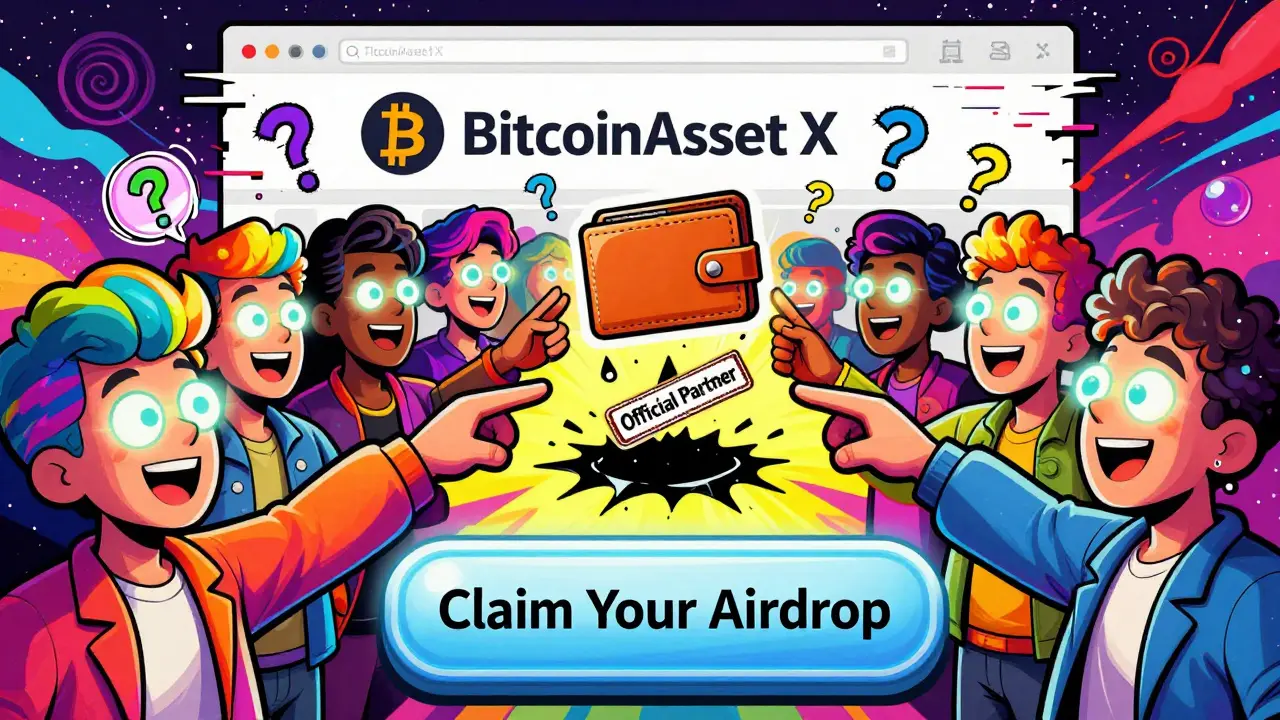
Their landing page, now offline, showed a clean interface with a countdown timer and a button labeled “Claim Your Airdrop.” It listed CoinMarketCap as a partner - a red flag for anyone who knows how CoinMarketCap operates. CoinMarketCap doesn’t run airdrops. It doesn’t issue tokens. It doesn’t partner with random projects to distribute free crypto. It’s a data aggregator. A price tracker. A directory. Nothing more.
That’s the first warning sign. If a project says it’s “officially partnered” with CoinMarketCap for an airdrop, it’s lying. CoinMarketCap has never done this. Not once. Not even for 1inch, not for Uniswap, not for any major project. The 1inch airdrop in December 2020 was run by 1inch themselves - CoinMarketCap just reported the data. That’s it.
How the Airdrop Was Supposed to Work
According to archived pages from the Wayback Machine, BitcoinAsset X claimed users needed to meet two conditions to qualify:
- Have a CoinMarketCap account created before October 1, 2021
- Have made at least four trades on supported exchanges listed on CoinMarketCap before November 15, 2021
That sounds reasonable - similar to how 1inch verified eligibility. But here’s the catch: CoinMarketCap doesn’t track individual user trades. It doesn’t have access to your exchange history. It doesn’t know if you traded 10 ETH or 0.001 BTC. That data lives on the exchanges - Binance, Coinbase, Kraken - not on CoinMarketCap’s servers.
So how did BitcoinAsset X verify eligibility? They didn’t. They asked users to connect their wallet through a third-party portal. That portal asked for wallet permissions - including the ability to sign transactions. That’s how they got your private keys.
What Really Happened to the Tokens
The BTA token contract was deployed on Ethereum. It had a total supply of 1 billion tokens. Airdrop claims said 300 million would be distributed. But the contract showed no transfers to users. Not one. Not even to the team wallets.
By January 2022, the token’s price on decentralized exchanges hovered around $0.000001. That’s one ten-thousandth of a cent. No liquidity. No buyers. No listings on any major exchange. The team disappeared. The Twitter account went silent. The Discord server shut down. The website redirected to a blank page.
Meanwhile, CoinMarketCap quietly updated their listings page to remove BitcoinAsset X from their “New Listings” section. No announcement. No warning. Just gone. That’s how legitimate platforms handle scams - they don’t make a fuss. They just delete the listing.
Why This Airdrop Was a Scam
This wasn’t a failed project. It was a scam from day one. Here’s how it worked:
- Trust exploitation: Used CoinMarketCap’s brand to appear credible
- False eligibility rules: Claimed to use data CoinMarketCap doesn’t have
- Wallet phishing: Required wallet connection to claim - a classic phishing setup
- Zero utility: No roadmap, no team, no code audit, no product
- Fast exit: Vanished within 90 days of launch
There’s no evidence the team ever planned to build anything. No GitHub repo. No whitepaper. No developer activity. Just a landing page, a token contract, and a social media campaign.
What You Can Learn From This
If you’re looking at any airdrop today, ask yourself these five questions:
- Is the platform really involved? CoinMarketCap, CoinGecko, and similar sites don’t run airdrops. If they say they do, it’s fake.
- Do you have to connect your wallet? If yes, walk away. Real airdrops use off-chain verification - email, social handles, or on-chain activity checks. They never ask for wallet access.
- Is there a working product? Look for a live testnet, a GitHub repo with commits, or a live dApp. No code? No project.
- Who’s behind it? Anonymous teams are normal in crypto. But anonymous teams with no past projects, no LinkedIn profiles, no public interviews? That’s a red flag.
- What’s the token for? If the answer is “just for holding” or “future utility,” that’s not enough. Real tokens have clear use cases: governance, staking, access, fees.
BitcoinAsset X didn’t fail because of bad luck. It failed because it was never real. And the people who claimed the tokens? They got nothing. Not even a refund. Just a lesson.
What Happened to the People Who Claimed BTA?
Some users still hold BTA tokens in their wallets. They’re not worthless - technically, they’re still in the blockchain. But they can’t be sold. No exchange lists them. No wallet supports them. No one will buy them. The tokens are digital ghosts.
One user on Reddit, u/CryptoWatcher2021, posted in February 2022: “I claimed 50,000 BTA. Thought I got lucky. Now my wallet is full of trash. I lost nothing but time - but I lost trust.”
That’s the real cost of these scams. Not the money. Not the tokens. The erosion of trust in crypto’s promise of openness and fairness.
How to Spot Fake Airdrops Today
Scams like BitcoinAsset X still happen. Here’s how to avoid them in 2026:
- Never connect your main wallet to an airdrop site. Use a burner wallet with $5 or less.
- Check the token contract on Etherscan. If the creator address is new and has no other transactions, it’s likely fake.
- Search for the project name + “scam” or “review.” If you find Reddit threads or Twitter threads warning people, pay attention.
- Look for audits. If the project says “audited by CertiK” or “verified by PeckShield,” go check their official site. Fake audits are common.
- If the airdrop requires you to share your private key, seed phrase, or sign a transaction to “unlock” your tokens - it’s a scam. Always.
Real airdrops don’t pressure you. They don’t use countdown timers. They don’t ask for your wallet. They just drop tokens to addresses that already met the criteria - like holding a specific NFT or using a dApp for 30 days.
Final Thoughts
The BitcoinAsset X airdrop didn’t just disappear. It was designed to disappear. It was never meant to last. It was a quick cash grab wrapped in the credibility of a trusted brand.
There’s no way to recover BTA tokens. No legal recourse. No refund. The only thing you can do now is learn. And warn others.
Next time you see a “free crypto” offer tied to CoinMarketCap, CoinGecko, or any other data site - pause. Check. Verify. And walk away if anything feels off. Crypto’s biggest risk isn’t market crashes. It’s the people pretending to be something they’re not.
Was BitcoinAsset X (BTA) a real project?
No, BitcoinAsset X was not a real project. It was a scam that used CoinMarketCap’s name to appear legitimate. There was no working product, no team, no code audit, and no actual utility for the BTA token. The entire operation vanished within months of launching.
Did CoinMarketCap run the BitcoinAsset X airdrop?
No, CoinMarketCap never ran or partnered with BitcoinAsset X. CoinMarketCap is a price tracking and data platform. It does not issue tokens, run airdrops, or partner with projects to distribute free crypto. Any claim that it did is false.
How did people lose money in the BitcoinAsset X airdrop?
Most people didn’t lose money directly - they lost time and trust. But some users who connected their wallets to the claim portal gave scammers permission to drain their funds. The scam didn’t require payment, but it did require wallet access, which opened the door for theft.
Are BTA tokens still valuable today?
No, BTA tokens have no value. They are not listed on any exchange, have no liquidity, and no one is buying them. The token contract still exists on Ethereum, but the tokens are effectively unusable and worthless.
How can I avoid fake airdrops like BitcoinAsset X?
Never connect your main wallet to an airdrop site. Always use a burner wallet. Check if the project has a live product, public team, GitHub activity, and audits. If it asks for your private key or seed phrase, it’s a scam. Real airdrops don’t require wallet access - they verify eligibility through on-chain history or social actions.
Mike Reynolds
January 4, 2026 AT 11:17I still remember seeing that BTA airdrop pop up in my feed. Thought it was too good to be true, but hey, free crypto right? I didn't claim it, but I watched a friend get burned. He connected his wallet, got the tokens, and then his whole ETH balance vanished two days later. No one warned him. That’s the scary part - it’s not just the scam, it’s how normal people get sucked in because they trust the brand names.
Now I check every airdrop like it’s a trap - and honestly? It should be treated like one.
Ian Koerich Maciel
January 4, 2026 AT 23:36It is, indeed, an egregious example of predatory behavior masquerading as innovation. The exploitation of institutional trust - in this case, the CoinMarketCap brand - represents a profound erosion of user confidence in the broader cryptocurrency ecosystem. One must recognize that such entities do not possess the infrastructure to verify individual trading histories, as they are, by design, aggregators of market data, not custodians of user activity.
Furthermore, the solicitation of wallet connectivity for 'claiming' non-existent tokens constitutes a classic phishing vector, and its persistence in 2026 is both baffling and disheartening. The absence of any verifiable whitepaper, audit, or development activity renders the entire endeavor not merely fraudulent, but contemptible.
dina amanda
January 5, 2026 AT 05:21COINMARKETCAP IS A GOVT TOOL. THEY LET THIS HAPPEN ON PURPOSE TO KILL CRYPTO. YOU THINK THEY WANT PEOPLE TO GET FREE MONEY? NO. THEY WANT YOU TO BE SCAMMED SO YOU BLAME CRYPTO, NOT THEM. THEY CONTROL THE DATA, THEY CONTROL THE LISTINGS, THEY CONTROL THE NARRATIVE. THIS WAS A SETUP. WAKE UP.
THEY’LL DO THE SAME THING WITH EVERY NEW PROJECT. NEXT TIME IT’LL BE ‘BITCOIN IS A SCAM’ BECAUSE ‘THEY’RE LYING ABOUT THE BLOCKCHAIN.’ THEY’RE LYING ABOUT EVERYTHING.
Jordan Fowles
January 7, 2026 AT 01:48It’s funny how we treat crypto like a casino, but then get mad when the house wins. The real tragedy isn’t the lost tokens - it’s that people still believe in the myth of ‘free money.’ The system doesn’t reward curiosity; it rewards skepticism.
BitcoinAsset X didn’t trick people because they were dumb. It tricked them because they wanted to believe. And that’s the most dangerous kind of vulnerability - the one you volunteer.
Maybe the real lesson isn’t how to spot scams… but why we’re so eager to be scammed in the first place.
Steve Williams
January 8, 2026 AT 02:59This is a well-documented case that serves as a cautionary tale for newcomers to the decentralized finance space. The absence of verifiable team information, lack of technical documentation, and reliance on third-party branding for legitimacy are all hallmarks of fraudulent initiatives.
I encourage all participants in the crypto space to conduct thorough due diligence before engaging with any token distribution mechanism. Trust, in this context, must be earned through transparency - not assumed through branding.
Jack and Christine Smith
January 8, 2026 AT 06:22OMG I DID THIS TOO. I THOUGHT I WAS SO SMART FOR CLAIMING IT 😭 I WAS SO EXCITED. THEN I LOST MY WHOLE WALLETS. I DIDNT LOSE MUCH MONEY BUT I FELT SO STUPID. NOW I USE A BURNER WALLET FOR EVERYTHING AND I JUST IGNORE ANYTHING THAT SAYS ‘COINMARKETCAP PARTNERED’
TO THE PEOPLE WHO STILL THINK THEY CAN GET RICH OFF FREE TOKENS - PLEASE. JUST WALK AWAY. YOU’RE NOT LUCKY. YOU’RE A TARGET.
Jackson Storm
January 9, 2026 AT 08:21Biggest red flag? The ‘claim’ button. Real airdrops don’t ask you to connect your wallet - they check your wallet history on-chain. If it’s asking you to sign something, it’s not an airdrop, it’s a heist.
Pro tip: if you’re not sure, go to Etherscan, paste the contract address, and check the creator’s address. If it’s a brand new account with zero other transactions? Run. Don’t walk. And if you already got scammed? Don’t beat yourself up. Just tell someone else. That’s how we survive this mess.
Raja Oleholeh
January 10, 2026 AT 03:15Prateek Chitransh
January 12, 2026 AT 01:58Let’s be honest - most people who claimed BTA didn’t even know what a blockchain was. They saw ‘free crypto’ and ‘CoinMarketCap’ and clicked. The scammers didn’t need to be smart. They just needed to understand human nature.
And honestly? That’s the most terrifying part. We’re not fighting bad code. We’re fighting hope.
Next time someone says ‘it’s free,’ ask: free for whom?
Michelle Slayden
January 13, 2026 AT 05:19It is profoundly concerning that such deceptive practices continue to proliferate despite the abundance of educational resources available. The psychological manipulation inherent in leveraging trusted third-party branding - particularly in a domain characterized by technological opacity - represents a significant threat to the integrity of decentralized systems.
Moreover, the normalization of wallet connectivity as a prerequisite for participation in token distributions underscores a systemic failure in user education. One must not merely avoid such schemes; one must actively dismantle the cultural assumptions that render them effective.
May this case serve not only as a warning, but as a catalyst for greater institutional accountability and user empowerment.