

Germany isn’t just tolerating cryptocurrency; it’s actively regulating it. If you are running a crypto business or planning to launch one in Europe, BaFin-the Federal Financial Supervisory Authority-is the gatekeeper you cannot ignore. Unlike many jurisdictions that still operate in legal gray areas, Germany has built a structured, transparent framework for digital assets. But transparency comes with strict rules.
The landscape shifted dramatically with the introduction of the EU's Markets in Crypto-Assets Regulation (MiCAR). For anyone operating in Germany, this means national laws like the German Banking Act (KWG) now work hand-in-hand with European directives. The question isn't whether crypto is legal-it is-but whether your specific operations require a license, and if so, how to get it without getting bogged down in bureaucracy.
How BaFin Defines Crypto Services
To understand compliance, you first need to know what triggers regulatory scrutiny. BaFin doesn't regulate every person who holds Bitcoin. They regulate services. Under the German Banking Act (KWG), activities involving crypto assets are classified as financial instruments. This classification brings them under mandatory authorization.
If your business provides any of the following, you likely need a BaFin license:
- Custody of crypto assets (safeguarding private keys for clients)
- Exchange of crypto assets against fiat currencies
- Exchange of crypto assets against other crypto assets
- Operation of trading platforms
- Issuance of stablecoins or security tokens
The key distinction lies in "service provision." Simply accepting Bitcoin as payment for goods does not automatically make you a regulated entity. However, if you use a third-party payment processor that exchanges the crypto for euros before paying you, that processor must be licensed. If they aren't, BaFin can take action against you for facilitating unlicensed banking transactions. This nuance trips up many small businesses.
The Impact of MiCAR on German Regulations
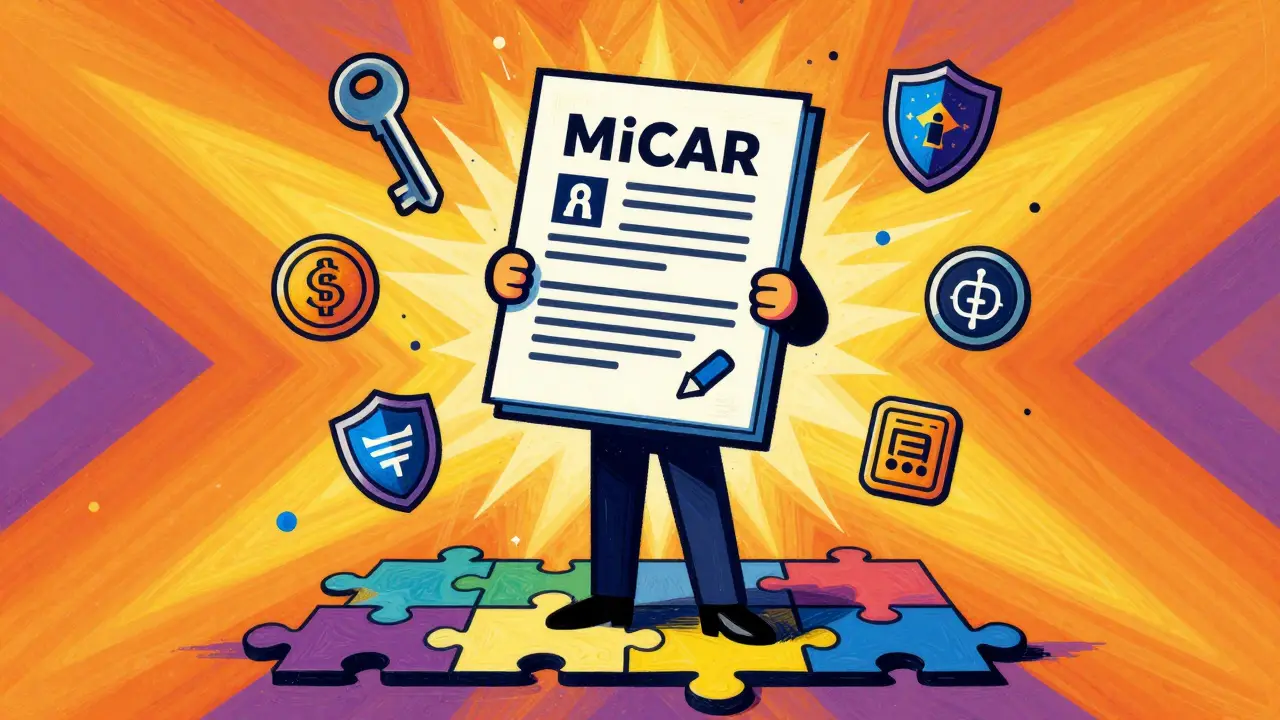
The Markets in Crypto-Assets Regulation (MiCAR) is the backbone of current oversight. While MiCAR sets the EU-wide standard, Germany implemented it through two critical acts: the Act on the Digitalisation of the Financial Market (FinmadiG) and the Act on the Supervision of Markets for Crypto-Assets (KMAG).
These acts created a transitional period. Existing licenses issued under older rules remained valid until December 31, 2025, allowing providers time to adapt to MiCAR-compliant standards. After this date, all operators must meet the new EU-wide criteria. This transition has forced companies to upgrade their IT infrastructure, enhance their reporting mechanisms, and refine their risk management protocols.
MiCAR also introduced stricter white paper requirements. If you are launching a new crypto-asset offering to the public, you must submit a detailed white paper to BaFin for approval before the launch. This document must clearly outline the asset's technical specifications, rights associated with the token, and potential risks. It’s no longer enough to publish a PDF on your website; it must pass regulatory review.
AML and KYC: The Travel Rule
Anti-Money Laundering (AML) compliance is non-negotiable. Germany enforces the international "travel rule" through the German Crypto Asset Transfer Regulation (KryptoWTransferV). This regulation implements guidelines from the Financial Action Task Force (FATF).
Here is what this means for your operations: whenever you transfer crypto assets, you must collect and transmit information about both the originator (sender) and the beneficiary (receiver). You cannot process anonymous transfers above certain thresholds. Your system must be able to verify identities (Know Your Customer or KYC) and maintain records of these verifications.
This applies to centralized exchanges and custodians. Decentralized Finance (DeFi) protocols face a harder path here, as identifying the responsible legal entity for compliance is often impossible. BaFin expects clear accountability, which pushes many DeFi projects to incorporate traditional corporate structures to handle compliance duties.
Recent Enforcement Actions and Trends
BaFin is not just writing rules; it is enforcing them. Recent actions show a regulator that is willing to shut down non-compliant operations quickly.
In June 2025, BaFin ordered the winding up of Ethena GmbH's operations related to its USDe stablecoin in Germany. Token holders were given a deadline to redeem their tokens, and a special representative was appointed to oversee the process. This case highlighted the risks associated with algorithmic stablecoins and the importance of adequate reserve backing and liquidity plans.
Additionally, the Federal Ministry of Finance (BMF) updated tax circulars in March 2025. These updates replaced vague terms like "virtual currencies" with "crypto assets" and clarified tax treatment for staking and DeFi activities. Active staking (providing validation services) is treated differently from passive staking (earning rewards simply by holding). This clarity helps businesses forecast their tax liabilities more accurately, but it also demands rigorous record-keeping.
Getting Licensed: Process and Timelines
Historically, getting a BaFin license was a slow, painful process, especially after the Wirecard scandal made regulators hyper-cautious. However, the process has improved significantly since 2024. BaFin now sets strict deadlines and expects compact, clear presentations of your business model.
For many crypto-asset service providers, decisions are now being issued within months rather than years. To speed up your application, ensure your documentation includes:
- A detailed business plan showing sustainable revenue models
- Evidence of robust IT security and cybersecurity measures
- Clear AML/KYC procedures aligned with KryptoWTransferV
- Proof of sufficient capital reserves
- A compliant white paper (if issuing tokens)
BaFin focuses heavily on IT infrastructure. You must demonstrate that your systems can withstand attacks and protect consumer assets. Regular audits and penetration tests are expected parts of your operational routine.
When Do You NOT Need a License?
Not every interaction with crypto requires a license. Understanding the boundaries can save you significant legal costs.
Private Use: Individuals buying and selling crypto for personal investment purposes do not need a license. Tax obligations apply, but regulatory licensing does not.
Pure Payment Acceptance: If you run a coffee shop and accept Bitcoin directly into your own wallet, you are generally not considered a financial service provider. You are acting as a merchant. However, if you use a payment gateway that converts the Bitcoin to Euros instantly, that gateway must be licensed. You are responsible for ensuring your partners are compliant.
Passive Freedom of Services: Foreign-based companies can sometimes serve German customers without a local license if the customer initiates the contact (passive freedom). However, if you actively market to German residents, advertise in German media, or have a physical presence (even an office), BaFin will consider you operating in Germany and require a license.
Is cryptocurrency legal in Germany?
Yes, cryptocurrency is completely legal in Germany. It is recognized as a "unit of account" and private money. However, businesses providing services related to crypto must obtain authorization from BaFin.
What is MiCAR and how does it affect my business?
MiCAR is the EU-wide regulation for crypto-assets. It standardizes rules across Europe. In Germany, it is enforced by BaFin. It requires stricter white papers, enhanced consumer protection, and uniform licensing standards for all crypto service providers.
Do I need a BaFin license to accept crypto payments?
If you accept crypto directly into your own wallet for goods/services, you usually do not need a license. If you use a third-party processor that exchanges the crypto for fiat, that processor must be licensed. You are liable if your partner is not compliant.
How long does it take to get a BaFin license?
While historically taking years, recent improvements mean decisions can be made within months. The timeline depends on the complexity of your business model and the completeness of your application documentation.
What are the tax implications of staking crypto in Germany?
As of 2025, the Federal Ministry of Finance distinguishes between active and passive staking. Active staking may be taxed as income from self-employment, while passive staking is often treated as capital gains. Proper documentation is essential.
Jan Gilmore
May 16, 2026 AT 21:06Look, I've been in the fintech space for over a decade and this is exactly what we needed. The ambiguity was killing innovation. BaFin finally drawing a line in the sand about MiCAR compliance is actually a good thing for serious players. You can't build a sustainable business on gray areas. If you're doing it right, you should welcome the clarity. It weeds out the scammers who were making legitimate operators look bad anyway. The transition period until 2025 gives everyone enough time to fix their IT infrastructure without panicking. Just get your house in order now.
Caique Muniz
May 17, 2026 AT 10:52another day another regulation trying to kill the soul of crypto lol. ba fin is just another government body wanting control. who cares about mi car when the whole system is rigged anyway. i bet they gonna tax every satoshi u touch soon. typical bureaucracy at its finest. why bother starting a business if you need a license for breathing basically? sounds like a nightmare to me tbh
Bradley Geldenhuys
May 19, 2026 AT 01:08You're missing the bigger picture here my friend. Regulation isn't about killing freedom; it's about creating a safe playground where trust can exist. Without these rules, only the bad actors survive because they don't care about ethics or safety. Think about it. When institutions can enter the market safely, the price goes up for everyone holding. Yes, it's annoying. Yes, it's bureaucratic. But it's the price of maturity. We have to grow up as an industry. The Ethena case proves that unchecked algorithms are dangerous for retail investors. We need guardrails so the bridge doesn't collapse under its own weight. Embrace the structure rather than fighting it blindly.
robert Whitehead
May 20, 2026 AT 01:20The fact that people are complaining about basic AML requirements shows how naive this community still is. Money laundering isn't a victimless crime. It funds terrorism and human trafficking. BaFin is doing society a favor by enforcing the travel rule. If you think anonymous transfers are a fundamental human right, you're delusional. The distinction between private use and service provision is crystal clear in the text. Stop whining about licenses and start understanding that financial stability requires oversight. The Wirecard scandal happened because regulators slept at the wheel. Now they are awake and watching. Good riddance to the wild west era.
Ankush Pokarana
May 20, 2026 AT 05:23i understand the frustration with paperwork but consider the long term benefits for all stakeholders involved in this ecosystem. when we have clear guidelines like the krypto w transfer v it becomes easier for traditional banks to partner with crypto firms which leads to greater liquidity and adoption rates globally. the key is preparation and not waiting until the last minute before december 2025 deadline arrives. many small businesses fail because they ignore these signals until enforcement actions begin against them directly. focus on building robust internal controls from day one instead of viewing compliance as an obstacle to overcome later on down the road.