

Crypto Enforcement Impact Calculator
Estimate how enforcement actions impact illicit crypto volume across different blockchains. Based on 2024-2025 global enforcement data from TRM Labs and Chainalysis.
Estimated Impact
Current Illicit Volume
$0.00B
Post-Enforcement Volume
$0.00B
Note: Based on real 2024 enforcement data where TRON's illicit volume dropped by $6B after T3 FCU actions.
By 2025, the world’s approach to crypto enforcement has changed. It’s no longer about shutting down Bitcoin or banning wallets. It’s about tracking, freezing, and recovering money - and some places are getting really good at it. While headlines still scream about crypto being a haven for criminals, the real story is more nuanced. Illicit activity is falling in some areas, rising in others, and the way governments and companies are fighting back is shifting fast.
Illicit Crypto Activity: The Numbers Don’t Add Up
You’ve probably seen two wildly different numbers floating around: $10.7 billion and $40.9 billion. Both are real. The difference? What they count.
TRM Labs focused on fraud - scams, phishing, fake exchanges, pump-and-dumps. In 2024, that totaled $10.7 billion, down 40% from 2023. That’s a clear sign people are getting better at spotting scams. Wallets are being flagged. Social engineering attacks are being blocked before they hit. The drop isn’t random. It’s the result of better tools and smarter alerts.
Chainalysis, on the other hand, counts everything: darknet markets, ransomware, money laundering, terrorist financing. Their 2024 estimate? $40.9 billion. But here’s the catch - their numbers always grow after the fact. Last year’s $24.2 billion jumped to $46.1 billion once they found more addresses. So this year’s $40.9 billion could easily become $51 billion by next year. That’s not because crime is exploding. It’s because they’re catching up.
The truth? Fraud is declining. But systemic, organized crime is still very much alive. And it’s getting harder to detect because it’s moving into less obvious places - like DeFi protocols and NFT marketplaces.
Which Blockchains Are the Problem?
Not all blockchains are equal when it comes to crime. In 2024, TRON carried 58% of all illicit crypto volume. Why? Low fees, fast transactions, and heavy use of USDT - the stablecoin that’s become the backbone of criminal cash flows.
Ethereum came second at 24%. That’s mostly because of smart contracts being exploited for rug pulls and fake staking pools. Bitcoin? Only 12%. Surprising? Maybe. But Bitcoin’s transparency makes it harder to hide. Every transaction is public. Criminals don’t like that.
Then came the turning point: August 2024. TRON, Tether, and TRM Labs formed the T3 Financial Crime Unit. Within months, they froze over $130 million in illicit funds. They traced blocklisted USDT, flagged sanctioned wallets, and even returned $20% of stolen coins to victims and governments. It wasn’t magic. It was collaboration.
TRON’s illicit volume dropped by $6 billion in just six months. That’s the power of public-private partnerships. No government could have done it alone. No crypto company could have done it without regulators. Together, they made a dent.

Regulation on Paper vs. Regulation in Practice
Over 60% of major crypto markets introduced new rules in 2024. The Financial Action Task Force (FATF) says 91% of countries have AML/CFT registration systems in place. Sounds good, right?
Not so fast. PwC’s 2025 report found that 75% of jurisdictions are still only partially compliant - or not compliant at all. Nearly 30% haven’t even implemented the Travel Rule, which requires exchanges to share sender and receiver info on transactions over $1,000. That’s the single most important tool for tracking cross-border crime.
There’s a gap between what’s written in law and what’s enforced. Countries like the U.S., UK, and Singapore have real teams, real tech, and real budgets. Others? They have press releases. A law passed in January, but no one’s trained to use it. No one’s checking the blockchain. No one’s talking to exchanges.
That’s why enforcement feels so uneven. One country freezes a $50 million wallet. Another lets a crypto exchange operate with zero KYC for two years. The lack of global alignment is the biggest weakness in the system.
Crypto Fines vs. Traditional Finance Fines
People act like crypto is the wild west of finance. But the numbers tell a different story.
Between 2020 and early 2025, the entire crypto industry paid $13.5 billion in fines, sanctions, and losses from hacks. That sounds huge - until you compare it to traditional finance.
Bank of America and JPMorgan Chase alone have paid over $97 billion in penalties since 2008. The whole financial sector? Over $300 billion - mostly for mortgage fraud, sanctions evasion, and money laundering.
So why does crypto get more attention? Because it’s new. Because it’s digital. Because it’s harder to understand. But the scale of crime? It’s not even close.
And here’s another twist: crypto enforcement is more frequent but less costly. Over 70% of actions are compliance warnings, license suspensions, or forced audits. Only a small fraction result in massive fines. Regulators aren’t trying to bankrupt crypto companies. They’re trying to make them follow the rules.
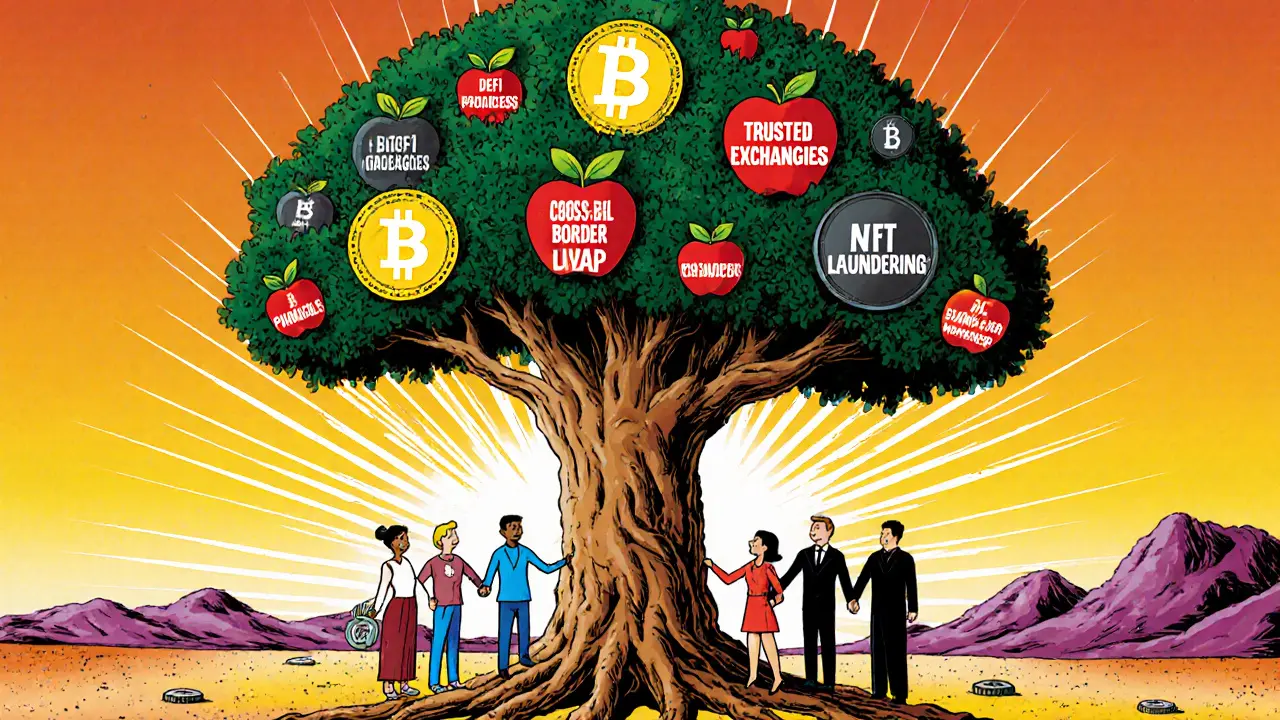
What’s Next in 2025?
2025 is the year enforcement gets smarter - not just harsher.
Stablecoins are now the #1 target. USDT, USDC, BUSD - they’re the cash of the crypto world. Regulators are demanding real-time monitoring. Tether has already started freezing wallets linked to sanctioned entities. Others will follow.
DeFi is next. Protocols like Uniswap and Aave don’t have CEOs. They have code. That’s a problem for regulators used to going after companies. But new tools are emerging. Chainalysis and Elliptic now track liquidity pools and smart contract interactions. By Q3 2025, 68% of regulators plan to release specific rules for DeFi.
NFTs? They’re still messy. But ransomware gangs are using them to launder money. Artists are getting scammed. Enforcement is lagging - but it’s coming.
And the biggest shift? Cross-border cooperation. The T3 FCU model is being copied. The U.S. is working with the EU. Singapore is sharing data with South Korea. The UK is training Latin American agencies. Recovery of stolen assets is no longer a fantasy. It’s happening.
Meanwhile, criminals are adapting. They’re using mixers less. They’re moving to privacy coins like Monero. They’re exploiting new DeFi lending protocols. The cat-and-mouse game continues.
Why the User Base Matters
There are now 560 to 659 million crypto users worldwide. By the end of 2025, that could hit 950 million. More users mean more crime - but also more eyes, more reporting, more accountability.
Every new user who learns to check a wallet’s history, who avoids shady airdrops, who uses a regulated exchange - they’re part of the solution. Enforcement isn’t just about governments. It’s about culture.
The days of crypto being a lawless frontier are ending. It’s becoming a regulated market - messy, uneven, but moving forward. The biggest wins aren’t in big fines. They’re in frozen wallets, returned funds, and blocked transactions. Quiet wins. But real ones.