

You click 'buy' on your favorite Indian exchange, and suddenly a chunk of your money vanishes before the trade even settles. If you are trading cryptocurrency in India right now, you have likely felt the sting of the 1% TDS on crypto transactions. It is not a scam, it is not a hidden fee, and it is not going away anytime soon. Introduced in the Union Budget of 2022, this rule has fundamentally changed how Indians buy, sell, and swap digital assets.
For many traders, the confusion starts immediately. Is it a tax? Do I pay it every time? What happens if I just move Bitcoin from one wallet to another? The short answer is that Tax Deducted at Source (TDS) under Section 194S acts as a tracking mechanism for the government, ensuring that every significant movement of Virtual Digital Assets (VDAs) leaves a paper trail. But the details matter immensely for your wallet and your annual tax filing.
What Exactly Is the 1% TDS Rule?
To understand why your balance drops, we need to look at the law itself. The Indian government introduced Section 194S into the Income Tax Act, 1961, effective July 1, 2022. The core idea is simple: when you transfer a virtual digital asset, the person or platform receiving the payment must deduct 1% of the transaction value and send it directly to the government.
It is crucial to distinguish between a 'transfer' and a 'transaction.' According to the Income Tax Department, a transfer means a change of ownership. This includes selling crypto for INR, swapping Bitcoin for Ethereum, or spending USDT for goods. However, moving funds from your personal hot wallet to your cold storage wallet does not trigger TDS because ownership hasn't changed-you still own the same coins. This distinction saves countless users from unnecessary deductions.
The rate is fixed at 1%. There are no slabs based on profit or loss. Whether you sold your crypto at a massive gain or a devastating loss, the deduction remains flat. This creates a unique pressure point for high-frequency traders who see their capital erode with every single swap, regardless of profitability.
Who Has to Pay? Understanding the Thresholds
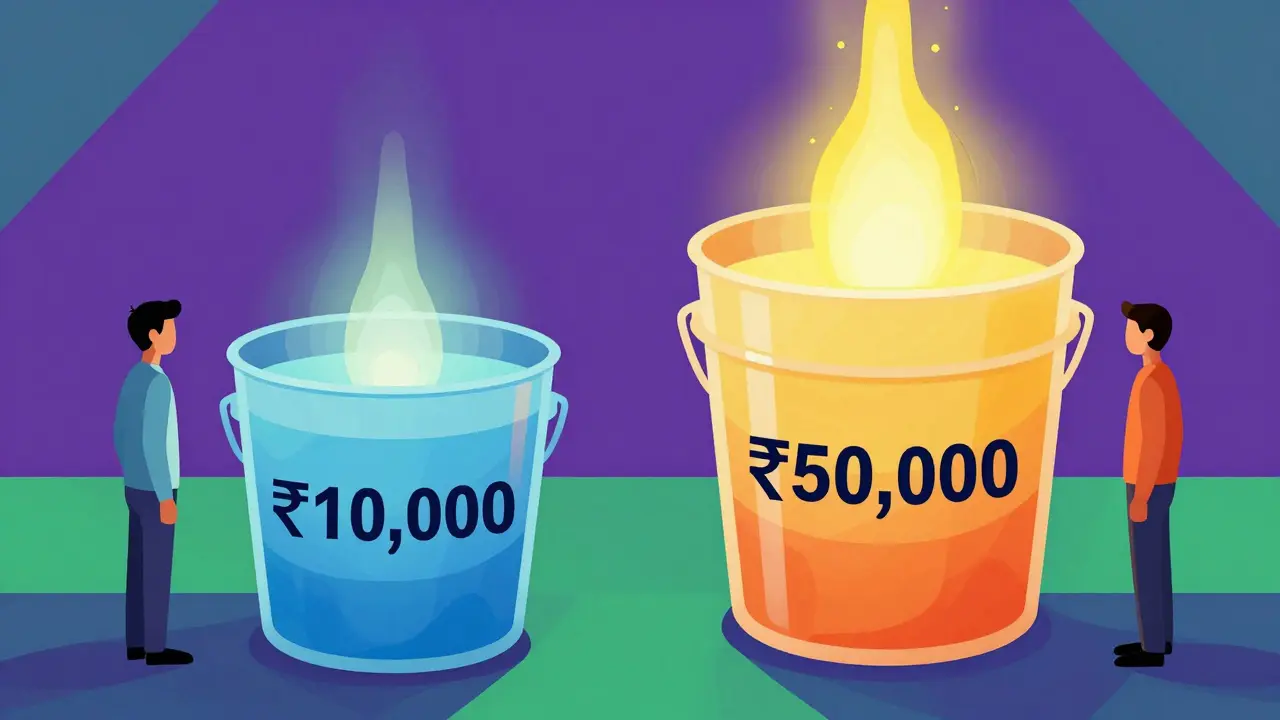
Here is where most people get confused. You do not necessarily pay 1% on every transaction. The law sets specific annual thresholds based on who you are. Think of these limits as buckets; once your total transactions fill the bucket for the financial year, the tap turns on, and every subsequent transaction gets taxed.
| Taxpayer Category | Annual Transaction Limit | TDS Rate Above Limit |
|---|---|---|
| Specified Persons (Individuals/HUFs without tax audit) | ₹50,000 per financial year | 1% |
| All Others (Companies, Audited Individuals, HUFs with audit) | ₹10,000 per financial year | 1% |
| Defaulters (No ITR filed last 2 years + TDS > ₹50k) | No exemption | 5% (Under Section 206AB) |
If you are a regular salaried individual who does not require a tax audit, you enjoy a buffer of ₹50,000. You can buy and sell up to ₹50,000 worth of crypto in an entire financial year (April to March) without any TDS being deducted. Once you cross that mark, even by a rupee, the next transaction will incur the 1% cut. For businesses or individuals subject to tax audits, that safety net shrinks drastically to just ₹10,000.
A critical warning applies to those who have neglected their income tax returns. If you failed to file your ITR for the previous two years and had TDS exceeding ₹50,000 annually, Section 206AB kicks in. In this scenario, the TDS rate jumps to 5%, and there is no threshold exemption. This punitive measure is designed to force compliance across the board.
How TDS Works on Different Types of Trades
The mechanics of deduction change depending on whether you are using a centralized exchange like CoinDCX or WazirX, or engaging in peer-to-peer (P2P) deals. On registered exchanges, the process is automated. The platform calculates your cumulative transactions for the year. When you cross the limit, the system automatically deducts 1% from your sale proceeds or adds it to your purchase cost, depositing it with the government on your behalf. You don't need to lift a finger, but you must monitor your dashboard to avoid unpleasant surprises during large trades.
Crypto-to-crypto swaps present a tricky double-dip scenario. When you trade Bitcoin for Solana, both parties are technically transferring VDAs. Consequently, the buyer deducts 1% TDS from the seller, and if the structure requires it, the seller might also face implications. In practice, many exchanges apply the 1% deduction on the fiat equivalent value of the outgoing asset. This means a ₹1,00,000 swap results in ₹1,000 leaving your portfolio immediately, reducing your effective buying power.
For P2P traders, the burden shifts entirely to you. If you buy crypto from another individual outside an exchange, you are responsible for deducting the 1% TDS from the payment sent to the seller. You must collect the seller's PAN card number, file Form 26QE within 30 days of the month-end, and issue a TDS certificate. Failing to do so can lead to heavy penalties. Most retail traders find this administrative nightmare too costly, which explains why P2P volume has shifted toward platforms that handle compliance internally.
The Hidden Costs: GST and Capital Gains
TDS is only the first layer of taxation. Many new investors mistakenly believe that paying 1% TDS means they have settled their tax dues. This is incorrect. TDS is merely an advance payment against your final tax liability. At the end of the financial year, you must still calculate your actual gains.
India imposes a flat 30% tax on all profits made from crypto assets under Section 115BBH. Add a 4% health and education cess, and your effective tax rate on profits hits 31.2%. Here is the painful part: you cannot offset losses. If you made ₹1 lakh profit on Bitcoin but lost ₹50,000 on Dogecoin, you still pay 30% tax on the full ₹1 lakh profit. The losses vanish for tax purposes. Furthermore, expenses related to mining, staking, or gas fees generally cannot be deducted from your taxable income, further squeezing margins.
Then there is Goods and Services Tax (GST). As clarified in recent updates extending to 2025-26, exchange services attract 18% GST. So, when you execute a trade, you pay the 1% TDS (if above threshold), plus the exchange's trading fee, plus 18% GST on that fee. While the GST amount is small relative to the principal, it compounds over time for active traders.
Compliance and Common Pitfalls
Navigating this landscape requires vigilance. One of the most common errors is misunderstanding the threshold calculation. The ₹50,000 limit is cumulative for the financial year, not per transaction. If you make five trades of ₹15,000 each, you have crossed the limit after the third trade. The fourth and fifth trades will attract TDS. Exchanges track this automatically, but if you use multiple platforms, you must keep manual records. Each exchange tracks its own internal counter, meaning you could hit the threshold on Platform A while Platform B thinks you are still exempt, leading to unexpected deductions.
Another frequent issue involves Form 26AS. This document shows all taxes deducted at source. After making crypto transactions, you should check your Form 26AS on the Income Tax Portal. It usually takes 7 to 10 business days for exchanges to reflect the TDS here. If you do not see it, contact your exchange's support team immediately. Missing entries here can cause mismatches when you file your return, triggering notices from the tax department.
For those involved in decentralized finance (DeFi), the rules are murkier. The CBDT clarified in Circular No. 15/2025 that the entity converting crypto to fiat becomes liable for TDS. If you swap tokens on a decentralized exchange (DEX) and then cash out via a ramp service, that ramp service provider is likely responsible for the deduction. However, self-executed smart contract interactions remain a gray area, urging users to maintain meticulous logs of all wallet addresses and transaction hashes.
Impact on Trading Strategies
The introduction of TDS has forced a strategic shift among Indian crypto participants. High-frequency day trading has become significantly less viable due to the capital erosion caused by the 1% deduction combined with the inability to offset losses. A trader executing ₹10 lakhs in monthly volume would lose ₹1 lakh annually just in TDS, not counting the 30% capital gains tax on profits.
Consequently, many investors have moved toward long-term holding strategies ('HODLing'). By reducing the frequency of transfers, they stay below the threshold longer or minimize the number of taxable events. Others have explored staking and yield farming, where rewards are often considered income from other sources rather than capital gains upon receipt, though this interpretation is subject to evolving judicial precedents. Some users have attempted to split transactions to stay under thresholds, but tax authorities view this as colorable devices to evade tax, carrying severe legal risks.
Looking ahead, the regulatory framework continues to evolve. With the proposed Digital Asset Bill under review and potential integration with India's Account Aggregation Framework by early 2026, transparency will increase. The NPCI pilot project aims to auto-report crypto transactions, making evasion nearly impossible. For now, staying informed, keeping detailed records, and consulting a CA familiar with Section 194S is the best defense against penalties and financial loss.
Is the 1% TDS refundable?
Yes, the 1% TDS is an advance payment against your final tax liability. When you file your Income Tax Return (ITR), you claim this credit. If your total tax liability (including the 30% capital gains tax) is higher than the TDS paid, you pay the difference. If the TDS exceeds your total tax liability (rare for profitable traders but possible for those with minimal gains), you can claim a refund from the government.
Does TDS apply to gifting crypto?
Generally, gifts between relatives are not considered 'transfers' for tax purposes and thus do not attract TDS. However, gifting to non-relatives may be treated as income for the recipient and potentially a transfer for the giver, depending on valuation and intent. The Income Tax Department defines 'transfer' broadly, so caution is advised. Always consult a tax professional for gift-related structures.
What happens if I forget to deduct TDS in a P2P transaction?
If you fail to deduct TDS in a P2P deal where you were obligated to do so, you are liable to pay the TDS amount plus interest under Section 201(1A). Additionally, you may face a penalty equal to the TDS amount under Section 271C. It is crucial to comply with the timeline for filing Form 26QE and issuing certificates to avoid these costs.
Can I set off crypto losses against salary income?
No. Under Section 115BBH, losses incurred from the transfer of virtual digital assets cannot be set off against any other head of income, such as salary, house property, or business income. These losses are also not allowed to be carried forward to future years. This is a strict provision designed to simplify administration but heavily penalizes speculative trading.
Does the ₹50,000 threshold reset every year?
Yes, the threshold resets with the start of each new financial year (April 1st). Your cumulative transaction count begins again at zero. However, you must track this carefully across all exchanges you use, as each platform operates independently regarding threshold monitoring.